
#On Marthe's Office
Marthe is a bell. I say so first because pilgrims who hear the name at the Cathedral of Saint-Victor assume a saint stands behind it, and some go on to ask a clerk which relic of her they may kiss. The registers record no saint. They record a duty. Marthe calls the pilgrims to muster, in a voice the Bells register describes as thin and sharp. In Marseille those words are usually reserved for knives and notaries.
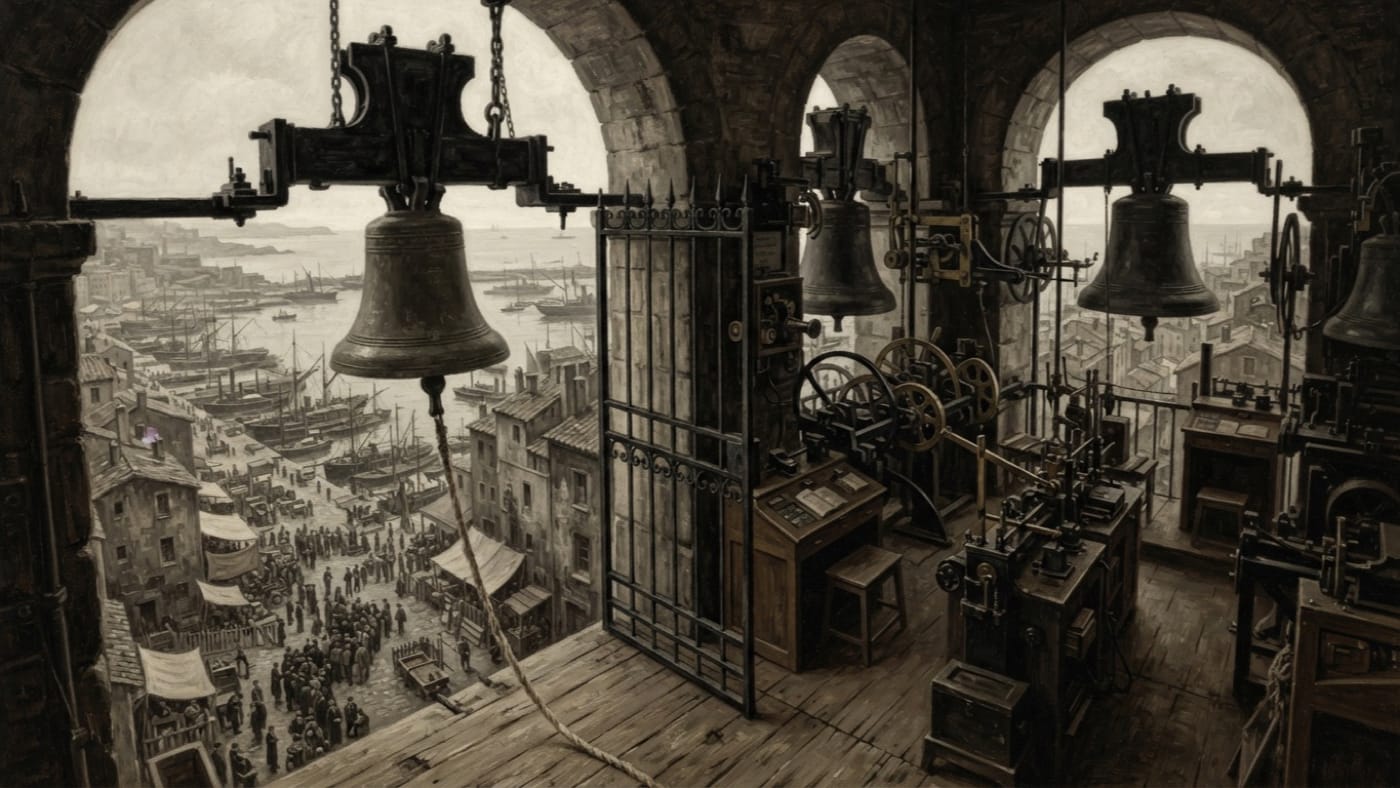
She hangs among the nine principal bells in the cathedral's western mass, inside the reinforced cage where the Bureau of Bells keeps its southernmost major relay. Below her is the old harbour of Marseille. It holds hulls, rope, hostels and relic stalls, along with several thousand souls who believe they are bound somewhere holy and have not yet found their berth.
The doctrinal interest of Marthe is narrow, and I find it exquisite. A bell is bronze given leave to speak with lawful authority. Most bells speak of time. Marthe speaks of place, and of the persons who ought to be standing in it. The Creator ordered the hours. The Church, having studied that example, ordered the crowd.
#On the Call to Assemble
A muster is a gathering. The heads are counted before anything costlier is done with them. Marthe's sharp voice tells the pilgrims to collect themselves, and it grants them nothing further. Clearance to board, permission to sail and the scrutiny of their papers belong to other signals and other offices, worked by men with ink on their cuffs.
The Bureau of Pilgrimage governs those later steps. Pilgrimage licenses the routes and issues the permits. Its southern headquarters sends the faithful by sea toward Thessaloniki. Its noticeboard near Saint-Victor's southern porch lists departures, penance schedules, berth changes and lost children, all pinned under equal authority. The board tells a pilgrim what is meant to happen. Marthe tells him it is about to happen.
When she sounds over the lower lanes, the quarter rearranges itself. Hostel keepers remember their unpaid bills. Licensed guides gather their companies with the urgency of shepherds paid by the head. Wax sellers and rosary-cutters press one last devotion on customers who have just discovered they forgot to buy one. The scribal booths find trade among men who wish to write home before the sea takes an interest in them. The relic dealers, who never go anywhere, sell protection against shipwreck to everyone who does.
The effect at the southern porch is administrative, without a trace of mysticism. Nobody kneels. Everybody looks for his group.
#On the Company of Bells
Marthe keeps company with bells that do not share her trade. Victor is the largest and owns the deep sound, along with most of the cathedral's troubles. Lazare tolls for relic arrivals and disputed deaths. Oraison marks Bureau business at the quay. Salt-John sounds harbour danger. Little Beryn cracked in A.S. 167 and was never properly repaired, and it gives its nasal complaint at terce. Three lesser bells divide parish business, funerals, debt remissions and small municipal duties among themselves. Each has its own rope, and Marthe has only hers.
The relay above them does wider work. From the western cage, the canonical hours are carried across the harbour, out to the pilgrim fleet, east along the coastal signal chain and inland toward the Rhône road. That is the installation's task. Marthe is one voice within it, and the register does not credit her with the whole chorus. I will not credit her with it either. A bell praised beyond its office ends up blamed beyond it too.
The register does name a sequence that opens pilgrim embarkation. It does not name Marthe as that sequence, and the difference matters to anyone holding a permit. A pilgrim who takes the muster for the boarding call reaches the quay early. That harms nobody, except that he then stands in the way of the stevedores, which harms everybody. The relay's other signals are further still from her duty: the hold on ship traffic while relics cross from Quai Saint-Lazare, the descending five-peal for fire in the docks, the broken triplet that calls Purity, and the low sustained toll that seals the harbour. A muster bell that cried fire would empty every hostel into the sea.
A previous Bells register entered Marthe as one of ten principal bells at Saint-Victor.
Corrected. Saint-Victor has nine principal bells. The tenth, Saint Armand of the Foam, was removed in A.S. 158 after repeated mis-tolls and melted into harbour brackets. No change to Marthe's office is entered against the removal. She has always been one of nine, and the Bureau has always said so.
#On Jurisdiction and Pilgrim Traffic
Bells owns the sound. Pilgrimage owns the movement the sound provokes. The cathedral chapter owns the frontage where that movement stops to buy candles, and Tithes assesses the candles. Relics claims every interval in which bones are in transit. War turns up whenever a harbour alarm reaches the garrison. Marthe hangs above them all under the Bells seal, and each of the other Bureaus within earshot would like to believe she speaks on its behalf.
No deed in the registers gives Pilgrimage authority over Marthe's rope. Pilgrimage behaves as though one exists, and Bells behaves as though Pilgrimage never learned to read. The two coexist by the old Synodal method: each files a memorandum asserting its precedence, and they take care to file them in different offices.
The quarrel has already spilled into sound once. During the A.S. 186 Thessaloniki surge, Pilgrimage demanded the nave for its departure blessings. Bells answered with a maintenance peal of six consecutive hours, and the pilgrims fled to the quay. The record does not say which bells rang. I observe only that the pilgrims went where Pilgrimage wanted them, by a route Pilgrimage had not chosen. Bells files the episode among its triumphs.
The Marseille Watch has no theology and less patience. In its A.S. 200 traffic note, it recorded pilgrim congestion between prime and terce as manageable and kept its harsher words for the relic-market overflow, the fish carts and the funeral crossings later in the day. The Watch credits no bell for the morning's order. I credit the Watch for noticing that any order existed.
#On the Present Application
As of A.S. 201, Saint-Victor and its relay remain in service, and Marthe still musters. The registers enter no silence, no recasting and no miracle against her name. She has none of Victor's midnight trouble or Beryn's famous crack. Most bells of her rank never earn an article, and she earns hers only because a parent register named her and a clerk found the name unresolved.
Her office is small, and its consequences are not. A ship cannot carry a penitent who is still arguing with his landlord. The permit, the berth and the blessing all wait on one prior fact: the pilgrim has to be standing where the Bureau expects him. Thin bronze secures that fact, and it secures it most mornings without complaint, which is more than can be said for any official on the quay.
When Marthe sounds, a thousand strangers become a company. Within an hour, the company becomes a manifest. After that it is Pilgrimage's problem.