
#On the Arm in the Eastern Chamber
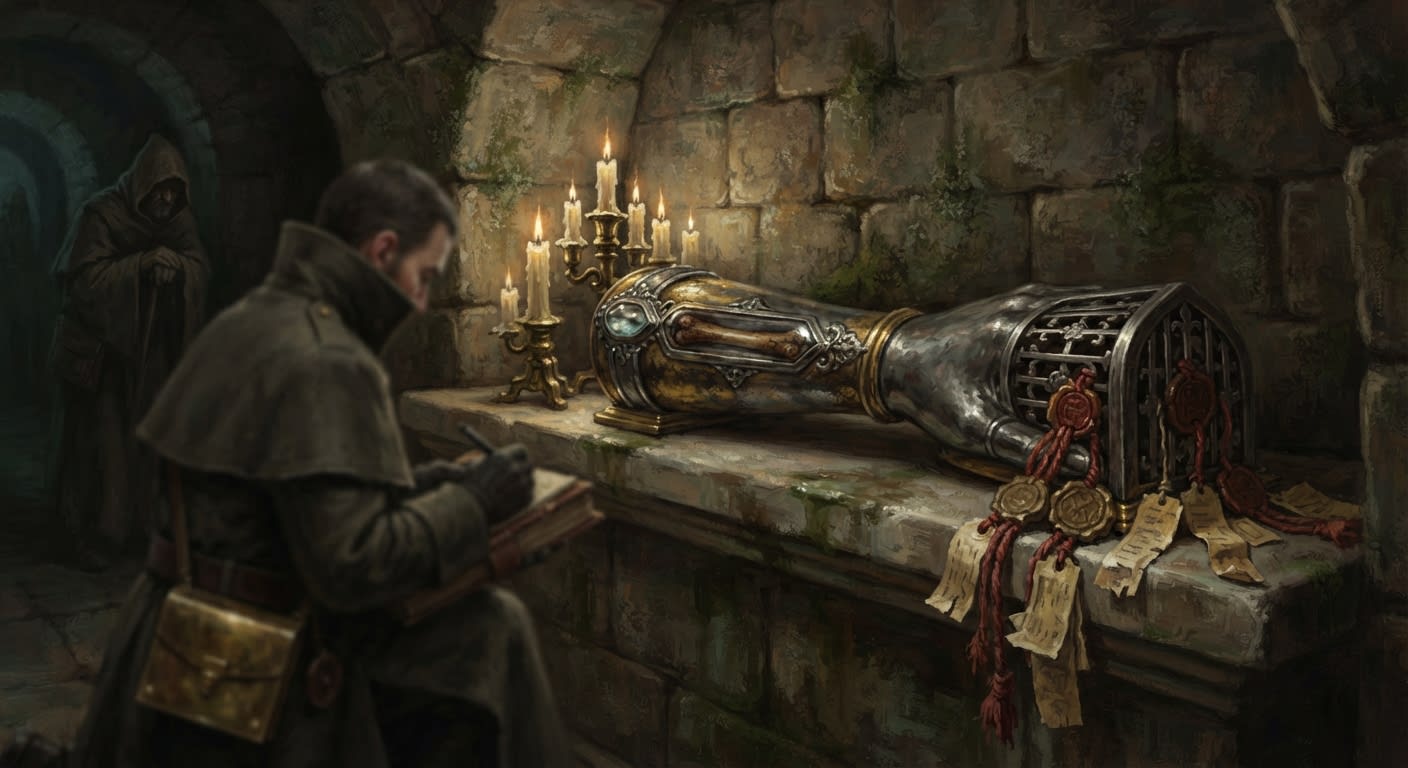
The Arm of Victor lies in the eastern chamber of the Victor Crypt, beneath the Cathedral of Saint-Victor, on a limestone shelf that has been damp since before anyone thought to write down its dampness. Its reliquary is a forearm of blackened silver laid over old gilt. It is fitted at the wrist with a crystal lozenge that shows the pilgrim a length of brown bone, and with an iron grille that shows the pilgrim nothing else. Wax seals hang from the grille on red cord. Paper tags hang from the seals. The tags have been replaced more often than the candles, and the candles are replaced daily.
Three reliquaries share the chamber. The Rib of Victor sweats brine during storms and keeps a congregation of fishermen who want their saints to do something useful. The Vessel of Harbour Rats holds small grey bones and a very large story. The Arm does neither of these things. It has paperwork. It has been authenticated twice and contested once, and that makes it the most official object in the crypt and the most nervous one in the ledger.
Pilgrims kneel before it with candles, and clerks stand before it with forms. The dealers of the lower quarter come only by invitation. They pay too much for the privilege and they study the grille the way a locksmith studies a sermon.
#On Victor's Convenient Body
The canons of Marseille say Victor was a soldier-martyr of the early Church. They say his bones were carried through the old port in a plague year. They say the harbour rats, on witnessing the procession, went down into the water and drowned themselves. The canons give no year for the plague. They say "the plague year" as though Marseille had only ever had one, which any harbour physician will correct at length and for a fee.
The Bureau of Relics has examined the bones attributed to Victor and kept a tally: three authenticated, five rejected, two reserved. It has also filed a supplemental note observing that rats often behave dramatically during plague. The faithful prefer the procession, and so do the canons. The Bureau prefers the tally and will not be drawn on the rats.
The Arm's own file does not settle how it sits within that tally, because the Arm is a forearm, and a forearm is two bones. One clerk of the southern office records it as a single relic under a single seal. Another records radius and ulna separately and then has to explain why his total for Victor does not match his colleague's. Whole afternoons have been spent in this dispute over a saint whose existence it treats as already settled. I have read both columns. Both are signed, and neither clerk will withdraw.
#On the Two Authentications
The Bureau's doctrine is simple, and I have always admired it: a relic authenticated is a relic made holy, and a relic unauthenticated is kindling. The seal does not measure sanctity that is already present. Once the seal is applied, the sanctity can be used within the public order of the Synod. Pilgrims may pray to such a relic under licence, chaplains may cite it, and Pilgrimage may print it on a route card. An unsealed bone can do none of these things, however holy it is. It is only a bone with ambitions.
The Arm has passed this test twice. Why twice is a question the public abstract does not answer, and the chapter prefers that it not be asked. The quayside explanations go as follows. The first certificate was lost to damp, since everything in the crypt is eventually lost to damp. Or it was issued under an earlier standard and had to be confirmed under a later one. Or it was issued correctly and later doubted by a clerk who then made his career confirming it. I print none of these as fact. What I can print is that both certificates exist and both carry seals. Both are kept somewhere drier than the Arm.
A relic authenticator once told me, over wine that had not been authenticated, that a relic confirmed once is a relic and a relic confirmed twice is a problem. He meant that no one reopens a file that caused no trouble. I have since stopped drinking with him. His observations were sound, and I do not care to have my evenings improved against my will.
A Cathedral Quarter pilgrim card, sold at the southern porch: "The Arm of Victor — thrice confirmed, never questioned."
Corrected by the Bureau of Doctrine. The Arm has been confirmed twice and questioned once. The chapter argues that surviving a contest amounts to a third confirmation. Relics does not accept this argument. The cards remain on sale, now with a smaller card pasted over the original wording, and the smaller card costs extra.
#On the Contestation
The Arm has been contested once. The docket records that a contest was brought, that it was heard, and that the Arm is still in the eastern chamber under seal. Relics privilege keeps the name of the party who brought the contest from the public register. I am permitted to state that the contest happened. I am not permitted to state who lost it.
Marseille is not restrained by any of this, and it has supplied its own accounts. The dealers of the lower quarter say a rival arm surfaced in an Iberian cargo and had to be defeated on paper. The fishermen say the Rib's devotees brought the contest out of jealousy, which is how fishermen explain most things. Some in the quarter say the contest came from inside the Bureau itself, as an exercise in self-discipline. Those men are the kind who say it quietly and then look over their shoulders. All three accounts reach me across the counter at Quai Saint-Lazare, and I file all three as rumour. That is their correct category.
The effect is easier to state than the cause. A relic that has never been challenged is only presumed genuine. A relic that has been challenged and kept its seal has a file, and a file can be quoted back to the Bureau in a hearing. The canons know this. They quote it often.
#On Pilgrims, Dealers, and the Price of Doubt
Pilgrims bound for Thessaloniki come down the crypt stairs with a candle in one hand and a ticket in the other. They want the blessing of a soldier-saint before they board a ship. They are asked for a votive fee, a lamp fee, and a small contribution the chapter calls voluntary and collects at the only exit. Tithes has asked more than once how much of this revenue is devotional and how much is admission. The canons reply that no one has ever been refused entry to the Arm, which is true. What they sell is the time spent in front of it.
The market between the harbour and the cathedral steps is the busiest relic market south of Strasbourg, and the Arm's name circulates there without any help from the chapter. Victor's knuckles are for sale. Scrapings are sold from under the grille, which cannot be scraped. There are threads from the red cord and flakes from the silver. There is wax "from the Arm's own seal," and most of it comes from a chandler on Rue des Pénitents who has never been down to the crypt. Counted together, the fragments of the Arm on sale in the lower quarter would supply a saint with four limbs and a spare.
The crypt makes this worse. Rejected offerings wait in the side passages beside the eastern chamber until someone from Relics removes them to the Quay. Some of these are bones turned away by Saint-Lazare. Others are objects that failed at the counter and were carried up the hill by owners who wanted them to be near something certified. The owners then tell the market that their bone "rests beside the Arm of Victor," and the market cannot tell nearness from blessing, since the Arm's certificate hangs a few yards off. Condemned bones pick up the Arm's reputation simply by sitting in the same damp room with it.
#On Present Custody
The Arm is held by the chapter of Saint-Victor under Relics seal. Pilgrimage may schedule visits to it and Tithes may assess what those visits bring in. Purity may inspect the seal. It has done so, found the seal intact, and left carrying its own suspicion. War has made no claim on the Arm, and this has surprised everyone who has met a quartermaster.
Above the chamber sits the Bureau of Bells' southern relay. Victor, the largest of the cathedral's nine principal bells, hangs in the tower above the crypt. It was cast after the Concordat and bears a prayer against shipwreck. When it tolls, the crystal at the Arm's wrist hums faintly and the tags on the grille move, though the crypt has no draught. The canons call this reverence. The Bells engineers say it is sympathetic vibration in an old crypt. The fishwives say nothing, because they have already crossed themselves.
Since the midnight return-peal of A.S. 191, the clerks have been more uneasy. No authorised ringer has been found for that peal and no explanation has been filed. I have seen a request from a junior Relics clerk, drafted in a hand that shook, asking whether the Arm might be moved further from the tower "pending clarification of the relay." No one has accused the Arm of anything, and no one has proved anything about it. The request was received and filed, and it was answered in the usual way for requests that nobody wishes to act on. The Arm has not been moved.