
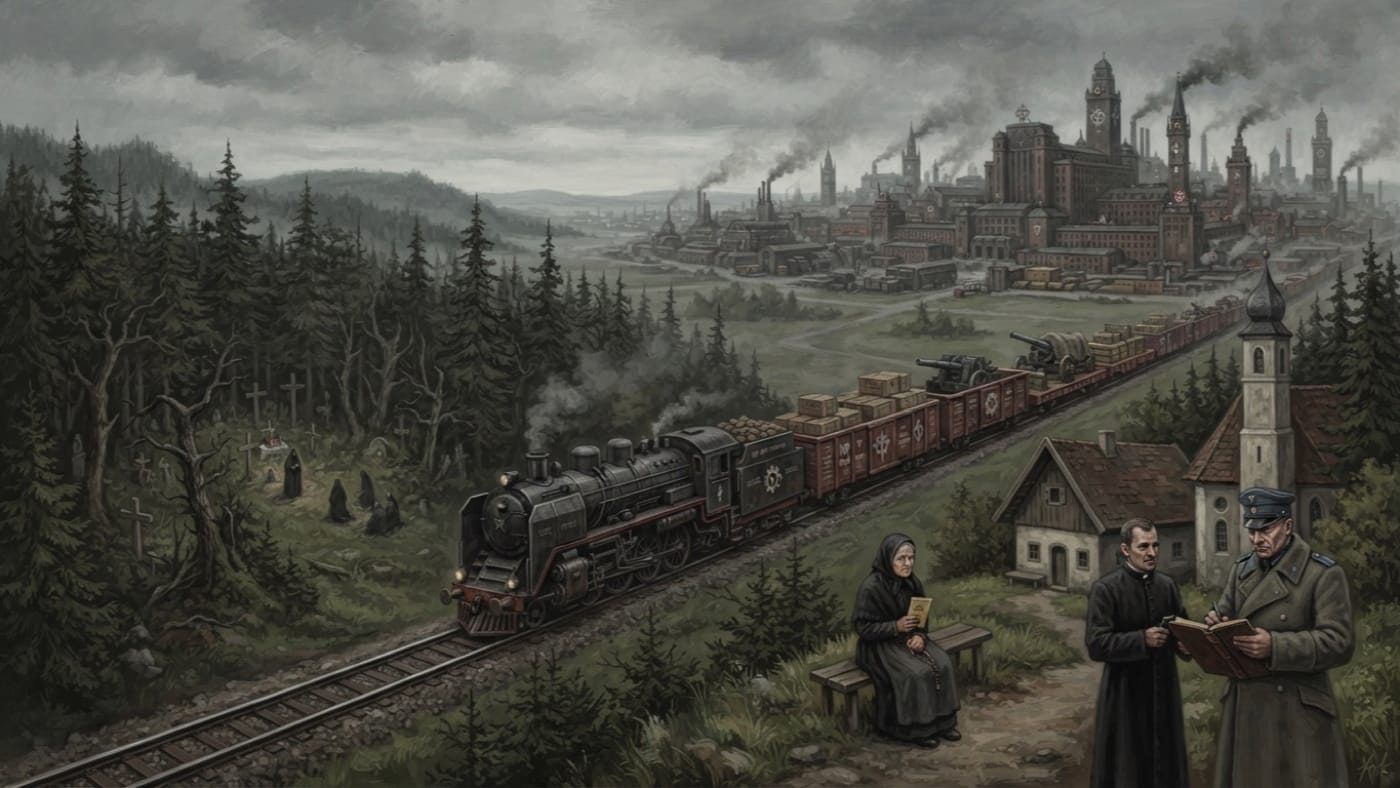
#On the Heartland
"A safe region is one where the war arrives by post."
Bavaria lies in the German Central Heartlands, behind the Sagittal Line and well west of any ground the Sin-Generals presently hold. The Codex will not draw its borders. The Bureau of Records has not supplied them, and a Hieromnemon who invents a frontier to tidy a paragraph deserves to be posted to one. What the region contains can be stated: forest, farmsteads, parish rolls, rail, and Munich, which sits in Zone 2 with the manners of a capital and the duties of a warehouse.
The region has no ruler named in this entry, no charter the Codex can verify, and no founding day for the feast-calendar. Its importance is plainer. For fifteen years its forests hid the faithful. For ninety-one years its households have supplied sons. The Bureau of Doctrine considers these two facts one story, and I have been asked to write them as one.
#On the Faithful in the Forests
"Trees keep no census. The Rationalists never forgave them for it."
After the Treaty of Regensburg in A.S. 30 (1740 CE), the Rationalist Republic claimed the continent, and the faithful had to choose between recanting and disappearing. In Cologne they went under the breweries. In Lyon they went down among the Roman bones. Above Innsbruck, which is outside Bavaria and higher than any Republican patrol cared to climb, they went into caves. In Bavaria they went into the forests, and they went scattered.
"Scattered" is the only word the record gives, and I will not improve on it. The Cellar Saints account names no Bavarian abbey in the pines, no forest bishop, and no congregation of sixty with a journal and a latrine trench. It says only that the Innsbruck caves did not communicate with the scattered faithful in the forests of Bavaria. The mountain did not know the woods. For all the archive can show, the woods did not know themselves.
A forest makes different demands on the hidden than a cellar does. A cellar has one door and one likely informer. A forest has a hundred paths, and every one of them passes somebody's woodpile. The believers who survived there needed what the wider network needed everywhere: a household willing to feed them, a lay trade to explain their comings and goings, a priest travelling by night if a priest came at all, and neighbours who would not trade a name for a ration card. The Codex can say that this was what hiding required. It cannot say which Bavarian did any of it.
Being scattered was their protection. A cell that knows nobody can betray nobody. It can also be forgotten by everybody, which is the more usual reward for prudence.
#On the Return of Public Authority
"The Church came up out of the ground in stages. The Bureau prefers to remember a single morning."
The Sundering of 1 November A.S. 45 broke Rationalist command without clearing the roads. Councils fell silent, while offices and guards carried on wherever nobody had told them to stop. The Church, which had already existed in hiding, began its public work unevenly, district by district. No Bavarian liberation day survives to be kept. The Bureau of Festivals has looked.
The stages are fixed, and I recite them here for provincial catechists who run them together. A provisional council sat about A.S. 50. The Common Allegiance of A.S. 55 was issued under the authority of Augustinus, and he shared the work of making it with Kratz and Sabine. The Night of Black Decrees followed in A.S. 58. The Line was defensible, though unfinished, by about A.S. 65–68. Only in A.S. 90 did the constitutional Synod come into being at Strasbourg, and by then both founders were dead. The record does not say when Bavaria subscribed to the Allegiance, or whether a Black Decree reached it that night, later, or by another hand. I decline to supply a date. Dates supplied by a Hieromnemon have a way of becoming feasts.
What the Synod took from the hidden years was their method. The faithful had kept prayer without buildings, records without offices, and relics without permission, and all three became raw stock for later government. In A.S. 104 the Bureau of Doctrine canonized the Cellar Saints collectively. Whatever faithful had lived among the Bavarian trees were included in that honour by category, some sixty years after they had needed it, and without being asked.
#On the Household Levy
"The forest hid sons once. The parish roll finds them now."
The First Continental Levy was decreed in A.S. 110, after the Brașov crisis taught Strasbourg that local banners die locally. Its public rate is one son in ten, assessed by household and subject to provincial correction. No source open to this Codex publishes what that correction amounts to in Bavaria. The one-in-eight fraction applied to certain provinces elsewhere may not be borrowed for it, and the ratios of the later renewals remain sealed.
The Continental Levy names Bavaria once, and once is enough. It lists boys from Bavaria alongside boys from Aquitaine, Dalmatia, Burgundy and the Rhineland among those drilled out of their local habits and into Synodal tempo. A Bavarian boy learns the heel-strike and the hymn cadence as every other boy does. The accent he arrived with is his first casualty, and the only one War does not record.
The machinery reaches a Bavarian house the way it reaches every house. The Bureau of Records holds the baptismal entry, and the parish roll holds the household. The Bureau of Conscription, constituted in A.S. 112 because the first musters had been an embarrassment, holds the count. Purity holds the consequences for any family that miscounts. At the mustering field an Assessor stamps the boy's wrist with the Triune Knot. The ink lasts nine days, long enough that a runaway carries his own warrant up his sleeve. The boy then passes into the custody of the Bureau of War. The household keeps what remains: a corrected entry, a pamphlet from Mercy, and a place at table that nobody is permitted to call empty.
The Levy's own record lists protests elsewhere: cobblestones in Lyon, dead Assessors in Bruges, forty-seven legal objections in Cologne. It records no Bavarian riot, and the Codex will not manufacture one. Quiet is a feature of the record. Purity has never mistaken it for consent.
#On Munich and the Eastern Corridors
"Every road in the heartland is short. The one east is long."
Munich anchors the region in the only sense the Bureau of War respects, which is freight. Rail lines from Strasbourg, Cologne and Kanzleiburg converge there before crossing into the forward zones, and War keeps its largest standing warehouse complex in the city. The full account of the city belongs to its own folio. Here it matters as the last comfortable city before the forward territories and as the western head of the Central Corridor.
The corridor was formally settled in A.S. 90. It runs from Munich through Vienna-Ruins, Bratislava and Budapest to the Carpathian and Danubian forward works, crossing three zones on the way. The bastions that the Levy feeds lie at its far end. A Bavarian village can be a long week's rail from the nearest Sin-General and still send its tenth son down the same line as the powder.
A warehouse is not a classroom. The Continental Levy names the catechism-barracks where boys are made into Line-matter, and Munich is not on that list. Soldiers pass through the city because everything passes through the city. No source open to this Codex says that every Bavarian recruit must do so, and I will not route a boy by rhetoric.
In my account of the Line I wrote that "when Lorraine burns, villages tighten their belts in Bavaria," and that when its ramparts smoulder "villages in Bavaria pull their shutters without being told why."
Corrected. The bastion formerly styled Lorraine is Bastion-Constantinople, southern anchor of the Line on the Bosphorus. Its bells carry to the shore of the strait and no farther. Nothing in the ration records ties a Bavarian larder to its ramparts. The sentences remain as figures of speech: news from the south arrives by rail and rumour, and the shutters close anyway. The Warden regrets the geography. He keeps the shutters.
#On the Present Condition
"Safe is a zone designation. It is not an exemption."
As of A.S. 201, Bavaria sits behind the Line and under it at the same time. Its forests stand where the scattered faithful hid. Its parishes keep the rolls that Conscription reads. Its central city stacks the crates that War sends east. No Sin-General claims the region. The Levy claims it every generation, one household at a time.
The heartland's safety is real, and it is paid for in the ordinary currency. The surveillance continues, and so does the tithe of sons. Grief continues too, subject to correction by Mercy and review by Purity. A boy born on a Bavarian farmstead this year enters the Great Ledger before he can walk. The Ledger does not ask whether his forebears once prayed among the trees to hide from men who kept ledgers.