
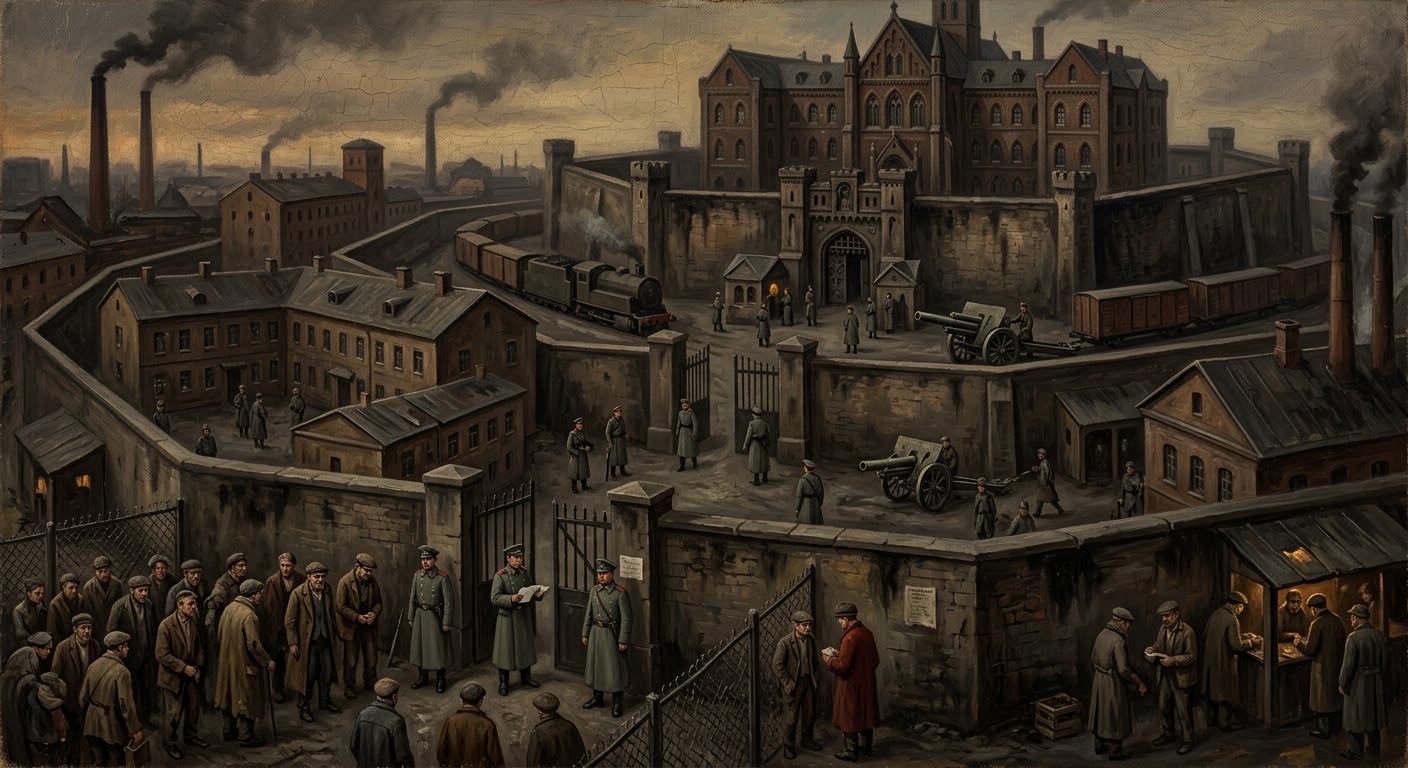
#On the Five Lawful Pressures
Zones 1 through 5 are the Synod’s western-to-eastern instrument of civic pressure: five bands of territory, obligation, ration, hazard, and permitted fear by which Strasbourg teaches the continent to measure danger without accidentally measuring guilt. The schoolroom says they are geography. The clerk says they are administration. The soldier says Zone 4 is where letters stop sounding like home and Zone 5 is where even the ground has become a witness for the prosecution.
The soldier is nearest the truth, and should be rewarded with socks.
The five-zone sequence runs from Zone 1, the Western Heartlands, through Zone 2, the Central Heartlands, through Zone 3, the Forward Heartlands, into Zone 4, the Sagittal Line, and out to Zone Five, the contested strip east of the Line and west of the Charnel Lands. Each band gives the state a graded permission to ask uglier questions. How much bread may be taken? How many sons? How quickly may a widow’s room be reassigned?
The system hardened after A.S. 65, when retreat became refusal and the Line fixed the West into a posture it has been calling permanent ever since. The Bureau of Settlement gave the bands household consequence. Records gave them names. Tithes gave them hunger. War gave them quotas. Doctrine, as ever, gave them language handsome enough to keep the knife from looking lonely.
#On Zone 1, Where Safety Learned to Charge Fees
Zone 1 is the Western Heartlands: Atlantic seaboard, French river-belt, Low Country warehouses, maritime gates, pilgrimage roads, salt courts, candle districts, festival wounds, and the cleanly dressed rear offices by which the war makes itself appear distant. It contains Lyon, Marseille, Paris, Rouen, Metz, Brittany, Candle-Sump, and the Vire River-Belt Interchange, which is what happens when a river is forced to become a tax argument.
It is safe in the military sense. No Sin-General presently sits outside Lyon asking for a toll. No Pale Chanter choir is scheduled for Parisian breakfast. No Maldrakite furnace has yet replaced the Marseille harbourmaster, though I advise periodic inspection of the man’s ears. Safety in Zone 1 means distance from direct claw, fire, fog, hunger-host, and shell. It does not mean innocence. It means the killing happens through supply.
Zone 1 feeds the Line with paper, wax, rope, salt, barrels, boys, candles, sea passage, and moral theatre. Its cities have old wounds polished into routes. The Red Slaughter of Lyon is taught with plaques, candles, guided silence, approved ash, and convenient vendors. Saint-Malo sells martyr-memory with Breton stubbornness and festival discipline. Calais, deep in the rear and still gnawed by sea pressure, proves that safety is a claim made by people standing too far inland.
Elementary maps once described Zone 1 as “peaceful western territory.”
Corrected. It is peaceful in the sense that its violence is processed, priced, routed, and mailed east with correct seals. Peace should not be confused with tidy accounting.
#On Zone 2, the Central Throat
Zone 2 is the Central Heartlands: Germany, Switzerland, northern Italy, western Austria, Rhine wealth, Ruhr smoke, Swabian drill, cathedral finance, and Strasbourg’s authority falling outward in rings of wax and dread. Here stand Cologne, Aachen, Stuttgart, Brast, Essen-of-Hymnsteel, Munich, Hamburg, Kanzleiburg, Regensburg, and the lesser gears of the central engine.
Zone 2 is safe enough for industry and near enough to power to know better than to sleep. Its chief product is obedience made material. Brast teaches fuel to kneel. Essen sings steel. Stuttgart sorts boys into the arithmetic of service. Cologne counts bones with a straight face and a full treasury. Aachen keeps shame under glass and calls the glass penitential continuity.
The Central Heartlands possess comfort with a furnace behind it. A Zone 2 citizen may dine well, complain about soot, recite the correct line on the Betrayal of Aachen, and wake to a levy officer measuring his eldest son’s wrist. He may never hear artillery. He will hear the bell that replaced artillery in places where the shell has been converted into policy.
The zone’s loyalty is excellent, which means it has been inspected often enough to make loyalty habitual. Its richest cities have archive-banks, rail courts, relic registers, industrial chapels, oath rooms, and enough minor tribunals to make a free man nostalgic for prison simplicity. No demon need breach Zone 2 to injure it. A forged seal, a wrong hymn, a bad alloy, a silent bell, or one misrouted train may do more subtle work.
#On Zone 3, Where Staging Becomes a Way of Life
Zone 3 is the Forward Heartlands: Bohemia, Moravia, western Hungary, Dalmatian corridors, shrine-ruins, rail junctions, medical ports, crossing towns, and those cities close enough to the Line to smell powder before the dispatch admits trouble. It is the place from which the front is fed, replaced, argued over, and misremembered before witnesses return.
Warsaw belongs to this logic: principal staging city for the Polish lowlands, never fully evacuated, too necessary to be comfortable and too exposed to be allowed honesty. Vienna survives as shrine-ruin and warning, its old prestige reduced to pilgrimage traffic, military stores, and the civic manners of a punished monarch. Bratislava holds crossings and overflow. Budapest faces the Danube with one eye on supply and the other on the abandoned districts where geography has stopped being polite.
Zone 3’s citizen lives under deferred emergency. The requisition is coming, though not always this morning. The hospital train is due, though not always with bodies that still answer names. The road may close. The bridge may become military. The barn may become a ward. The school may become a sorting room. The baker is still a baker, but his flour has begun answering War before it answers hunger.
The zone breeds practical minds and bitter jokes. A Zone 3 mayor knows the difference between a temporary requisition and a permanent theft by how many Bureaus attend the opening notice. A Zone 3 mother knows which roads lead to depots and which to hospitals. A Zone 3 priest learns to bless carts without asking what they carry. Curiosity delays traffic.
#On Zone 4, Called the Line When Brevity Still Has Lungs
Zone 4 is the Line in its formal skin: the north-south defensive continuity from Bastion-Königsberg to Bastion-Constantinople, with Brest, Przemyśl, Sibiu, Irongate, and Shipka set between like vertebrae in a saint whose body has been asked to carry Europe and pretend not to ache. Zone 4 is where geography becomes mechanism. Lakes, rivers, passes, cliffs, tunnels, fog corridors, chain gates, bell towers, wards, trenches, mud roads, corpse routes: all bound into one refusal.
The citizen becomes rarer here and more suspect. The soldier, porter, engineer, bell-ringer, medic, ash crew, confessor, smith, wireman, brand-worker, and permit clerk become common. The Line eats professions into special forms. A Gasket-Hymn Mechanic learns pressure like doctrine. A Gate-Carver cuts refusal into wood and iron. A Deathbed Confession Harvester collects last words before Mercy loses the receipt. A Geometry Brand-Smith applies classification to flesh because paper in forward weather is an optimist’s toy.
Older civic primers described Zone 4 as “the eastern wall.”
Corrected. A wall is clean, vertical, and stupidly confident. Zone 4 crawls, leaks, rings, burns, freezes, breathes, and occasionally demands another name from the man standing on it.
Zone 4 requires discipline with no theatrical surplus. Old bastion names are sentimental mildew. Current doctrine uses geography. The Line runs Baltic to Bosphorus. The northern anchor is Königsberg. The southern anchor is Constantinople. Anyone who calls Constantinople the western anchor after correction will be forgiven once, corrected twice, and used as a teaching aid on the third offence.
#On Zone Five, Where the Map Is Cross-Examined
Zone Five is No-Man’s-Land: the contested strip east of the Line and west of the Charnel Lands, a belt of shell basins, dead villages, false dry ground, abandoned roads, listening wire, bone reefs, prayer failure, wrong shadows, and mud with an archival memory for ankles. It is called a zone because Records required a column. The ground has never consented.
Zone Five began as emergency ground after the A.S. 45 Sundering, hardened during the Great Retreat, and acquired doctrinal form after A.S. 65. West of it stand bastions, rails, garrisons, and men paid to pretend stone does not panic. East of it begin demonic dominions, where pressure is no longer weather and has begun acting like government. Between them lies a receipt so wet that the ink must be forced to testify.
Its authorities are local and hostile. Flesh-Mud folds the living into the dead. Prayer-Jam teaches bells to lie in familiar voices. Shadow Noon makes a man’s darkness pull harder than his officer. Patrols move under salt, plank, rope, slate, witness, and profanity. Prayer appears in the manual, but not before salting, which proves the manual was amended by survivors.
ZONE FIVE MOVEMENT ABSTRACT — FIELD COPY, A.S. 201 Unit crossed on dry slate. Bell returned two answers. Shadow direction inconsistent after second marker. Seven men listed; eight shadows counted. One shadow remained after lamp removal. Disposition: █████████████████████████████
Zone Five is the final correction to every tidy western idea about territory. It cannot be abandoned, because the Charnel Lands would lay their own claim against the Line. It cannot be owned in the ordinary sense, because ownership requires ground willing to stay itself long enough for a title deed to matter. The zone is held by patrol, artillery, salt, rope, burial refusal, and the unwilling courage of men who have learned to sit down when their shadows misbehave.
#On the Instruments That Make Five Zones One Machine
The five zones differ in smell, noise, and probability of being eaten, but they are bound by shared instruments. The Zone Permit fixes the citizen to lawful ground. Transit writs ration movement. Tithe brackets convert distance into obligation. Ration categories convert obligation into bread, or into the absence of bread with better paper. The Erasure Notary can unmake a person across Zones 1 through 5 with black wax. The Geometry Brand-Smith makes identity visible when ledgers, gates, weather, and fear have made paper insufficient. The Ration Plunder Winter taught the same lesson by flour and wall: a system that cannot protect bread will learn to protect terror.
This is the geography the Synod actually governs: a gradient of appetite filed over a wounded Europe. In Zone 1 the war is invoiced. In Zone 2 it is manufactured. In Zone 3 it is staged. In Zone 4 it is endured. In Zone 5 it is argued with by men tied together at the waist and advised not to trust bells that sound too much like home.