
#On the Twelve Verses
"Appropriately functional." — Bureau of Orison and Song, on the manner of its recitation
The Ration Psalm has twelve verses. Nobody is named as its author, it has no melody, and nobody recorded the first time it was heard. It has outlived all three deficiencies without complaint. The congregation speaks it on one held pitch that neither rises at the close of a verse nor falls at the end of the whole. The Bureau of Orison and Song has opinions about every breath drawn inside a consecrated building, and it classes that monotone as "appropriately functional." I have sat on Orison committees. That phrase is the warmest thing they have ever said about anything.
It has five subjects: bread, water, warmth, children and faith. It declares each of them sufficient. The word enough occurs forty-three times across the twelve verses. I counted them myself, standing, in a hall where the benches had gone to pregnant women and the infirm. I give the figure with the confidence of a man who has counted worse things for the Ledger.
That is all that can be said of the text with a seal behind it. No complete copy has crossed my desk under any office's authority. I cannot tell the reader how the forty-three are distributed, which subject opens, or what tongue first carried the words. Any pamphlet offering a verse-by-verse gloss is selling something, usually at a chapel counter.
#On the Saint's Last Breath
The Bureau of Doctrine sealed its approved account in A.S. 94. In that account Saint Halva dies with the Ration Psalm on her lips, one hand on a cradle and the other on the storehouse key, the ladle across her knees. The first queue finds her so at dawn. The northern Plenty Houses prefer to say she starved, and the eastern bastions say the crowd trampled her. Both of those deaths are also approved. Only the sealed one gives her the Psalm.
Doctrine chose that version because it contains the correct objects. Ladle, cradle, key and psalm are now the Mothers' iconographic group. They hang on the feast banners and are sold as tokens at the chapel at Mainz. The copper ladle in its case there is the wrong ladle. The psalm, being a psalm, has been spared a foundry stamp.
A saint who may never have lived cannot certify the age of what she recited at a death that may have been invented. Her canonization attested no miracle and produced no body. The approved account claims only that she recited the Psalm. The file credits nobody with composing it. Aldous Crenn's hand fills the witness statements in that folder, and the Psalm nowhere carries his name. I will not be the theologian who promotes a productive clerk to hymnographer on the strength of his penmanship.
Bureau of Doctrine, Tract Series 44, "On the Antiquity of the Mothers," held that Saint Halva was canonized "in the first century of the Faith" and that her cult predated the Concordat by "many generations."
Corrected: Halva was canonized in A.S. 94, Third Quarter, in the administrative season that chartered the Mothers of Plenty, four years after the Concordat of Strasbourg. The cult postdates the office. Neither date establishes the age of the Psalm recited at its saint's approved deathbed, and the Bureau declines to lend it one.
#On the Recitation
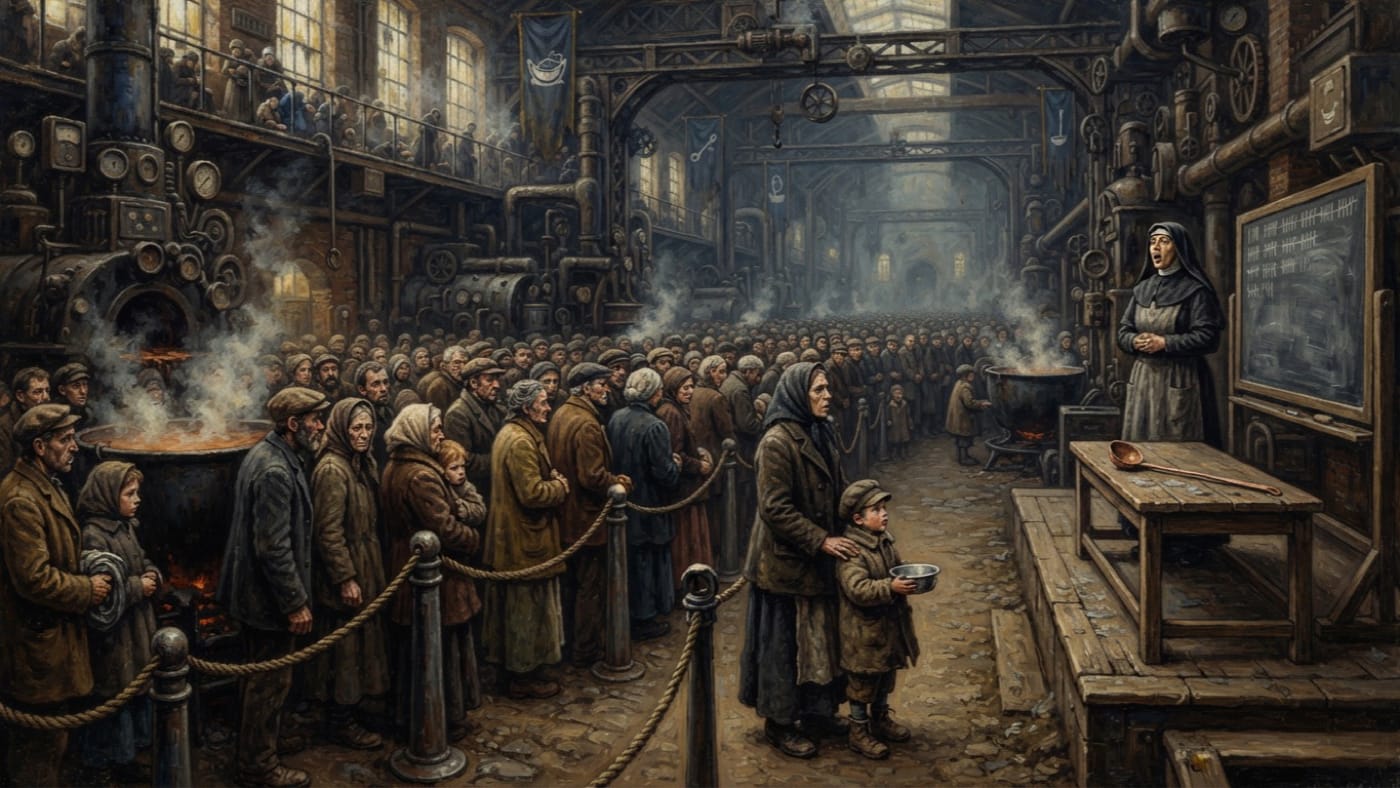
On 14 Brumaire the Feast of Saint Halva opens with the Ration Psalm. It is said in every Plenty House, ration hall and maternity ward in Synod territory. The congregation is whoever stands inside the ropes when the bell stops: women with chits, men with fuel slips, grandmothers who have outlasted three Matrons, and children sent ahead because a child's face is better currency at the hatch. No cantor leads. A Mother stands at the measure table with her slate chalked and her working ladle laid flat. When the hall is quiet enough she begins, and by the second word the hall has joined her on her pitch.
Orison approves the arrangement because it is cheap. A melody has to be taught, kept, and corrected now and then by a choirmaster on salary. A monotone needs only a hall and the habit of obedience, and the Mothers supply both. Orison keeps other instruments for other purposes along the Line. It has filed none of them against this recitation, which works on the ear in the ordinary way and has never been asked to do more.
The sound is long and flat. Steam comes off the cauldrons and off the wet wool of the queue. Infants cry through the verses and are allowed to. After the twelfth verse there is no amen worth the name, only the scrape of the queue settling and the first chit held out.
The Psalm belongs to the morning and to nothing that follows. The Stirring comes at midday and the broth in the evening. While the Psalm is said nobody advances, and the processional copper that will later tap the queue-posts is still in its cupboard. Pamphleteers like to merge the rites into one pious morning. The Bureau of Festivals keeps them on separate pages of its register.
#On the Measure of Enough
What follows is my own reading of the Psalm's function, and I sign it as mine. The verses do not supply it. The halls do.
The Mothers decide what enough is long before anyone recites it. Their measure cup defines the portion, and their household classifications decide which pour a chit earns: full, half, child, prenatal, widow, punitive. The Bureau of Records has the household in writing before the household has a bowl. A declared and inspected pregnancy brings flour, milk when there is any, a place nearer the door, and heat priority in certain wards. Food of that kind keeps a woman alive through a winter. It also enters her in the Womb Ledger, and the Ledger feeds a forecast that nobody mentions at the hatch. The Mothers keep plenty talk and levy talk in separate rooms, and the Psalm is said in the front one.
Once a year, then, a hall of people whose bread, coal and children's entitlements all pass through a Mother's approval stands and declares forty-three times that there is enough. Warmth is among the things it declares. On the same day the Bureau of Tithes adds a quarter-measure to every portion and recovers it the following week out of the fuel ration. The coal-chits come thinner seven days after the hall has sworn that its warmth was sufficient. Nobody has lied. The Psalm names no date for its warmth, and Tithes has chosen one.
I would be a careless witness if I made the Mothers a single creature. Some know exactly what the recitation buys and spend it on hunger. Some remember the bread riots and believe that a hall which says enough together will not tear itself apart. They are often right. Some say every verse with the rest and then go off to falsify a risk score, or to a bin of reserve flour that appears on no slate. All of them keep the same shift ritual. They wash the ladles, tap the cup three times, chalk the quota and whisper the formula every apprentice learns: Enough, if obedient. That is a professional formula. No source makes it a verse, and I will not make it one, though the reader may hear it as an answer to all twelve.
#On What the Children Learn
Children in the queue learn the Ration Psalm before they learn the Creed. No catechist set that order. The hall sets it, because the hall gets to them first. A child of three stands inside the ropes beside her mother, hears two hundred people say enough on one pitch, and learns the shape of the word before its meaning. By five she has all twelve verses. She says them with her bowl at the height the ladle sisters prefer.
The Creed comes later, in a schoolroom, with a priest and a primer. It has to argue the Creator's claim against the Great Deceiver, and that is work. The Psalm argues nothing. It reports. It tells the child how much bread, water, warmth, children and faith makes a sufficiency, and that amount is whatever the cup held that morning. By the time she reaches the Creed she has spent years as a satisfied party to a measure she never saw set.
I do not regard this as a corruption of catechesis. It is simply the order in which a ration-hall child meets authority: first the cup, and the reasons afterwards. The schoolroom finds her easier to teach for it, and so, years later, does every office that keeps her name on file.
#On the Present Application
My survey for A.S. 201 finds the Ration Psalm opening the Feast in every hall I visited and every hall that sent returns. It has not changed in any way a monotone can change. There are still twelve verses and still forty-three enoughs. I counted again this year, on the same fingers. The fuel offset stands. Since A.S. 199 the audits of the Mothers have inspected the measure cups first, so the quantity the Psalm calls sufficient is checked more closely now than at any point since the charter.
I have never heard the Psalm recited by anyone who believed every word of it. I have also never heard anyone break it off. Orison calls that function. I call it the one liturgy in the Church that is literally true when it is said, because it is said on the only day of the year when the cup holds a quarter more.