
#On the Survey and Custody
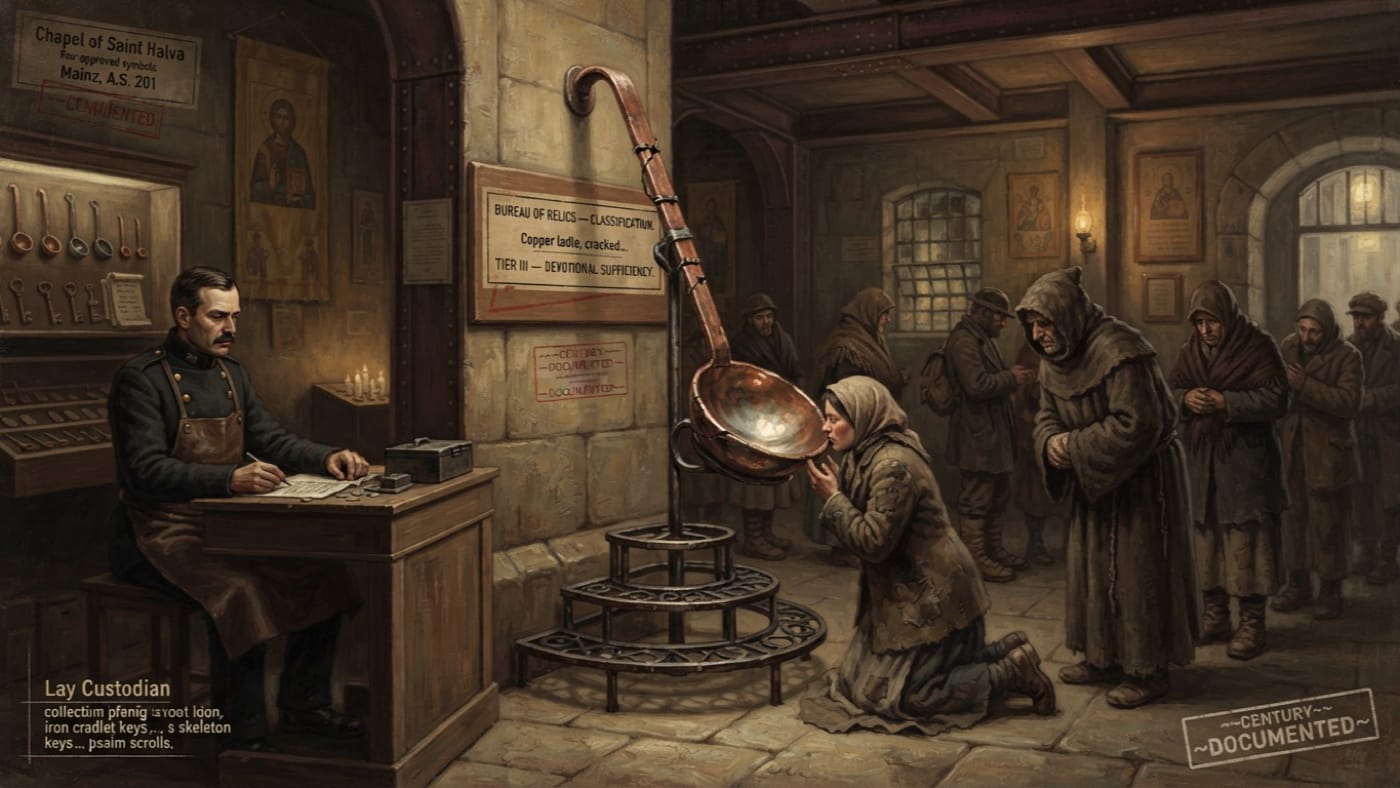
This entry surveys the Chapel of Saint Halva at Mainz as it stands in A.S. 201, the present year of the Ledger. It records a place and the object kept in it. It does not say when the chapel was raised, by whose hand or at whose expense. The Ledger does not know, and I will not make the Ledger say what it does not know. That privilege belongs to the Bureau of Doctrine, which exercises it daily.
What the Ledger does know fits on one folio. There is a chapel at Mainz. In it is kept a cracked copper ladle attributed to Saint Halva of the Warm Ladle, patron of the Mothers of Plenty. The Bureau of Relics classifies it. Pilgrims kiss it. The kissing is paid for, and the Bureau is not the party paying.
None of the files I have been shown say how the ladle reached Mainz, who carried it, what kitchen it left or whose seal sent it. For documentary purposes its chain of custody begins with the ladle already in place. Many relics begin that way. The fortunate ones are never asked where they were before.
Readers inclined to date the chapel from its saint should restrain themselves. Sub-Office IV of the Bureau of Doctrine canonised Halva in A.S. 94, four years after the Concordat of Strasbourg. That is the year of a decree. It is not the year of a roof.
#On the Ladle Under Examination
I have held it. The faithful approach the ladle with their mouths. I was allowed to approach it with my hands, briefly and by dispensation, wearing the gloves that the Bureau of Relics requires for authenticated artefacts of Tier III designation. The gloves protect the object. Relics has not thought to ask whether the mouths that follow owe it the same courtesy.
The ladle is cracked. It is also large, far too large for any hearth. Its proportions belong to a cauldron: a garrison kitchen or a brewery, some establishment that measures broth by the vat and labour by the shift. In the approved hagiography, a widow fed two hundred from a pot meant for twelve. Whatever pot this ladle served was never meant for twelve. A widow of uncertain province would have needed a cooper's forearms to lift it full.
The handle bears a foundry stamp. It reads Essen. Essen made no copper household goods until well after the Sundering, and by my reckoning the copper itself is eighty years too late for the saint it supposedly served. I give no year of casting. Eighty years is a distance, not a date, and I will not turn one into the other to flatter a paragraph.
The handle has been re-riveted twice. The first repair is competent. The second was made by someone who owned a hammer and an opinion, and had been trained in neither. Two repairs mean two failures, or one failure and one fit of temper. Either way the object had a working life of its own, among people who needed it to hold soup and did not care whose it had been.
It is the wrong ladle. I said so in the dossier on its saint. I repeat it here, ungloved, from my desk.
#On the Kiss and Its Charge
The pilgrims kiss the bowl. Over the years the copper there has worn thin and bright, polished by mouths to a finish no foundry would bother to give it. It is the brightest thing about the object, and the only part of it that is honestly old.
In the dossier on Saint Halva I wrote that the bowl was worn "from a century of lips."
Corrected: the Ledger holds no record of the first kiss, the first pilgrim or the first charge. "A century" was rhetoric. The wear is real; its duration is not documented. The Hieromnemon regrets the round number and retains the lips.
The Bureau of Relics charges three pfennig per kiss. The unit of account is the contact, so a pilgrim who kisses twice pays six. The arithmetic is simple enough for a child in a ration queue. It is meant to be. The charge is for the kiss alone. It is not a fee to enter, a tithe or the price of anything sold at the door. It buys the mouth a moment on the copper.
By my estimate the chapel takes more each year than some parish churches take in a decade. I give no figure, because I have not seen one. The figure exists somewhere in the accounts of Relics. Relics has never asked to see my ledger, and I extend them the same discretion regarding theirs.
The Bureau of Relics does not claim that the ladle heals, wards, multiplies broth or warms the hand. I have checked. Its classification asserts no miracle. The pilgrims supply one at their own expense, three pfennig at a time.
#On the Objects Sold
Devotional tokens are sold at the chapel in four subjects: ladle, cradle, key and psalm. They are not chosen at random. They are the objects of the Approved Account, which Doctrine sealed in A.S. 94. In it, Halva dies reciting the Ration Psalm with one hand on a cradle and the other on the storehouse key, the ladle across her knees. The same four make up the Mothers' iconographic standard and appear on the feast-day banners. In the chapel they appear at the counter.
I cannot say what the tokens are made of, who makes them, what they cost or who keeps the takings. I have not bought one. I have no idea how a psalm is rendered as a purchasable object, and I will not describe one I have not handled. The other two deaths, Hunger and Trampling, produce no merchandise that I have seen. A ladle bent around a dead woman's wrist sells poorly.
The legend's storehouse stood in no province the file names. Mainz is where the ladle is kept, which is a different claim. Pilgrims who go home believing they knelt where the broth was stretched have had their beliefs supplied by somebody else, and not, for once, by me.
The chapel honours the patron of the Mothers of Plenty. That is a devotional association and nothing more. I have seen no paper placing the chapel under the Mothers' rule, staffing it from their houses or routing its revenue to them. Honouring their saint does not make it a Plenty House, and I would not file it as one.
#On Devotional Sufficiency
The Bureau of Relics classifies the ladle as Tier III, Devotional Sufficiency. I have seen that designation applied to fourteen relics across the Synod's holdings. It means that the faithful's belief in the object is adequate to the object's purpose, and that the object's history is not required to keep up. The designation stands. Nothing in this survey has revoked it, and nothing in my desk is empowered to.
The evidence against it is on record. The copper is eighty years too late. The scale is a cauldron's. The stamp says Essen, and the rivets record two repairs, one of them botched. Against this the Bureau sets the bright bowl and the queue that wore it bright. Under its own rules the Bureau wins. Sufficiency was never a finding about provenance. It is a finding about use, and the ladle is used.
Canonisation is a different matter, and so is the question of whose ladle this was. The saint's file holds no attested miracle and no body. Those are defects in Halva's dossier. They do not prove she never lived, and they are not a history of this building. The chapel would stand just as it does if she had stirred broth with her bare hands. The ladle would stay wrong even if she were proved beyond all doubt.
The pilgrim kneels. The copper takes the kiss, and the Bureau takes three pfennig.