
#On the Copper
The ladle at Mainz is cracked. Everything else about it is argument. The crack is evidence, and I begin with evidence because the Bureau of Relics begins with the conclusion, and a man in my position likes to keep a little distance from his colleagues.
It lies in a glass case in the Chapel of Saint Halva at Mainz. I have held it once, briefly and by dispensation, in the gloves the Bureau prescribes for artefacts of Tier III designation. Below I set down what the gloves told me, and after that, separately, what I made of it. The Ledger keeps observation and opinion in different columns. On good days, so do I.
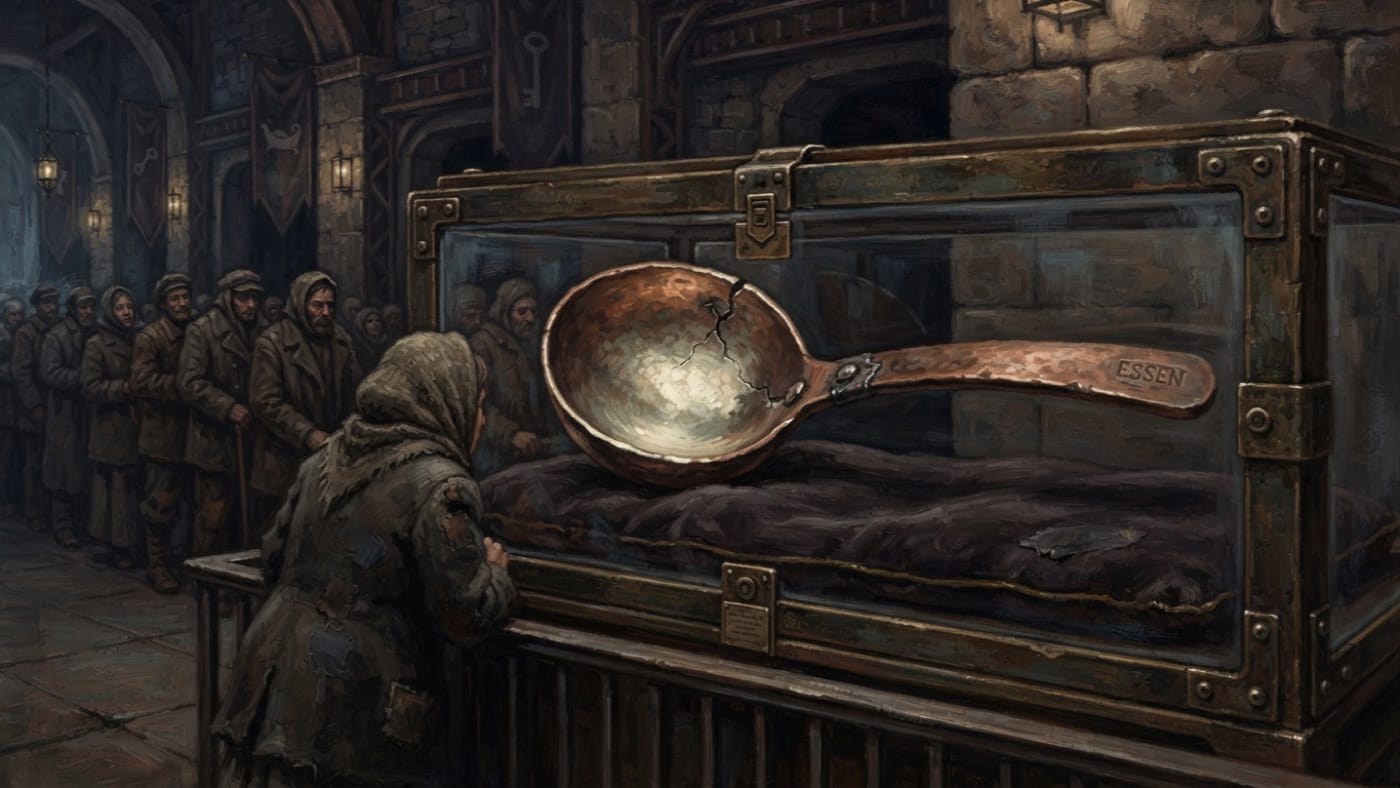
Observed: a copper ladle of cauldron proportions, the bowl deep, the handle long enough to reach the floor of a vessel no widow ever owned. Observed: a crack. Observed: a foundry stamp on the handle, reading Essen. Observed: two re-rivetings where handle meets bowl, one of them poor. Observed: the bowl worn thin and bright where mouths have touched it, kissed down to a colour the founder never cast.
Judged: this is a working tool. Its scale belongs to a garrison kitchen or a brewery, some establishment that measures broth by the vat and labour by the shift. Judged: the copper is about eighty years too late for the saint it is attributed to. Judged: the stamp places its making at Essen, whose foundries, on my reading, came to copper household goods well after the Sundering. These are my estimates. I hold them as firmly as a man holds anything he has written in his own hand.
The crack I cannot date. No one can. Nor can anyone say when the rivets went in, or what blow split the metal. It was dropped, or overloaded, or struck against an iron rim by a cook at the end of a long shift, and somebody mended it, because a ladle is cheaper mended than replaced. Then it was mended again, worse.
#On the Attribution
The approved hagiography is short, which is a mercy. During the ration panics after the Sundering, a widow of uncertain province stood between a crowd and a locked storehouse. She served broth to two hundred from a pot meant for twelve, and while the crowd ate she exchanged ration-ledger packets behind the storehouse wall and bought her district another month of allocation. That is the whole of it. Saint Halva of the Warm Ladle was canonized by the Bureau of Doctrine in A.S. 94, Third Quarter, four years after the Concordat of Strasbourg, in the same season that formalized the charter of the Mothers of Plenty. Women had kept ration queues long before any charter. The charter gave them a patron, and a patron wants an object.
Her file holds no attested miracle and no body. Neither absence proves there was no widow. There were widows with pots in every famine winter after the Sundering, some of them brave, none of them waiting on a decree. The defect lies elsewhere. Nothing in the file joins a woman stirring broth in a province no one can name to one particular piece of Essen copper under glass in a river city. The legend names no storehouse. Mainz is where the ladle is kept, which is a separate claim and far easier to make.
The three approved deaths only make it worse. In the Death by Hunger the ladle lies in her lap. In the Death by Trampling it is bent around her wrist. In the Approved Account it rests across her knees, beside cradle and key. Three placements, all approved, and none of them mentions a crack, a rivet or a foundry. The ladle at Mainz is not bent. Pilgrims who prefer the trampling are welcome to explain how it was straightened.
Doctrine made the saint. Relics classified the copper. These are two decisions by two offices, and neither office audited the other. A saint canonically sufficient and a ladle devotionally sufficient lean against each other in the chapel like two drunks in a doorway, and each looks steadier for the arrangement.
#On Devotional Sufficiency
The Bureau of Relics files the ladle under Tier III, Devotional Sufficiency. I have seen that designation on fourteen relics across the Synod's holdings. Fourteen is my count; the Bureau has not offered me its census and I have not asked. The Bureau does not publish its reasoning. Mine, after long observation of its practice, is that the designation finds the object adequate to the devotion directed at it. It makes no finding that the object belonged to the person named on the card. Nor does it find that the object does anything.
The faithful ask three questions as if they were one. Whose was it? May it be venerated? Does it work? Tier III answers the second and leaves the other two on the desk.
A trained Relic Authenticator grades on a different scale. Ward-safe, Votive, Contaminant, Fraud: these concern what an object will do to a garrison or a congregation, and whether its papers lie. The Synod's vaults hold objects that will keep a ward lit and objects that sweat black through a glove, and the people who sort one from the other earn their cuffs. Tier III does not belong on their scale, and I will not translate it onto it. A Fraud grade would empty the chapel by Vespers. A Ward-safe grade would send the ladle to a bastion wall, where it would hold back nothing at all. Tier III asks less. The queue may continue.
The Bureau claims no miracle for this ladle. It does not heal or ward. It multiplies no broth. The epithet "Warm Ladle" belongs to the saint and describes a legend, not a temperature. When I held the thing, gloved, it was exactly as cold as the case it came out of.
#On the Kiss and the Measure
The Bureau of Relics charges three pfennig per kiss. The unit is the contact, so a pilgrim who kisses twice pays six. By my estimate the chapel takes more in a year than some parish churches take in a decade. I have seen no audit, and I will not say where the coins go after the box. The worn bowl is a receipt. It proves that the kissing happened. It proves nothing about the saint.
In my dossier on Saint Halva I wrote that the bowl had worn thin and bright "from a century of lips."
Corrected: the bowl is worn thin and bright from lips. Nobody has established how many years of them, and nothing in the file dates the first. "A century" was rhetoric. I have withdrawn it, and I ask the faithful not to subtract it from A.S. 201 and then come to me with the answer.
The ladle has authority because every Mother of Plenty carries one. A ladle sister learns early that a ladle is a gavel, that the measure cup is tapped three times and that the last pot is never scraped dry, because a line that sees the bottom becomes a mob. The ladle stands among her tools with the chalk slate, the ration stamp, the queue rope, the ledger and the key. It serves broth. It also decides who gets broth and how much, and the decision goes into a ledger that the levy clerks read later. When a woman at the hatch looks up at a ladle she is looking at food and law at once. The relic in Mainz borrows its weight from ten thousand ladles in ten thousand ration halls, all of them stained, none of them kissed.
There is a third ladle, and pilgrims confuse it with the other two. On 14 Brumaire, at the Feast of Saint Halva, a senior Mother carries a polished, oversized ceremonial ladle through the ration hall and taps each queue-post, and the queue advances one pace per tap. The Bureau of Festivals calls this the Stirring. That ladle is for processions. The working ladle is for soup. The ladle at Mainz is for kissing, and I have no record that it has ever left its case to process anywhere.
The iconographic standard puts the ladle beside cradle, storehouse key and Ration Psalm on feast banners and at the chapel counter. I have not handled the tokens and will not describe them. The image is enough. A cook's tool has been lifted onto a banner and given a cradle for company, and the hungry recognise it at once, because they have watched it all their lives from the wrong side of a hatch.
Under all this lies honest hunger. Women queue at Mainz who have stood in ration lines since childhood and who know what a full ladle weighs. They kiss the copper because it looks like the one tool in their lives that ever gave them something. The Bureau of Purity keeps its own views on those who complain of a short measure. Nobody complains at the case.
#On Continued Custody
The ladle stays at Mainz, in its glass, cracked, twice riveted, stamped Essen, too large for any hearth and too late for its saint. Its classification stands. My observations are filed in the appropriate ledger, which is in my desk. My desk is locked. The Bureau of Relics has not asked for the key, and the Bureau of Tithes has not asked me what the chapel earns. Each office respects the other's silence.
The pilgrim kneels, the copper takes the kiss and the box takes three pfennig.