
#On the Designation
The Bureau of Relics keeps a phrase for objects it cannot honestly authenticate and will not publicly doubt. The phrase is Devotional Sufficiency. In every case I have handled, it is stamped beneath the numeral III. Tier III is the only numeral that concerns this tract. The other numerals belong to other cabinets and other clerks, and I admire their drawers from a respectful distance.
Read plainly, the designation is a permission. A relic so classified may be displayed, venerated, kissed, carried in procession, printed on devotional cards and charged for. It is not a finding. It certifies no saint's ownership, no unbroken custody and no wonder worked. It records three things: that the faithful believe the object is what its label claims, that the Bureau has examined that belief, and that the Bureau has found the belief adequate to its purposes.
I have seen the designation on fourteen relics across the Synod's holdings. That is my own tally, kept in my own hand from my own visits, and it is not an inventory. The Bureau has never published one. I suspect it has never compiled one, on the sound principle that within a week any list of devotionally sufficient objects would be read as a list of something else.
No statute contains my translation of the term. I offer it as a theologian's reading of Bureau practice: the object is almost certainly wrong, but the faithful believe it is right, and their belief pays for pilgrimage, candle-wax and doctrinal compliance, and the Bureau does not correct beliefs that pay their own upkeep. I wrote that sentence once before, in a dossier on the saint who introduced me to the designation. I see no reason to improve it. The Bureau has seen no reason to dispute it, and in this building that counts as applause.
#On the Ladle and Its Evidence
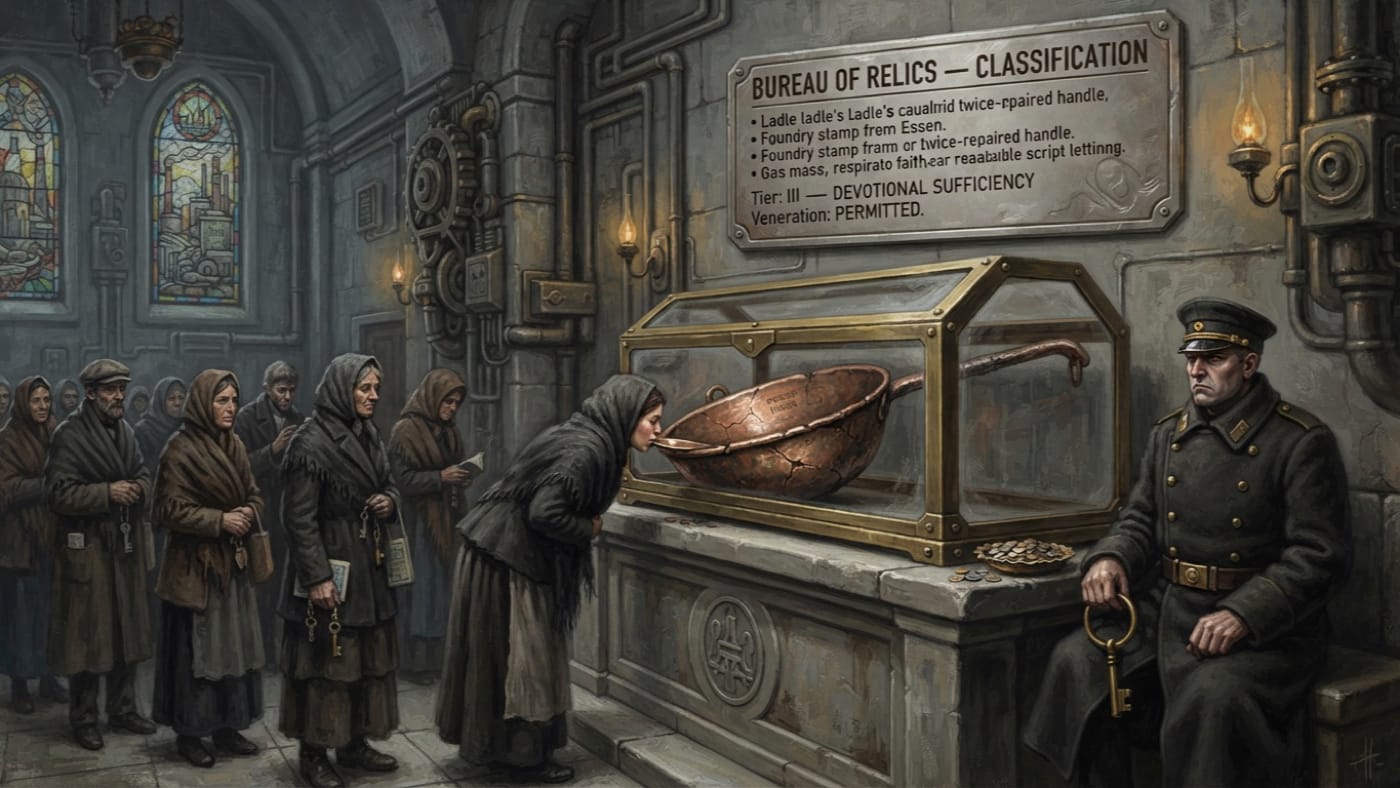
The principal example sits in a glass case in the Chapel of Saint Halva at Mainz. It is a cracked copper ladle, attributed to Saint Halva of the Warm Ladle, patron of the Mothers of Plenty. I held it once, briefly and by dispensation, wearing the white gloves the Bureau requires for Tier III artefacts. The gloves exist to protect the object from the examiner. In some vaults, with some objects, the protection runs the other way. With this one I felt nothing but copper.
What the object records, it records without piety. It is a cauldron ladle, the instrument of a garrison kitchen or a brewery. No widow's hearth could have used it unless the widow had a smith's forearms and a pot as broad as a baptismal font. The handle bears a foundry stamp from Essen. It has been re-riveted twice. The later repair is competent. The earlier one was done by someone in a hurry or in drink. By my assessment, the copper is some eighty years too late for the life it is said to have served.
I cannot give its casting year. Nobody can on the present evidence, and the Bureau has not asked. I possess no custody chain linking the ladle to anyone before it entered the chapel. None is shown to visitors, and none was shown to me.
The story supplies everything the copper lacks. In the ration panics after the Sundering, a widow stood between a crowd and a storehouse. Her broth, meant for twelve, fed two hundred, and she bought her district another month by ledger-work behind the wall. The multiplication of the broth is hagiography and was never attested as a miracle. In A.S. 94, Third Quarter, four years after the Concordat of Strasbourg, Sub-Office IV of the Bureau of Doctrine canonized her. It waived the requirement of a miracle and the requirement of a body.
None of this proves that no widow ever stood before a crowd with a pot and her nerve. The wrong ladle is evidence about a ladle. It says nothing whatever about the woman. I record the distinction because the Bureau will not. Someone, somewhere, should be permitted to have been brave even if the cutlery came later.
#On What the Institution Receives
Pilgrims kiss the bowl. They come in the grey of ration mornings and in the cold of feast evenings, and they bend. Where their mouths meet it, the copper has worn thin and bright. The Bureau of Relics charges three pfennig per kiss.
"...where the copper has worn thin and bright from a century of lips." — V. Drax, dossier on Saint Halva of the Warm Ladle.
Corrected: the bowl is worn thin and bright. The wear is observed. Its duration is not certified. I hold no record of when the kissing began, and "a century" was an ornament I mistook for a measurement.
I once wrote that the chapel earns more in a year than some parish churches earn in a decade. I stand by that as an estimate and claim nothing more for it. Nobody has told me where the pfennigs go after they leave the dish, and the Bureau of Tithes has not volunteered it. I have learned to treat not being told as a form of instruction.
Money is the coarsest thing the Bureau receives. The finer receipts are harder to count. A woman who has kissed Halva's ladle has rehearsed, with her own mouth, the proposition that Halva fed the hungry and that the hungry ought to be grateful. The Mothers carry their keys, queue ropes and ration stamps under the same patron. Her story authorizes queue discipline, reduced portions and the obedience the Mothers require of the women whose pregnancies they register. A pamphlet can tell that story. A relic gives it weight. Pamphlets are paper, but this is copper, and for three pfennig you may touch it with your lips.
The faithful are not fools for paying. They are hungry people buying continuity. They want proof that someone once stood at the head of a queue and did not run, and that the institution standing there now remembers her. The Bureau sells them that proof at a fixed rate.
Two judgments travel together here, and they belong in separate drawers. The Bureau of Doctrine found Halva canonically sufficient, meaning her existence was adequate for a feast, a patronage and an office. The Bureau of Relics found her ladle devotionally sufficient. Neither office needed the other's finding, and neither finding confirms the other. Her canonization and the Mothers' office belong to a single administrative season. The institution came before the cult that was created to sanctify it. When the ladle reached Mainz, nobody has written down for me.
#On the Other Judgments
People often confuse a Tier III classification with an authenticator's grade. They are different instruments. The Relic Authenticator takes an object through intake and quarantine, reconstructs its provenance, examines it physically, tests its fit with doctrine and tests its response under lamp and bell. Then the authenticator notarizes it and decides its disposition. The result is graded Ward-safe, Votive, Contaminant or Fraud. Those grades say whether an object may stand near a ward, whether it may be venerated, whether it must be locked away and whether it is a lie. Devotional Sufficiency answers a narrower and more profitable question: whether the believing may go on.
Three questions, then, kept apart: who owned the thing, whether the Church may let the faithful use it, and whether it does anything. Attribution, permission, efficacy. The ladle at Mainz has a doubtful answer to the first, a stamped answer to the second and no recorded answer to the third.
Relics do act, and the Church should not pretend otherwise. Some repel what comes through from the Great Deceiver's side of the world. Some contaminated objects produce phenomena of their own, which is why authenticators carry quarantine wax. A Tier III stamp gives an object no protective power and does nothing to cure contamination. A devotionally sufficient ladle sent to the front as a ward would be a stamp sent to do a relic's work. To my knowledge the Bureau has never tried it, and I commend its restraint in the one place where restraint is cheap.
On certification itself, the Bureau's authority is complete. The cathedrals of Cologne hold seventeen femurs of Saint Aldebrand, all notarized and all equally holy. Seventeen thighbones would require a saint of unusual construction. The Bureau settled the question by declaring every notarized femur authentic. That ended the matter administratively and left the anatomy to the Creator. Measured against that precedent, one copper ladle eighty years adrift hardly counts.
#On Present Application
At this survey, A.S. 201, the ladle remains in its case at Mainz, classified Tier III, and the kissing continues at the posted rate. The designation has not been revised. I have not asked for a revision. My tally stands at fourteen. It would be higher if I travelled more, or lower if I noticed less. It measures my itinerary and nothing grander.
My observations are filed in the appropriate ledger: the Essen stamp, the scale, the rivets and the eighty years. The ledger is in my desk. My desk is locked. The Bureau of Relics has not requested access, and the Bureau of Purity has not been invited to. Three offices thus keep an understanding that no document records.
On 14 Brumaire the queue lengthens. The Mothers keep it straight with their ropes. The pilgrims bend to the bowl, the copper takes another lip's worth of polish, and the dish fills in threes.