
#On the Missing Copies
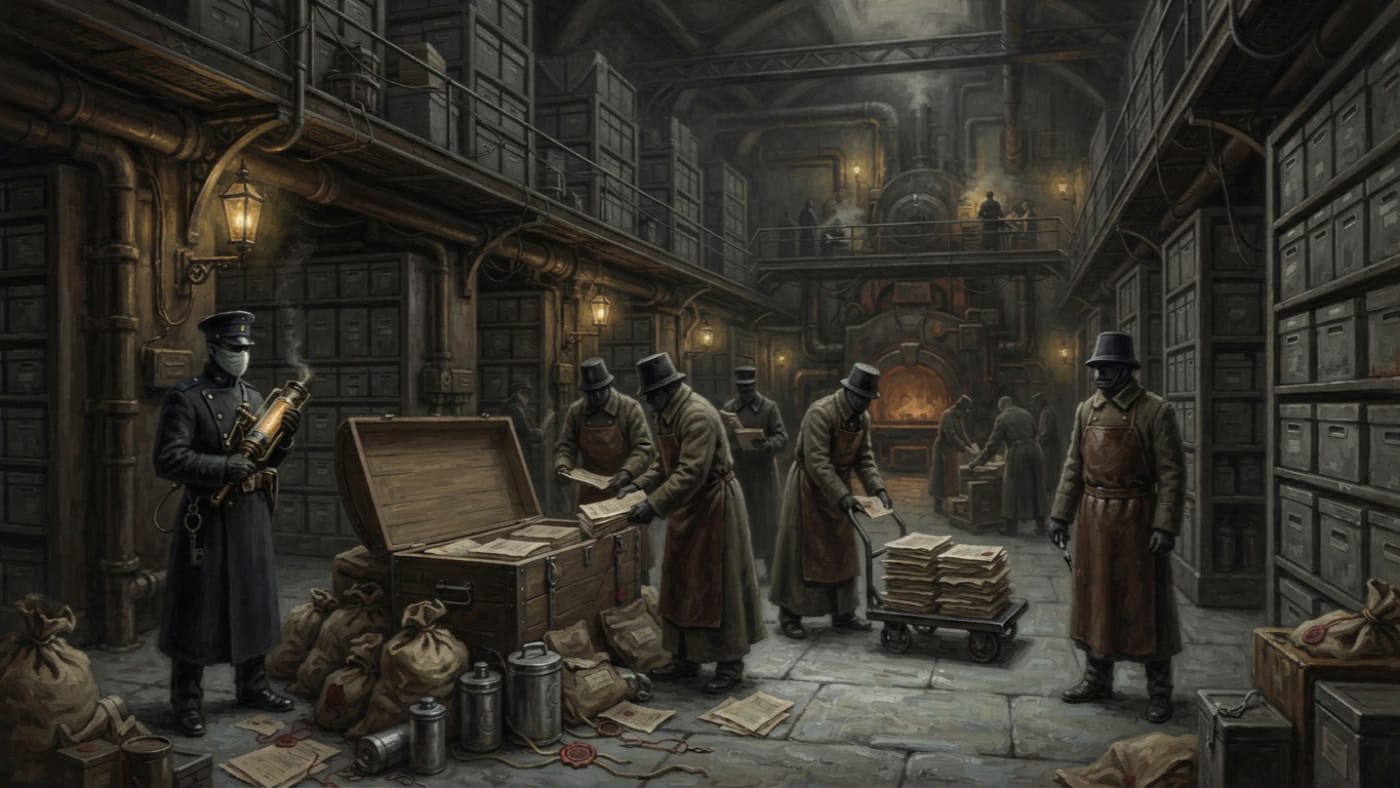
In A.S. 101 the old ducal houses of Swabia lost the papers they had kept longest and trusted least. These were copies of disputed oaths. Families held them in their chests for three generations and brought them out, unfolded them and read them aloud whenever Strasbourg asked a Swabian house for coin, wagons, or sons. During the Quiet Inventory of that year the copies vanished. The Stuttgart plate gives the whole event in four sentences, which is three more than Records has ever volunteered.
Two descriptions survive. Records calls the disappearance archival consolidation. The families call it theft. I have already said, under seal, that I admire both terms: the first because it has a seal, the second because it is true. I see no reason to revise that judgment merely because it embarrasses my own Bureau. Embarrassment is not an audit finding.
What the record does not hold is longer than what it holds. It names no commissioner and lists no household. No warrant, count, day, season, route or repository has reached the Codex. We have the year: A.S. 101, or 1811 by the old reckoning. That is eleven years after the Concordat of Strasbourg made the Synod formal, and forty-three years after the Night of Black Decrees. The man who had pressed the Swabian dukes hardest had been dead for thirteen years. His paper had outlived him.
#On the Ducal Objections
Swabia came into Synodal obedience under pressure. During the long consolidation before the Concordat, Cardinal Hieronymus Kratz threatened wavering Swabian dukes with excommunication. He proclaimed loyalty in names that had not yet given it, and he set the pulpits to work until private hesitation sounded like apostasy from the nave. The Common Allegiance of A.S. 55 required local subscription, and in many places that subscription became an instrument of coercion. In A.S. 58 the Night of Black Decrees carried writs and accessions through every jurisdiction already within the emerging authority's reach. Swabia was one of them, and the Stuttgart plate says the Night left wax in the grain.
The houses kept copies, and I stress the word. A copy is a witness. It is never the instrument itself, and nobody in Swabia pretended otherwise. Its value was that it stood outside Strasbourg's register and recorded what a duke had been made to say, in what form and under what circumstance. The Codex does not hold the wording of these copies, and I will not invent it. Nor do I know that every one was a subscription to the Allegiance or an accession from the Night of Black Decrees. Swabian grievance is patient and broad, and the families did not sort their chests for my convenience.
What I know is how they were used. When Strasbourg wanted coin, a copy came out of the chest. When it wanted wagons, the copy came out again. When it wanted sons, the copy was read in a cold hall to whoever Strasbourg had sent, a man who had come to collect and was made to listen instead. The record does not say whether a single reading ever reduced a single demand. It does say the copies were produced every time. Swabians do not repeat an expense that has never paid.
#On Archival Consolidation
Archival consolidation is a beautiful phrase. It has the gravity of a canon and the discretion of a locked choir-stall. To consolidate is to gather scattered parts into one body, and in that sense the phrase is perfectly accurate, the way a coroner is accurate. Something scattered was gathered. The phrase does not say where it went, who carried it, or whose keys turned.
I can describe the Bureau's general habits without pretending they are the Inventory's procedures. Records keeps the authoritative register. It makes duplicates, certifies copies, reconciles one ledger against another, and treats the Master Roll as the thing that is real. In this theology a paper outside the vault is either redundant or impertinent. If it agrees with the register, it is unnecessary. If it disagrees, it is a rival memory kept under a private roof and taken out whenever the Synod asks for something. Every scribe is taught that ink remembers what flesh forgets. Every scribe also learns, more quietly, that ink kept in the wrong chest remembers on its own terms.
The families see it more simply. The copies were theirs. They lay in household chests under household keys and had been handed from father to son with the plate and the debts. Paper removed from such a place and never returned has a name in every language that has a word for mine.
I cannot say how the copies left the chests. I do not know whether a clerk knocked, a steward was paid, or a pretext was offered. Perhaps a duke simply opened his chest one morning to arm himself against another request and found the space empty. The record gives the vanishing and stops there. I do not fill the gap with a burning, a cart, or a vault. Disappearance is the only fact on file, and I refuse to promote it.
#On What the Papers Could Contest
Strasbourg governs by documents. Property, transactions, confessions and identity all exist because they are written, filed and cross-referenced in the vaults beneath the Cathedral. My Bureau's motto is What is Written is Real. I believe it professionally and fear it everywhere else.
In such a government, a household holding a copy of a disputed oath holds a small competing reality. The copy cannot defeat the register, because the register is also the judge. What it can do is make the register argue. It could put a cardinal's methods back on the table in a ducal hall forty years after the cardinal had any use for them. It could turn a demand for sons into a conversation about whether the oath behind that demand had ever been given freely. Strasbourg has always disliked that conversation, because Strasbourg wrote both sides of the original.
The contest was unequal from the first page. One side holds the recognized record, certifies which copies are true, employs the clerks who decide disputes, and keeps the wax. The other side has a chest, a key and a grievance. To appeal a register to the institution that keeps it is to petition the author against his own sentence. The petition is received with courtesy and filed with care.
The Codex holds no case that grew out of A.S. 101. I have no confiscated estate, erased lineage, won appeal or missing heir to offer you, and I will not manufacture one to make the story feel finished. All I can certify is the order of events. The copies were kept, then produced, then gone, and after that Strasbourg's requests went on arriving.
Older Stuttgart civic primers described the city's entry into Synodal obedience as voluntary alignment under ducal leadership.
Corrected in the Stuttgart plate. The correction is entered here as well, because it bears on this event. A voluntary oath needs no disputed copy, and had the primers been right, the Quiet Inventory would have been a tidying of waste paper. The dukes aligned after excommunication threats, forged-name proclamations and pulpit pressure. That is why their heirs kept the copies, and why losing them earned two names.
#On the Surviving Instruction
The Bureau of Doctrine's civic-military plate on Stuttgart, filed in A.S. 201, ends with a list of instructions: maintain Short Ration Week, preserve Kratz-era oath copies under seal, suppress sausage songs, and continue measuring westward glances. The oath copies sit between bread arithmetic and a ban on songs, which is Doctrine's way of showing that it considers them neither sacred nor trivial.
The instruction does not say which copies it means, or where they are. It gives no count. It does not say whether they are the Swabian copies of A.S. 101 or other papers from the same unhappy decades. An instruction to preserve is not a receipt of custody. Either something survives to be preserved, or Doctrine is guarding an empty chest with great formality. The Codex has evidence for neither, so I record both possibilities without choosing.
The rest of the Swabian story belongs to the Stuttgart plate. Eleven years after the Inventory, in A.S. 112, War fixed its garrison at Stuttgart and began teaching boys how much hunger a body can afford. When the Levy demands came, the houses objected in twenty-seven folios. As that plate lists them, the folios held three tables, two lineage charts, a toll-road estimate and a priestly appendix on the precedence of sons. No oath copy appears in the list. I read that list as families arguing with what they had left. They had arithmetic, and they used it so well that Conscription took more offence than it would have at a riot.
I file the Quiet Inventory under events, although no one has admitted to doing anything during it. Records keeps its phrase, the families keep theirs, and the Codex keeps both on the same page.