
#On Admission
"No draught shall be administered without prior confession." — First Mercy Charter, A.S. 92, as reproduced in the Bureau of Medicine survey
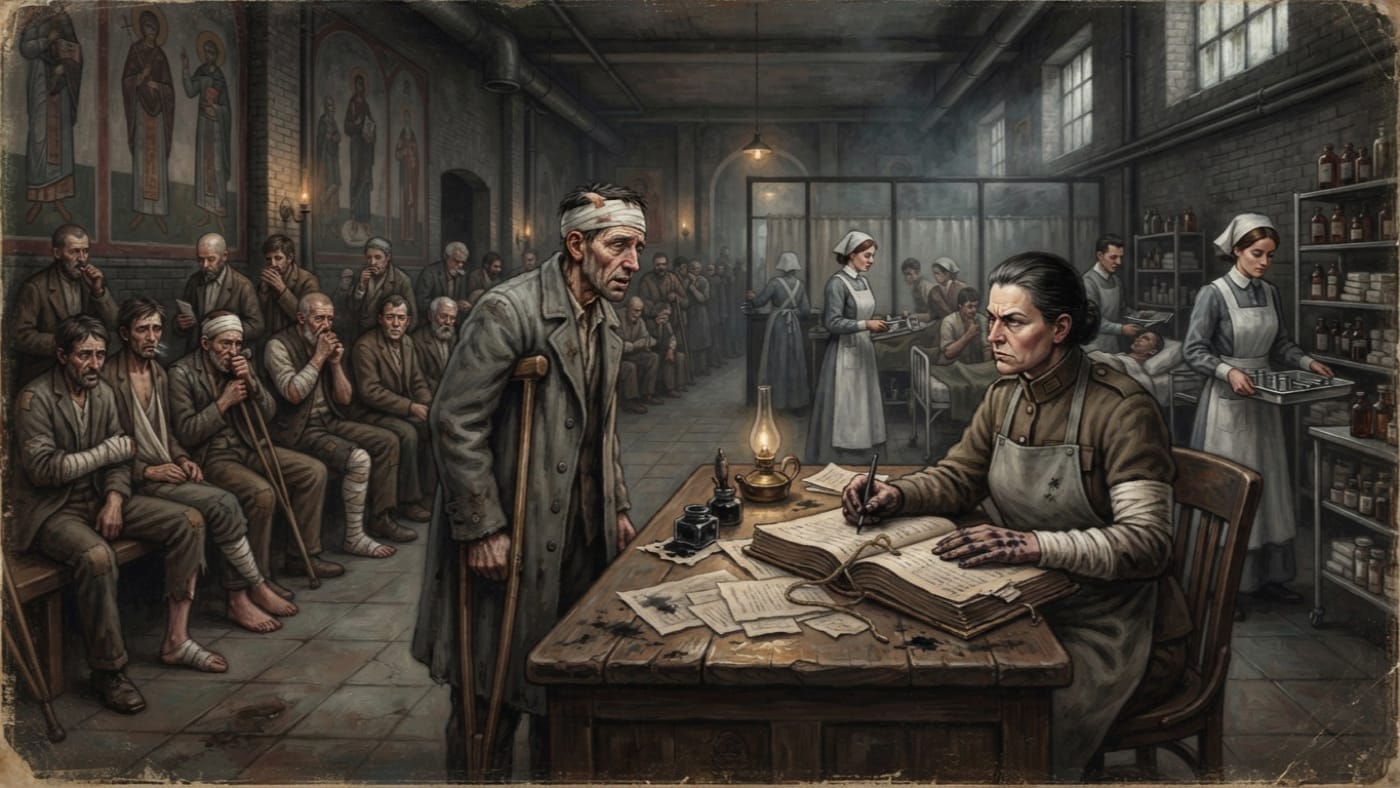
A clerk stands between the sick and the apothecary, and everyone who arrived earlier stands between the sick and the clerk.
In its plainest written form, the rule says that no one approaches an apothecary without first standing in line and confessing their sins aloud to a clerk. That is the narrow definition. The Bureau of Mercy has since found it too modest for a well-governed ward. Its present survey puts the surgeon and the broth-ladle behind the same desk, so a subject cannot get a splint, a tincture or a bowl of soup by any route that goes around the clerk. The Queue is compulsory. The Bureau calls it a sacrament of access. The patients call it the line.
The patient's condition is not relevant to their place. They have a fever, a crushed hand or a cough that has outlasted the winter, and they have a position in the line. Waiting in a Mercy Ward is quiet work. My earlier survey described patients sitting in silence beneath painted martyrs, and the silence lasts until the clerk calls the next name. Then the patient has to speak.
The clerk belongs to the Bureau of Records. Grey apron. Fingers stained to the second knuckle. A ledger tied shut with string, because string costs less than a clasp and gives a curious thumbnail nothing to work at. The clerk is no priest and holds no commission to absolve. The clerk receives what is said and writes it down. Then somebody decides who goes on.
#On the Spoken Account
"Confession purges disease, for guilt is the womb of illness." — Bureau of Mercy, as entered in a contradictory sidebar
When called, the patient speaks and the clerk transcribes. As far as the Synod is concerned, the confession is what the clerk writes, and what the patient said was only the occasion for writing it. A patient who cannot write loses nothing under this arrangement, and the Bureau cites that as proof of its charity. A patient who speaks badly, or too quickly, or in the wrong order loses a good deal, and the Bureau cites nothing.
Somewhere between the last spoken word and the next written line, a judgment is made. I have looked for its instrument. No document I have been shown sets a tally of sins, a fixed length of confession, a scale of contrition or a means of appeal. The Mercy survey says only that some patients are "deemed insufficiently repentant." Note the passive voice. The Bureau has given that sentence no subject, and the omission is deliberate.
Those deemed repentant go on. Those deemed unrepentant are turned away, and their wounds get a classification in place of a dressing: Heaven's rightful chastisement. It is the only entry in the Mercy pharmacopoeia that needs neither a bed nor a bottle, and the ledger records it in the same ink as a fracture. This is the institution's classification. It follows from the doctrine that guilt is the womb of illness. The Bureau of Doctrine has never asked a clerk to confirm that anatomy at the desk, and no clerk has volunteered.
The admitted patient has not been absolved. The charter makes absolution a separate condition for closing a wound, and the clerk's desk does not provide it. Passing the Queue makes a patient eligible for treatment and nothing more. From there the Ward-Sisters and Ward-Brothers sort the admitted into clean, grey and black zones, and the confession has no say in which. A contrite man with a rotting leg is classified by his leg.
"A man does not receive medicine until he has confessed his sins in writing."
— from my earlier general survey, "Medicine & Mercy."
Corrected against the dedicated description of the Queue of Confession and against the Bureau of Mercy's present survey: the patient confesses aloud to a clerk, and the clerk transcribes. No patient's pen was ever required. The writing has always belonged to the clerk, which is why the clerk's version is the one the archive keeps.
#On the Record
After it is transcribed, the confession is filed. The Queue's work ends at that point and the Record's work begins.
The Bureau of Records keeps confessions inside a much larger apparatus of identity and entitlement, which decides who a subject is, what that subject may draw, and on what authority. A confession taken at intake becomes one more paper among the papers that follow a subject through life. The wards also have their own duties. Mercy staff record spiritual anomalies such as dreams, whispers and stains, and they route those cases to a Confession Liaison or to the inquisitorial officers who answer to the Bureau of Purity. A remark made at the desk to get a splint can therefore come up again later in a room with no splints in it. No general timetable governs this, and I have found no fixed destination for every intake abstract. In my experience, the absence of a schedule has never stopped a file from arriving.
Marrowgate shows the mechanism most plainly. Confession booths stand at its intake gates. A receipt is required for entry to its wards, so the spoken account becomes something a patient carries in the hand and must show to the next official. Marrowgate's confessions are appended to medical ledgers and cited in tribunal judgments. Other wards have their own customs. Marrowgate has simply put a stub on the procedure.
The deathbed transcript is a separate practice and should be kept separate. Ward-Sisters take down what the dying say in their last hours, and the Mercy survey reports that those transcripts are forwarded before the body is cold. The Queue collects its toll from the arriving, while the deathbed harvest audits the departing. Clerks of the two practices may share an ink supplier, and that is as far as their kinship goes.
#On the Waiting Wound
The First Mercy Charter of A.S. 92 states the doctrinal premise. Its conditions, as the Bureau of Medicine reproduces them, are confession before a draught, absolution before a wound is closed, and acknowledgment that recovery is Providence's gift. The charter came two years after the Concordat of Strasbourg settled the formal Synod. It set the doctrine down in writing. Whether it invented the line, I cannot say: the archive gives me no first ward, first clerk or founding decree for the Queue, and I decline to manufacture one to fill the column.
What I can document is resistance. During the Great Retreat and the decades after it, medicine was in the hands of the Church and of provisional offices that would later receive grander names. By about A.S. 65–68, when Sagittal Line was defensible but incomplete, the trenches were producing wounds faster than any desk could hear their owners' sins. By A.S. 78, forward stations were working under emergency dispensations and borrowed Mercy protocols. Garrison commanders called the result practical theology. Other offices called it something less polite. In A.S. 82 the records show a Medical Directorate under the military command that would later be filed as the Bureau of War, eight years before the Synod formally existed to approve it.
One example of the tension survives as report rather than record. Doctor Kael Brenner, later the Directorate's first Chief Anatomist, is said to have preferred amputating at once to letting a leg rot while its owner confessed, and to have left the soul for the Creator to attend to at leisure. He was excommunicated and then rehired, and the paperwork for both was filed on the same day. No date survives for the exchange.
None of this abolished the Queue at the front, and nothing I have read guarantees an emergency exemption to any particular patient on any particular night. The Bureau of Medicine operates under Supplementary Charter 14-C with no seat among the Twelve, under joint oversight from Mercy and War, and the old quarrel about the leg and the confession is carried on inside that arrangement. Neither side has conceded. The wounded are still waiting while it goes on.
#On the Present Application
The ward smells of boiled grain, old blood, damp linen and disinfectant. The cough-wave starts at one end of the line and works its way along. Paper is everywhere. Bells mark the hours, and the line advances as the hours pass.
The staff wear grey aprons and white sleeve wraps, with masks during bell-hours and corded badges at the hip. Beyond the desk, supplies wait in counted quantities: ladles measured, cloth cut by the inch, every dose matched to a signature at the end of the shift. The Ward-Sisters and Ward-Brothers do real work. They set bones, clean wounds and spoon broth into mouths that cannot hold the spoon. They also write down what they see. These are two duties, performed by one pair of hands, and the Bureau sees no conflict between them.
The clerk at the desk is not a Ward-Sister, and the two should not be confused, even though by evening both have the same ink on their fingers. The clerk decides who comes through. The Ward-Sister has to deal with everyone who does. The ones turned away wait outside the ward's accounts, where any kindness shown to them goes unrecorded, and the profession's own lore says unrecorded mercy can earn a heretic's brand. Some staff show it anyway, quietly, at a cost to themselves that no ledger column measures.
The Queue is in force. When the next bell rings, the clerk will call the next name, and the line will close up the space that patient leaves.