
#On the Lower River and the Southern Roads
Provence is where the Rhône drops its northern hurry and settles into work. The river comes down from Lyon, an upstream city that is not Provençal whatever the Lyonnais say after the third glass. It passes Avignon, then Arles, and widens into the lower reaches. Roads leave it for the coast and for Marseille, where the Synod lets the Mediterranean touch it under supervision. The region lies in Zone 1 of the western heartlands, far to the west of the Sagittal Line. No Sin-General has ever wanted it. The dangers here are domestic ones: hunger, contraband and memory.
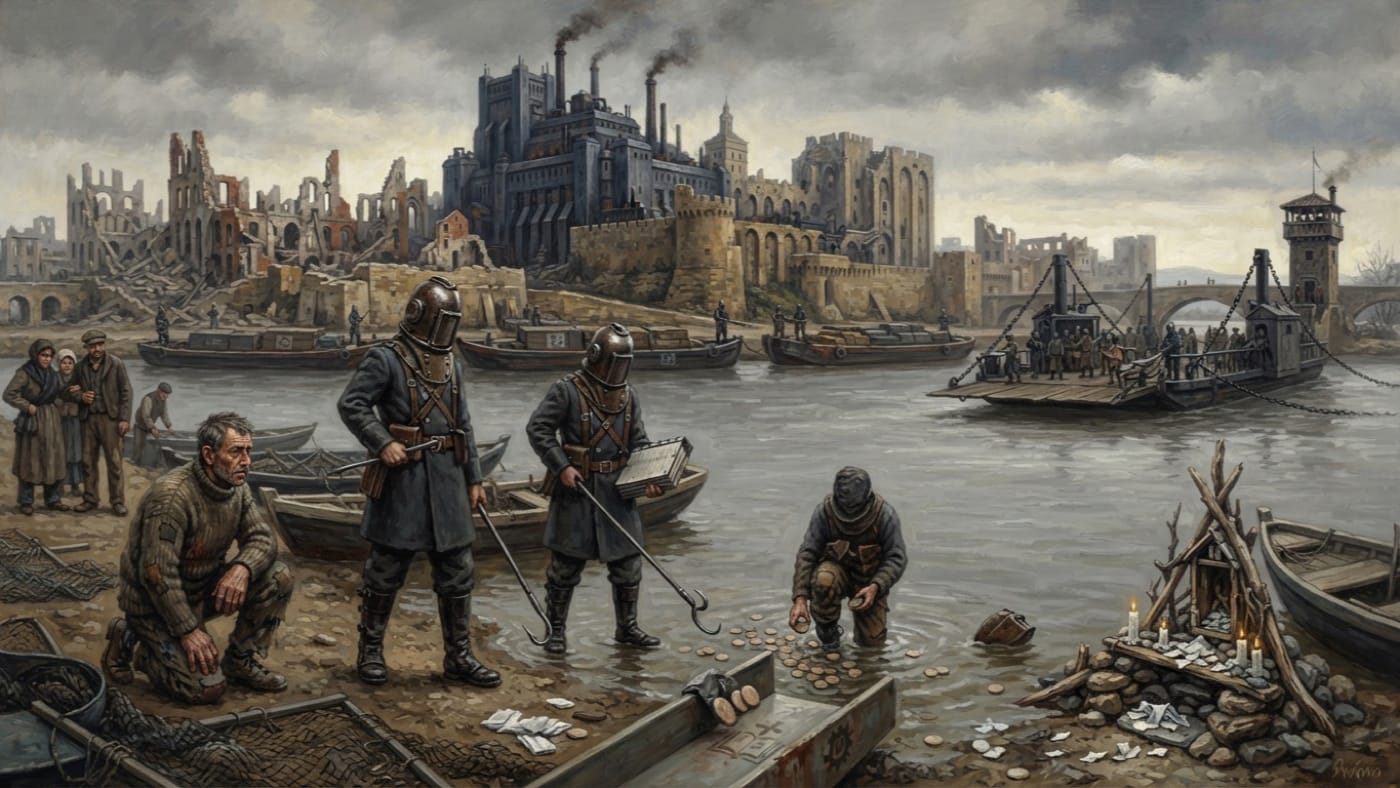
People live here. The northern clerk forgets this first, and his boots are the first to remind him. At dawn the fishers open their nets on the gravel. Boatmen pole downstream with grain, wine, salt and chapel oil. Some of them carry crates under relic seal and are paid not to think about the contents. Vine-labourers climb the terraces with their knives. Ferries cross on chains. The parish bells mark the hours over all of it. The Bureau of Passage keeps a register at every landing worth the ink, so a man cannot cross his own river without becoming a line in a column.
The province is useful, and that is its misfortune. The Church watches everything useful in proportion to its use. Provence is watched from the riverbank, from the bell-tower, and from Strasbourg at a comfortable distance.
#On Grain and Diocesan Reach
The annalist's account of the Famine of Provence is short and flatters no one. Grain grown in Provence was held back for Rationalist garrisons, and Provence starved beside its own granaries. He puts the dead at a million, and I record that figure as his. He names policy as the cause. Of all the ways to die, policy is the one that keeps the best records of the harvest.
A second famine is on file, undated, and I will not marry it to the first to make the index tidier. During that famine the Diocese of Arles extended its boundary by decree to take in fields sixty miles away. The decree reasoned that the cathedral bells, rung with fervour, carried on the mistral as far as those fields. The peasants in the fields said they heard nothing. The Bureau of Records certified that the bells had been heard, on the grounds that the ledger said so.
The reader must keep three things apart. Arles is a town of quays and markets. The Diocese of Arles is a jurisdiction. Provence is the region that holds both and agrees with neither. In the Archivist's geography a diocese is a supply grid. Its edge runs as far as its bells can be heard and as far as its names stand in the Great Ledger of Souls. The Bureau of Bells answers for the first condition and Records for the second. The Bureau of Tithes comes afterward and collects on both.
The sixty miles are the decree's own claim. Nobody walked them with a measuring chain. Nobody tested a bell against the wind, and no current boundary rests on the figure.
The coast keeps its own arithmetic. Marseille's Salt Dues were imposed in A.S. 92 as a temporary surcharge for the Iberian campaigns, and they are still temporary. Every cargo leaving the Provençal coast pays toward a campaign that began before its sailors' grandfathers were born, and it pays again when the barrel goes upriver.
#On Strasbourg's Southern Authority
The Concordat of Strasbourg created the formal Synod in A.S. 90, two years after the last of its founders was buried. It bound the southern dioceses to a capital most southern priests had never seen. The later Council of Cologne tightened those bonds in A.S. 100. The seals became Strasbourg's. Appointments went north and came back. A Provençal bishop who wanted to bless a new chapel bell found he needed a form. The form needed a seal, and the seal was kept in a city that smelled of ink and cold stone.
The southern resentment was a quarrel over jurisdiction before it became anything else. Clergy disputed who held the wax, who heard appeals, and whose tithe crossed which river. Most parishes paid, grumbled and paid again. Grumbling is a Provençal sacrament, administered daily without a licence.
One faction of clergy went further.
#On the River Crown and the Razing
In A.S. 111, twenty-one years after the Concordat, a body of Provençal clergy declared Strasbourg's authority void. The figure they raised, or who rose from among them, was one of their own. He was a seminary-trained priest, and the surviving testimony identifies him by his speech, the flat vowels of the lower Rhône. His name has been scraped from every surface the Bureau controls. The record calls him the Pontifex Submersis. The fishers call him the Drowned Pontiff.
He preached for six months from riverbanks, from boats, and from the flooded places beneath Avignon. Thousands came. The larger totals are estimates, and I do not sign them. I give his propositions as his and condemn them as heresy. Water is older than stone. Succession passes through the river and not through Rome's rubble or Strasbourg's chancery. The Concordat turned a living faith into bone. Against the Synod's wax he set a seal of river clay with nothing pressed into it. That blank disc was his anti-stamp.
He was crowned in water. One account puts the ceremony in the river itself. Another puts it in catacombs that flood at low tide. The Bureau of Doctrine has not chosen between them, and I see no reason to choose on its behalf, since both accounts have him standing waist-deep.
The Bureau of War sent the Strasbourg garrison south with wardens of the Bureau of Purity. Avignon's walls held for nine days. On the tenth the gates were opened from within. The record does not say whose hand opened them, and I will not supply one. The city was razed. Its good stone went north by barge and became staircases in the Cloister of Concord, a house whose clerks were climbing stairs long before Avignon sent new ones. Records erased the names and reclassified the city. The Razing was the first formal application of the Trifold Erasure.
The Pontiff's body was never recovered. The fishers' depositions describe faceless white figures kneeling in rows at dawn, rods of glass, and rosaries fused with glass. The Bureau calls the rosaries mineral accretion. The depositions remain sealed. Both statements are on file, and neither cancels the other. The full matter belongs to the Schism entry, which I recommend to readers with strong stomachs and weak career prospects.
Provincial almanacs and certain parish wall-chronologies date the river crowning and the Razing to A.S. 145.
Corrected. The crowning, the six-month crisis and the Razing belong to A.S. 111. A.S. 145 is the later southern docket correction, thirty-four years afterward, when the remaining rolls were burned into agreement. Provence is asked to stop keeping two anniversaries for one ruin.
#On Speech, Catch and Permitted Memory
Provençal is the speech of this country, and no office has put the speech on trial. I have found no ruling on the tongue as a whole. Doctrine keeps the approved vocabulary. Purity keeps its lists of forbidden words. The Bureau of Orison and Song licenses melody. Each of them works one word or one tune at a time. A boatman may curse his tiller in Provençal all afternoon. If he sings a verse about water older than stone, he is in trouble in any language.
The nets are inspected. Wardens carrying hooks walk the banks below Avignon and turn over whatever the river gives up. It gives up rosaries, glass and blank clay discs. The discs are confiscated, crushed and catalogued. Then they turn up again in market stalls, in coat pockets, and in cupboards that have already been searched. Pilgrims come to the ruins by a licensed route, pay at the gate and leave by the same road, and they are counted on the way in and on the way out.
Languedoc lies to the west and keeps grievances of its own. The two provinces share roads and complaints, and the north treats them as one sunburnt problem. They are two provinces, and only Provence has the river.
Memory here is kept the way the poor keep coin, in small sums and in places officials do not bother to search. Families who say they venerate no one keep flakes of white glass folded in paper. Old women nod to the river as they pass, a gesture that matches nothing in the approved liturgy. Records has no column for a nod.
#On the Present Holding
As of A.S. 201, ninety years after the Razing, Provence is at work. Boats come downriver with grain and wine and go back up with salt and sealed crates. Arles still hears farther than its peasants do. Marseille still pays its temporary surcharge. The ruin at Avignon is restricted, staffed and profitable, and the fishers keep finding things there. No survey of all Provence has been commissioned, so I give no census, no governor and no frontier. A reader who wants a map can buy one in Marseille from a man who will also sell him a pilgrim token.
At Ninth Peal the wardens clear the bank. The nets are stacked to await inspection at first light.