
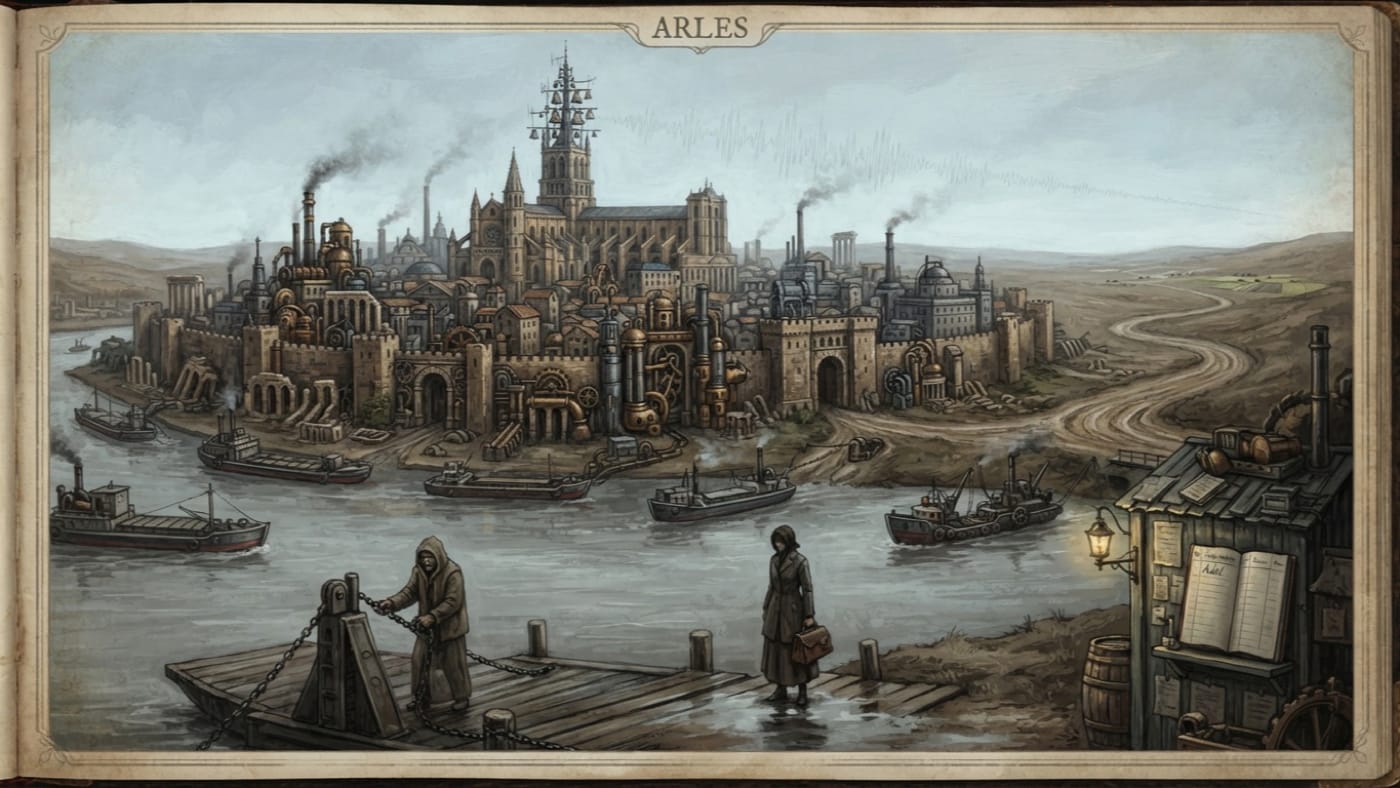
#On Arles and the River Register
Arles is a town on the lower Rhône. The Passage registers list the Arles approaches among the river's principal nodes, below Avignon and above the lower Provençal reaches, and the roads toward Marseille lead away from it. It lies in Zone 1, in the western heartland, under the same blue southern sky that persuades every Provençal clerk he is exempt from audit. It is no bastion and no front. No demon has yet done it the honour of a siege.
I compiled this survey at my desk from what the files would give. That is the proper way to survey anything, because a town will lie to a visitor and a folio will only leave things out. The commission asked for a dossier of the place. The cupboard held two entries of any substance. The first is an old account of the Diocese of Arles moving its boundary by bell. The second is a single line in a ferry registry kept somewhere near the town, which records a woman's name and nothing after it. On this evidence Arles is a diocese that claimed too much and a column that recorded too little. The rest is river.
#On the Diocese as a Supply Grid
The reader should first separate the town from the diocese, since the peasants of Provence never managed to. The town is stone, quay and market, and its edges can be paced by any man with sound boots. The diocese is a jurisdiction. Its edges are set by two instruments, neither of which owns a pair of boots.
The Archivist's administrative geography states the first principle plainly: the land belongs to those who tithe it, whoever tills it and whoever bleeds on it. A diocese in that reading is a supply grid. Its boundary follows bell audibility and ledger density, and mountains and rivers have no say in it. A hamlet belongs to a diocese if its cathedral's bells can still be heard over the wailing of its infants and if its names appear in the Great Ledger of Souls. The Bureau of Bells supplies the first condition. The Bureau of Records supplies the second. The Bureau of Tithes then arrives with a wax-sealed satchel to collect on both.
The same section records a quarrel between offices that has never been settled. Doctrine holds that a diocese is a body, indivisible, mapped upon Creation by Providence. Records holds that a diocese is a column, indivisible, mapped upon parchment by clerks. Both statements are filed, both are correct, and only one of them has ever been used to enlarge an acreage.
So any figure given for Arles's agricultural reach describes the diocese's claim on paper. It measures nothing about the town. A man who stands at the quay and looks for the edge of the Diocese of Arles will find a field, then another field, then a tithe-collector who knows exactly where the edge lies and will charge him for showing it.
#On the Bells Carried by the Mistral
The account is in the Archivist's geography, and I give it as he gives it, minus one figure that the calendar has since withdrawn.
Famine struck Provence. During that famine the Diocese of Arles extended its boundary by decree and claimed fields sixty miles away. The decree's stated reason was that the diocese's bells, tolled with excessive fervour, carried faintly on the mistral to those fields. The peasants of the fields objected that they could not hear the bells. Records answered that the bells could be heard, because they had been heard, because the entry in the ledger proved it so.
Case closed, the Archivist writes. I have reopened it only to admire it.
Observe the economy of the thing. A famine shrinks harvests, and a shrinking harvest shrinks tithes. A diocese whose tithes are shrinking can either reduce its appetite or enlarge its plate. Arles enlarged its plate, and it did so by the most refined method the Church has: it took no land, it moved no stones, and it simply heard further. The bell-ringers rang harder, the wind did its part, and the ledger did the rest. Whether a peasant heard anything was immaterial. The ledger had heard it on his behalf, and the ledger is a far more reliable listener than a hungry man with ringing ears.
The account sets three parties in front of the reader, and I keep all three. The decree claims audibility. The peasants deny it. Records certifies it by citing itself. I will not decide among them by inventing a fourth, such as a surveyor with a measuring chain or a bell-warden's sworn log of the wind on the day. No such witness appears in the account.
The sixty miles are the claim's own distance. They are not a measured acoustic range. No Arles bell is known to have been tested against the mistral, and no current survey fixes the diocese's boundary at that distance or any other. The account names no signatory to the decree and no bell. It names no field, no method of measurement and no cathedral. The Office of Bells received its constitution in A.S. 52, and the Bell Codex was ratified in its current recension in A.S. 115, but the Arles decree cannot be placed against either of those dates. It may have come before either standard or after both, and the account will not say which.
An inherited recension of the Archivist's geography assigned the Provençal famine, and with it the Arles boundary decree, to a year of the Synodal reckoning that the present has not yet reached.
Struck. A famine cannot be filed before it is due, however efficient the clerk. The account stands undated. No replacement year is supplied, and other Provençal famines on file are not to be borrowed for this one. Records regrets nothing, as is customary.
#On the Name with No Destination
The second entry is narrower, and readers like it better, which is reason enough to handle it with tongs.
The Sister Adelhaid dossier, sealed in A.S. 201, reports that a woman called Adel appears in a ferry registry near Arles, and that the destination column is blank. That is the whole of the trace. The registry is described as being near Arles, so it was kept at some landing in the town's vicinity on the river. It is not described as being in the town, and no named terminal is given. The entry gives no vessel, no date of passage and no direction of travel. It does not say whether she boarded, crossed or arrived.
Its interest comes from the dossier it sits in. Sister Adelhaid is named once, in an unnamed Confessarius report, as having corresponded with a Marseille bookseller whose shop burned on Saint Isidore's Eve. The reporter states that the two facts may or may not be related. After the fire her trace in the useful record becomes thin. The Adelhaid file lists several faint marks: a Sister A. copying fever lists in a Mercy ward, a parish death roll with a scratched question mark, and Adel at the ferry. Her order is unconfirmed. No public charge has been recorded against her.
The Bureau's position is therefore exact. The name Adel resembles the name Adelhaid. The registry records an Adel. Nothing proves the registry's Adel to be Sister Adelhaid. The first statement concerns spelling, the second concerns ink, and the third concerns a proof that does not exist, and a respectable dossier keeps them in separate drawers. Adel at the ferry is not on file as a nun, an alias, a courier, a fugitive or a victim. She is on file as a name in a column.
The blank destination is also nothing more than blank. No one has entered a black bar there, so it cannot be called a redaction. It could be the result of a hurried clerk, a passenger who would not say, a rain-spoiled line or a crossing that was never made, and the paper does not choose among these. The Bureau of Passage keeps a great many ferry registers along the Rhône, and their destination columns go unfilled more often than its inspectors would care to admit. A blank is the most common entry in any register, and it means a clerk did not write.
I will not draw a route from Arles to anywhere for this woman. Readers are fond of routes because a route implies a finish. The file implies nothing of the kind.
#On the Present Survey
As of A.S. 201, the commission can record three things.
Arles stands on the lower Rhône in the western heartland, among the river approaches the Passage registers watch, with roads leading toward Marseille. The Diocese of Arles appears in the Archivist's geography as an example of jurisdiction by bell and ledger. In an undated famine it claimed fields sixty miles off on the strength of bells the peasants said they could not hear and Records said they had. A ferry registry near the town contains a woman called Adel, with no destination entered, and her identity is unproved.
The survey can record nothing beyond these. The file holds no bishop, no cathedral dedication, no population count, no current boundary, no wind log, no ferry name and no conclusion about Adel. The survey would have been easy to fatten, and an inexpert hand would have done it with a few saints, a riot and a romantic crossing at dusk. I have left those out because they are not on file. A dossier padded with what ought to be true can no longer be trusted on what is.
The town is a place. The diocese is a claim. The registry line is a name.