
#On the Observatory
"The earth swallowed heresy whole." — Bohemian folk saying, entered under A.S. 61 in the Lore Book's chronology
In A.S. 61, which is 1771 by the old count, the University Observatory of Prague was still standing. For months the faithful had brought everything they had against it. The tower belonged to the Rationalists, and they had reinforced it with wards that bent light. Shells struck those wards and rang like a dropped chalice. The armies that went at its base, in the Lore Book's phrase, "died in heaps." The Lore Book gives no number for the heaps, and I will not invent one to round off a sentence. The Bureau of Records has inherited enough invented numbers from braver compilers than me.
The setting matters, and it is usually painted wrong. Sixteen years had passed since the Sundering. The Great Retreat, which the chroniclers date from A.S. 48 to A.S. 65, was nearly over, and nobody living through it could have known that. The Sagittal Line was still a set of wartime earthworks. It would not become defensible for some years. Prague stands in Bohemia, west of where the Line would eventually run. The observatory was no frontier bastion and had no demon at its gate. It was a stone tower in a Church city, held by men who had decided the heavens were best studied through a lens, and it would not fall.
#On the Twelve
"A Rationalist may fell a wall with charts; a Litany-Engineer fells it with a hymn." — Proverb of the profession, as quoted in the Bureau of Engineering's own codex entry
Twelve men came to Prague. Some accounts say "a dozen," as if the number were casual. I do not trust a casual number in a sacred story, so I write it as twelve.
They are called Litany-Engineers, and the name is applied backwards in time. It is accurate the way a reliquary label is accurate: it was written later, by someone who was not there, about bones that could not object. No Synod existed in A.S. 61. The formal Synod is a creature of A.S. 90. The Bureau of Engineering received its charter in A.S. 92. Standing Order 14-E, which now licenses every sanctified mechanic from Brest to Constantinople, was issued in A.S. 97, thirty-six years after the Twelve last needed a licence. In the early Retreat the profession was a practice without a name. Men in the field had noticed that sound mattered to powder and engine and stone, and they wrote numbers in the margins of their psalters because they had no other paper.
That is the whole of the Twelve's recorded equipment: hymnals, and sacks of unstable powder. The Lore Book says "nothing but," and I let the phrase stand. It is the one boast in the account that the evidence supports.
I cannot describe their bodies. No account describes them. I know what the trade did to the bodies of its later practitioners: the black under the nails, the burned forearms, the raw throat wrapped in cloth, the cough that never leaves. Whether the Twelve already bore those marks, or got them at Prague, the record does not say. Their names are not on file either. I have looked, so the reader need not.
#On the Work Beneath
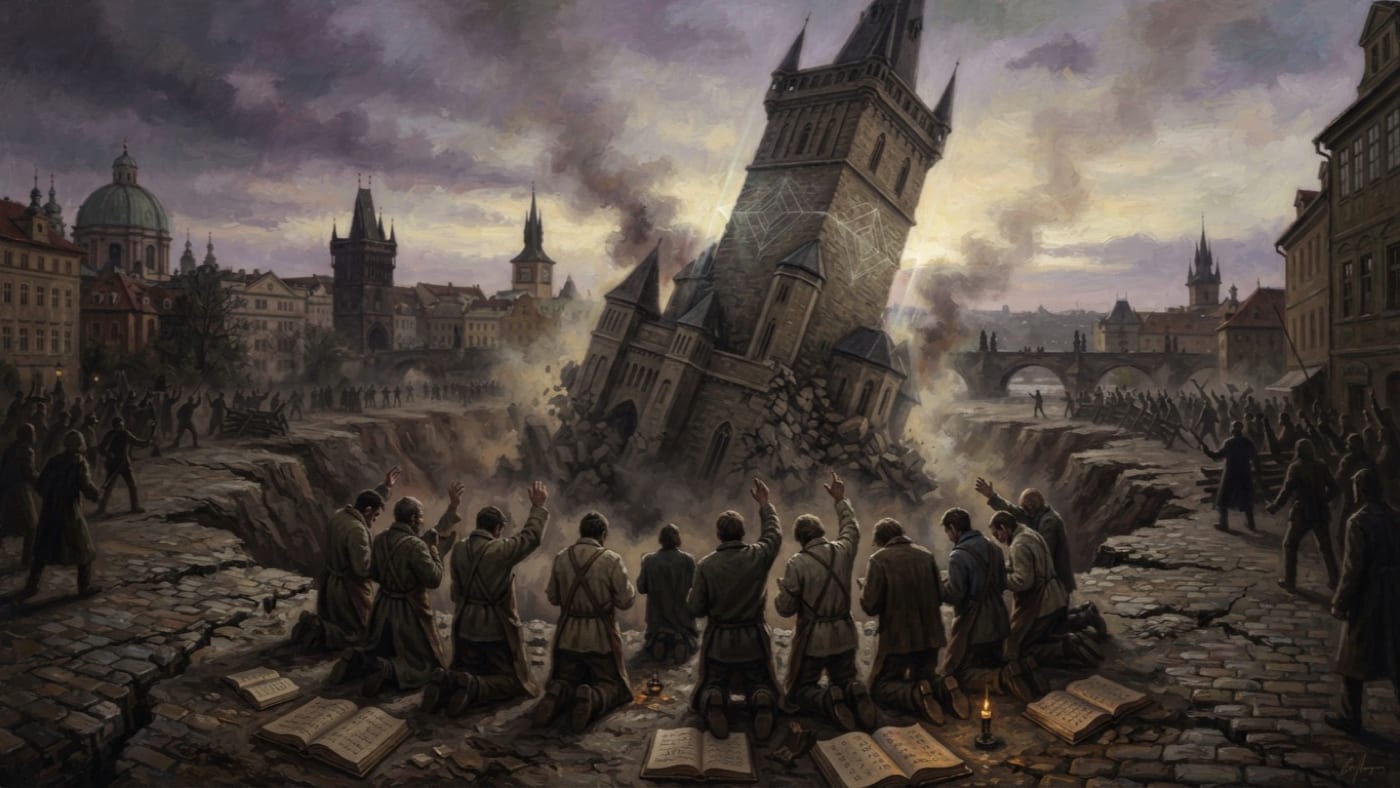
They tunnelled under the city's stones.
Consider what that sentence asks of twelve men. Prague is an old city. Its stones were laid over earlier stones, which were laid over rubble, and the rubble sits on a city older still. Every yard of that tunnel was dug by hand, under streets that Rationalist patrols were walking, toward a tower its defenders were watching from every side but below. Overhead the guns went on proving that shells could not reach it. Underground the Twelve worked at it from the one direction the wards had not been built to face, or so I infer. The accounts make no claim about the wards' geometry, and I will not supply one.
They dragged their powder with them. The sources call it unstable, and they have no reason to exaggerate. Unstable powder in a hand-dug tunnel, under a city, in the dark, carried by men who were also singing. A war artist would paint the dawn. I find it harder to think about the hours before it.
They sang the whole time, and that is where the operation becomes something only this profession would attempt. The psalm was continuous. They kept it going by alternating voices, so that whenever one throat failed another was already carrying the line and the psalm did not falter. No single man sang for months without stopping. That is a legend, and the Engineers who tell it should know better. The relay never stopped, though, and its cost is recorded plainly: their throats bled. They went on singing with bleeding throats. The account says the psalm did not falter "not even" then, and it is the only place in the passage where the old compiler sounds moved.
At dawn the observatory folded into the earth.
I have read that sentence in four compilations, and none of them adds a thunderclap. The Lore Book offers no fireball, no flame in the sky, no fragments raining onto the Vltava. The tower folded. The ground took it, in the old compiler's words, "as if ashamed of its own existence." The account records collapse, inward and downward, at first light, and gives no fuse sequence, no charge weight and no explanation of how wards that had turned shells for months failed to turn whatever came at them from below. The Bureau of Engineering's catechists teach that detonation is the Engineers' sacrament and the thunderclap their amen. The amen at Prague, if there was one, has not reached the record.
#On the Finding
"Subsidence." — Rationalist archives, on the same event
Two findings were entered on the collapse, and neither has been withdrawn.
The Rationalist archives blamed subsidence, or "subsoil instability" in their longer form, which is how a man of reason writes when he wants to sound measured while the ground under him shifts. The Lore Book's narrative history adds that they put up a plaque commemorating "scientific sacrifice." No account I accept records when it went up, who carved it or where exactly it hangs. The same history records what the people of Prague did with it: they spat on it, and they made the sign of the cross as they passed.
Doctrine declared a miracle of hymned calculation. In A.S. 61 the Bureau of Doctrine did not yet exist under that name or under its charter, so the declaration belongs to the authority that later inherited the event and wrote it into its histories. Doctrine's phrase has two halves, and each interested office reads the half it prefers. Preachers lean on "miracle." Engineers, I have noticed, lean on "calculation," and they say the word the way a surveyor reads a plumb-line, as if it can only come out one way.
I am a servant of the Church, and I have no reason to be fair to a plaque. Even so, the Rationalists picked the word "sacrifice," and they picked it about the wrong side. Twelve men sang in a hole until they bled. The observatory's defenders lost a tower. If anyone at Prague was sacrificed to science, it was a tunnelling crew, who worked their arithmetic in the margins of a psalter and paid for it in throat.
Older compilations set the Sundering within A.S. 51–100 and listed the Prague Collapse in the same run of years as the Night of Knives at Kraków (A.S. 58) and the action at Aachen (A.S. 66).
The Sundering is fixed at 1 November A.S. 45. The Night of Knives at Kraków belongs to A.S. 18, and Aachen to A.S. 25. The Prague Collapse stays at A.S. 61, a date supported independently by the chronology and by the profession's own account. Its neighbours in a faulty chronology establish no sequence of cause between those events.
#On the Fissures
The observatory fell a hundred and forty years ago. The ground it fell into has not settled.
Fissures run under the streets of Prague near the place, and they hum. The Lore Book calls the sound "faint counter-songs," and I keep the phrase because I cannot improve on it and will not pretend to translate it. I do not know whose voices those are, or whether they are voices. I do not know whether the psalm the Twelve kept up through the night simply failed to end. The old compiler wrote that "the truth lies" in those fissures. It is a fine sentence. It also commits the fissures to testimony they have never been called to give.
How many of the Twelve came back up that tunnel, no account I accept says. The Bureau of Engineering lists the Prague Collapse first among the profession's achievements and names none of the men who achieved it. Their trade asks a man to give his voice before it takes his hands. At Prague it took their voices in a single night, and the record keeps the bleeding and leaves out the rest.
The Rationalist plaque still says sacrifice. The Bureau of Doctrine still says miracle. The Bureau of Engineering lists the event and declines to explain it, and in that office declining to explain something is a way of keeping it filed. The ground says nothing anyone has officially transcribed. It goes on humming.