
#On the Converted Cloisters
"Three days can fix anything." — Saying of the pilgrim road
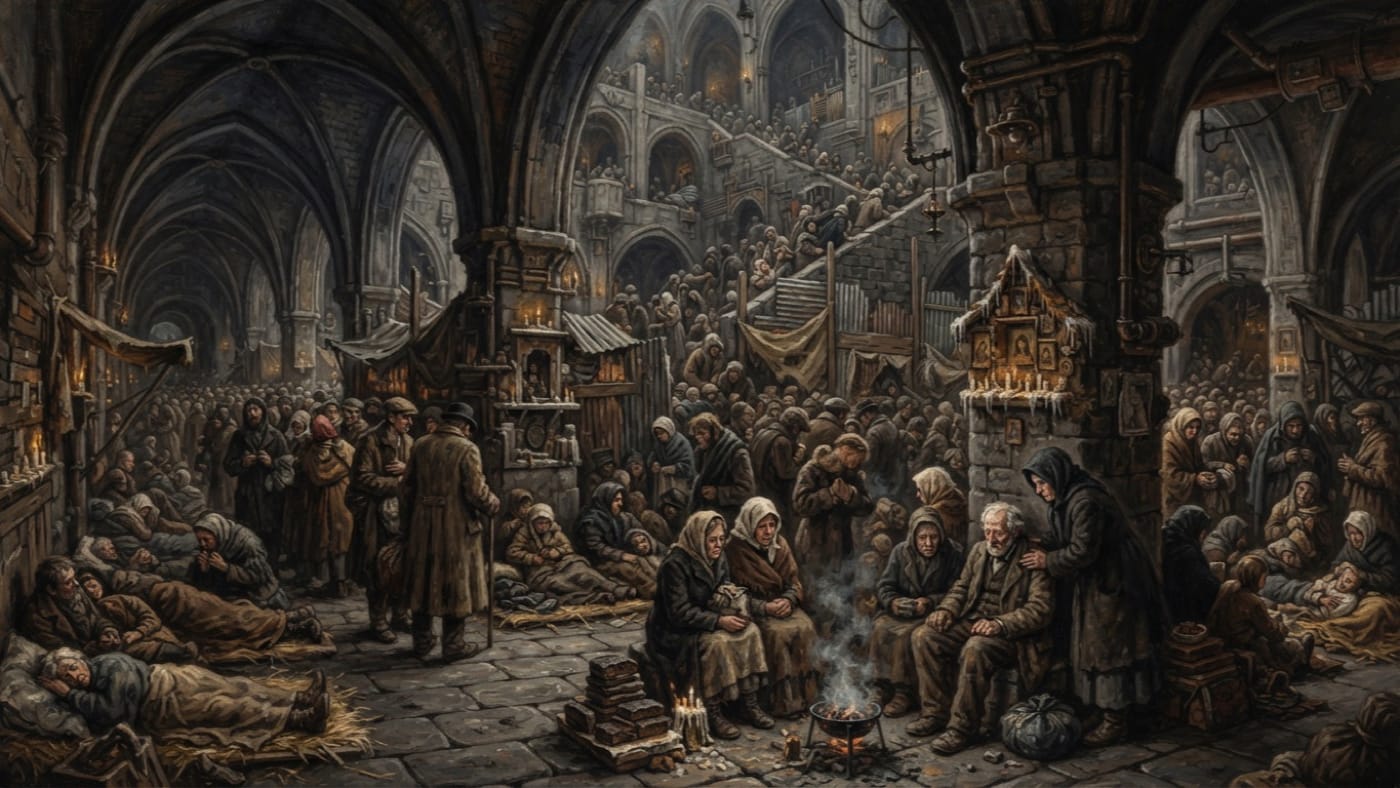
The Pilgrim Dormitories of the Ember-Priory of San Vesta sprawl through converted cloisters on the priory's terraced basalt rise, above the Cinder Markets and below the Ledger Cloisters. This is the district where the Synod keeps the people it has not yet decided what to do with. The cloisters were built for contemplation. They now hold bodies at a density contemplation never anticipated. Arcades that once framed a quiet walk now frame bedrolls and travel bundles. Iron grates meant to admit air admit soot. The basalt holds the heat of the ovens and gives it back at night, so that a pilgrim lying on a cloister floor sleeps on stone faintly warm as a hand, if sleeping is the word.
The district smells of sweat and prayer wax. Visitors who expect the yeast of the Great Ovens are disappointed. The bread is baked elsewhere, and the dormitories receive only its rumour. Every niche that can hold a stub of candle holds one. The wax runs, cools, is scraped and remelted, and runs again. After hope, it is the most diligently recycled substance in the district.
Older residents call the place the Maze, and the Bureau of Records has not troubled to object. Passages turn back on themselves. Cloister walks end in partitions of slag-glass and kiln-ceramic that someone put up for a reason the Ledger Cloisters did not record.
The pilgrims arrive by the stamped pilgrim road, past gate scribes and infirmary screeners, and a great many arrive carrying someone: a mother on a litter, or a brother who coughs grey. They have come for resurrection-bread, and they have been told the dormitories are temporary.
The dormitories are temporary in the sense that the pilgrim is.
#On Names and Rations
Nobody at San Vesta governs the dormitories, and everyone does. The Priorate Council, under Prior Celestín of the Third Ember, holds the doctrine by which a pilgrim's waiting is declared meritorious. The Infirmary Tribunal decides whose relative is admitted to treatment, and in what order. Sister-Physic Marra Vell, who runs Ward Seven, controls a good part of those triage lists. The Oven Quartermastery, under Quartermaster Odran Ashweight, holds the flour and the coal. A pilgrim in the Maze answers to all three and can petition none of them directly. The arrangement has the elegance of a confessional with three screens and no priest.
Food comes through the Flour Gate, which has one road and one ledger desk, and the dormitories eat ash-bread like everyone else: grey, dense, durable, adequate. It is issued against ration chits and stamped bread tokens, and each token carries the bearer's name. At San Vesta your ration is your identity. A pilgrim who loses a token goes hungry. In the assessment of the Ledger Cloisters, that pilgrim also becomes administratively absent: present in the body, coughing in the cloister walk, and nowhere in the books. The Ledger Cloisters' schedules decide when the issue comes. The waiting in between is the pilgrim's own affair.
Cure priority can be bought, and so can bread portions. A family that arrived with savings spends them in the Maze, on medical priority slips and an extra loaf. A family that arrived with nothing finds out what it has instead: hands, hours, and a signature.
#On the Price of Three Days
"Eat the ash. Keep the oath." — Inscription above the Flour Gate
Two breads come out of San Vesta, and the dormitories learn the difference faster than they learn the catechism. Ash-bread is the ordinary ration. It keeps for years and promises nothing beyond the next shift. Resurrection-bread is issued to the dying by the Tribunal, under restriction, and it postpones death for three days. It cures nothing. The illness that brought the relative up the pilgrim road stays exactly where it was, only deferred.
The pilgrims know this, and they come anyway. Three days is enough to settle accounts, write a letter, or sit at a bedside one had expected to miss. Some recipients outlive the reprieve. The priory does not promise that any particular recipient will, and the dormitories have learned not to ask the Sister-Physics for that promise.
The price is recovery service, and for resurrection-bread the oath is lifelong. Its terms run past the third day into whatever life the recipient has left. They are written on a template the Bureau of Oaths would recognise, because it is the Bureau's own. Patients treated at San Vesta owe labour in the ovens, the kilns, the canalworks, or the dormitories themselves, until the ledger says the body is paid. The ledger is slow to say so.
So leaving the infirmary does not mean leaving San Vesta. A pilgrim who came to wait on a relative can find themselves, months later, working the same cloister walk they once slept in, under the same tokens, now on the issuing side. The Maze is the one district of the priory where the waiting room and the workforce share the same stone. Nobody in the dormitories speaks of the fourth day. The priory forbids it, and the pilgrims, who have reasons of their own, comply.
#On the Vigils
The dormitory preachers call the bread's takers the Third-Day Debtors, and some of them have turned the name into a congregation. They organise in the Maze. They hold vigils in the cloister walks, wax pooling at their knees, and they press the Tribunal for wider access to resurrection-bread. The Tribunal restricts it in the name of "theological stability." Prior Celestín has twice authorised increased production, and demand has outrun both increases. The vigils grow with every new arrival who comes up the road with a dying relative and a willingness to sign.
Their methods are crowds, pressure, and the example of their own martyrs. They recruit where recruiting is cheapest: among the newly arrived, at bedsides, and in the hour after a triage list goes up without the expected name on it. I have been shown no record that names a leader. The parent survey observes that the arguing is done with an organisational coherence suggesting someone is doing it on the dormitories' behalf. The Bureau has noted the suggestion. The Bureau has not been introduced.
Most pilgrims on the floor are not Debtors. They are what they appear to be: people with a sick relative, a token, and no plan beyond the next issue. The vigils draw on them the way a bell draws a parish, simply by being heard.
The sellers move between the faithful and the desperate. Bread fragments change hands in the Maze along with sedatives and counterfeit triage slips, traded with the urgency of secrets. The Tribunal has not said in public what a fragment does, so the sellers say whatever the buyer needs to hear. A crumb of violet crust buys an evening of belief. Whether it buys anything more, the Bureau of Purity has declined to certify, and so must I.
#On Heat and Custody
The Maze kills the way crowded stone always kills. A rumour of bread at one end of a cloister walk moves the floor faster than any provost can. Passages that turn back on themselves turn crowds back on themselves too. The dormitories are known for crush deaths. The records I have consulted give them no date and no count, which is a kind of record in itself.
Heat does the rest by degrees. Pilgrims suffer heatstroke and dehydration. The ember winds carry ash in, and it is breathed by people who cannot afford a cool mask. The masks come from the Cool Mask Brotherhood, a mutual-aid network working out of the canalworks and the lava-tube underpaths below. For those who ask the right questions, the Brotherhood offers routes as well as masks. It smuggles medicine and people out of the quarantine zones the Tribunal locks down. The Bureau of Purity knows better than I do where its tunnels lead, and whether any begin in the dormitories at all. It says less.
Pilgrims see the heat-visions too: doctrine written as moving text in the shimmer, legible, luminous, and authored by nobody on the Bureau's register. The vision-struck are taken to the Cool Rooms, deep in the basalt, until the text fades. What writes it remains unclassified, as the Bureau of Doctrine prefers. The pilgrims have opinions. The priory's advice is older and plainer: if the smoke writes you, don't read it.
An earlier draft of this entry borrowed the Bureau of Mercy's former description of the Scorch-Cure Infirmary, "a model of compassionate efficiency," and applied it to the waiting district the infirmary draws from.
The Bureau of Mercy has revised its assessment of San Vesta. The current classification is "efficient." The adjective has been withdrawn here as well.
#On the Present Condition
This entry supplements the survey of San Vesta's condition as of A.S. 201 (1911 CE). It reports that survey's conditions and does not improve on them.
The pilgrim influx has tripled in four years. The dormitories overflow into the Cinder Markets below, where barter runs on pepper oil and ash-cakes and a family may now sleep beside the stall that sells them. Resurrection-bread remains restricted. A flour convoy from the coastal port of Vall de Sal is late, so Quartermaster Ashweight has sealed the gates and begun the count: mouths against loaves, tokens against names. In the Maze the count is felt before anyone announces it. The issue thins and the vigils lengthen. A relative on a litter waits for a triage list that the arithmetic has already drawn up.
The survey does not say what the count will find, and this supplement will not guess. The Synod has a long habit of learning its totals after the fact.