
#On the Market's Situation
"Paper buys bread; tunnels buy freedom." — saying among San Vesta's less devout economists
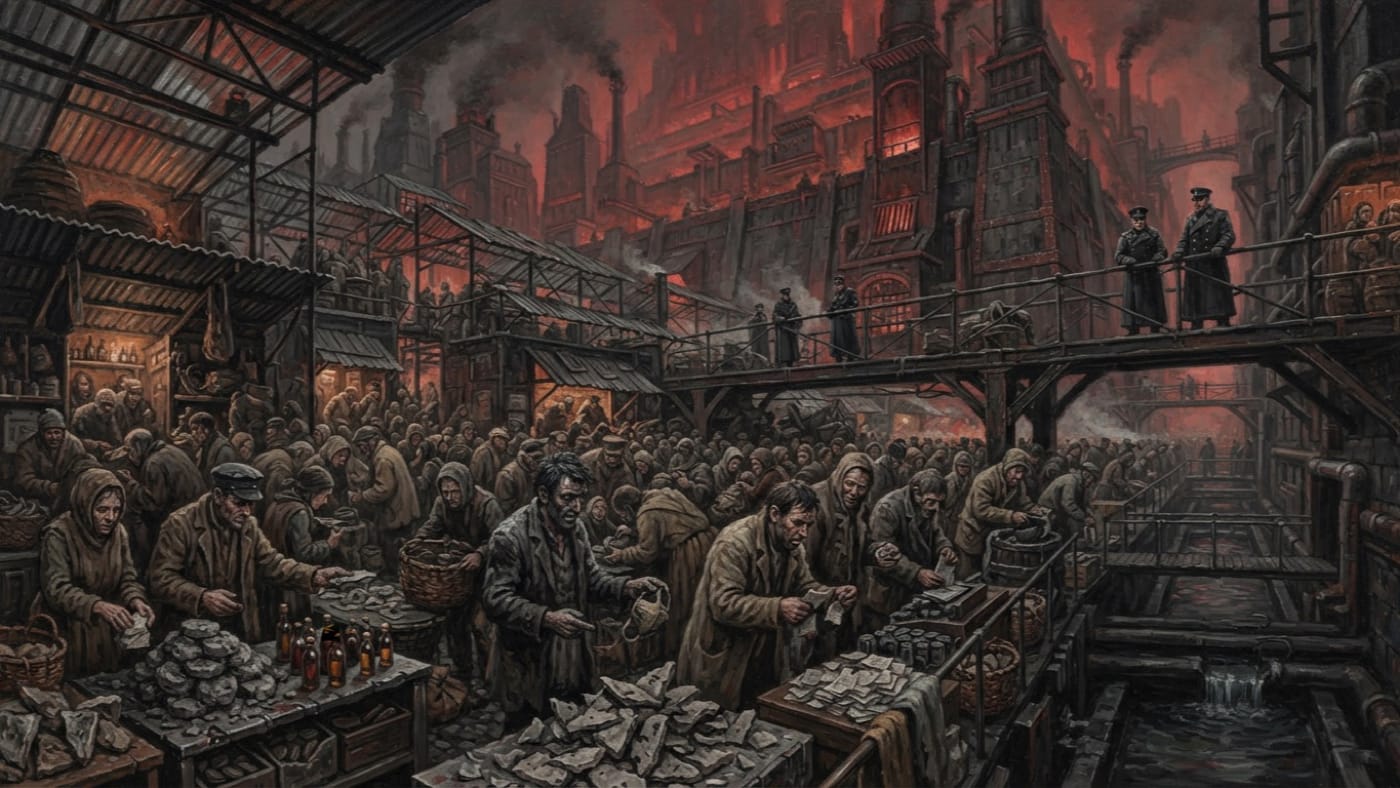
The Ember-Priory of San Vesta climbs its heated basalt rise in terraces. The priory sits at the top, the ovens in the middle, and the wards and the poor further down, where both gravity and the Ledger prefer them. The Cinder Markets occupy the base. Below them, the Ash Canalworks carry cooling water and wet soot away through channels cut in the lower rock. Above them, the Great Ovens glow red through a heat shimmer that does not lift even in winter. Whatever falls from the upper terraces reaches the market eventually: soot, runoff, gossip, pilgrims.
The district trades by barter, and its signature goods are pepper oil and ash cakes. The oil is sold in small vessels, and its smell is sharp enough to cut through the yeast drifting down from the ovens. The ash cakes are grey and dense and sold everywhere. Their composition appears in no ledger I have been shown. An ash cake is not Ash-bread, the durable grey ration the Bureau of War buys by the thousand loaves. The market keeps this distinction more strictly than some quartermasters do, because ash-bread belongs to the Quartermastery and a cake belongs to whoever baked it.
Most of what changes hands here is lawful and dull: food for food, labour for food, a mended apron for a cake and a measure of oil. San Vesta is a working town of basalt brick, iron grate and slag-glass, and working towns eat. The ember winds lay soot on the counters in steady sheets. Nobody wipes the cakes. Nobody could tell the difference.
The crowds are thickened by overflow from the Pilgrim Dormitories, where the people who came for the bread of the third day sleep in shifts and wake hungry. They come down with nothing to barter except their hands and whatever their families packed for them. The market takes both.
#On Bread, Tokens, and Names
San Vesta circulates four instruments of value: ration chits, stamped bread tokens, oath-notes and medical priority slips. None of them is pepper oil. A vessel of oil belongs to whoever is holding it. A bread token belongs to the name stamped on it, and the person holding it merely has custody for now.
This is the Ledger Cloisters' great contribution to commerce. Your ration is your name. A man who loses his token goes hungry, which is ordinary. Then he becomes administratively absent, which is a different matter. The Cloisters bind ration to identity and identity to work schedule, and without the token they find no proof that he exists. The Bureau of Records does not accept an empty stomach as evidence of a living subject. A token can be passed across a market counter in the dark. The name stays with the man it was issued to, and so does his absence. In the Cinder Markets, a counterfeit token forges a loaf and a person at once. The priory lists it among its crimes next to bread theft and triage fraud.
Every crumb sold in the district first passed through the Flour Gate: one road, one ledger desk, and one clerk whose stamp decides who eats. The market has no flour of its own. It has bread that was issued to someone, broken up and carried downhill. The bread shards that circulate here are pieces of named entitlements, snapped off and traded for oil, for cakes, or for an hour's relief from a shift. The ledger records the loaf and has no column for the shards. The local cant has a word for the debt that follows them: flour-shadow, the hidden tax that trails every loaf.
Labour comes before bread. San Vesta's quotas are tied to rations, so a stoker who misses his shift also misses his chit, and a man without his chit comes to the market with only what he can sell. Bread portions can be bought through the priory's less upright channels. This corruption is documented, deplored and continuing. What the market adds is distance. A portion bought at the Flour Gate costs a bribe and requires showing your face. A shard bought at the market requires neither.
#On the Price of Relief
San Vesta measures wealth in calories, pain relief, heat access, triage rank and clean lungs. The Cinder Markets trade openly in the first and quietly in the rest.
The cause is recovery service. A patient cured in the Scorch-Cure Infirmary owes labour shifts until the ledger declares the body paid. Only a body that can stand a shift can pay a debt counted in shifts. The priory's ordinary hazards are ash-lung, scald burns, dehydration and heat that sits on the skin like a poultice. No one designed them, and everyone is charged for them. A debtor who cannot breathe cannot stoke. A debtor who cannot stoke falls behind. The market sells against that arithmetic.
Cool masks for ash-lung change hands here, cloth and charcoal against the soot. So do sedatives, for workers whose pain has started to interfere with their schedule. Counterfeit triage slips are rarer and cost more. The triage forger sells life in small squares of paper, and the paper passes often enough to keep the trade going. San Vesta's own record of corruption admits that cure priority can be bought. Two things cannot be. Only the Infirmary Tribunal may grant a relapse exemption, and Tribunal signet wax is not available at any price the market has found.
Then there is the other bread. Resurrection-bread (Unregistered) gives a dying person three more days. It does not cure them. Anyone who accepts it signs a recovery-service oath that runs for the rest of their life, on a template the Bureau of Oaths would recognise. The Tribunal restricts access. Selling the bread outside the priory is one of San Vesta's red lines. Selling it inside does not become lawful as a result, and the crumbs that reach the market are contraband.
Nobody knows what a crumb buys. The Tribunal has issued no dose for a crust, no rate of reprieve per ounce and no table of hours against fragments. Nobody selling a shard of the violet-edged loaf can tell the buyer how many days it holds. The buyer pays anyway. He is buying for a relative who cannot climb the terraces, and the market has always known that a man in that position does not haggle.
"Resurrection-bread is a gift."
Resurrection-bread is given in exchange for an oath of recovery service lasting the rest of the recipient's life. This survey corrects the public phrasing. The pilgrims may go on saying it. The Ledger Cloisters will go on billing them.
#On Inspection and the Underpaths
The Cinder Markets answer to the Priorate Council, the Infirmary Tribunal and the Oven Quartermastery jointly, and to none of them in particular. Prior Celestín of the Third Ember holds the doctrine stamps the Bureau of Doctrine recognises. Sister-Physic Marra Vell holds the triage lists. Quartermaster Odran Ashweight holds the flour and the coal. No record I have seen names any of them governor of the market, yet each can reach into it. The Prior reaches through what may be preached there, the Sister-Physic through every slip that claims her ward's authority, and the Quartermaster through every crumb.
The hands that do the reaching belong to the priory provosts, whose boots ring on the hot tile, to the infirmary marshals, and to inquisitors posted under the title of hygiene auditors. The title is accurate. They audit hygiene the way the Bureau of Purity audits souls, with a list.
The lava-tube underpaths run beneath the lower terraces, and the Cool Mask Brotherhood moves through them. By its own account it is a mutual-aid society. Everyone else calls it a smuggling network. Its territory is the canalworks and the tubes. Its masks surface in the market, and by report so do its forged slips. The people it carries out of the quarantine zones travel below the counters, and the market has learned not to listen at the grates.
The Bureau of Purity has mapped the mask channels and left them open. Closing them would stop the masks, which would stop the workers, which would stop the kilns. That tolerance covers masks. It does not cover forged triage slips, smuggled patients, or the tunnels themselves, which the Bureau seals from time to time and finds replaced.
The Third-Day Debtors organise in the dormitories, not the market, but their pressure travels downhill with the pilgrims. Every vigil for wider access to the bread sends another crowd into the Cinder Markets asking for crumbs. The counter-slogan whispered in the dormitories is whispered here too, between the oil and the cakes: Stamped mercy still burns.
#On the Present Condition
At this survey, in A.S. 201 (1911 CE), the dormitories are overflowing, and the overflow comes down to the market. The Tribunal still restricts resurrection-bread. Production has been raised and demand has outrun it. The black market in fragments that the restriction created has spread from the dormitory maze to the market counters, where it sits among the ash cakes looking like what it is: evidence. At San Vesta, ash-bread crumbs serve as medicine and as evidence. The market's customers prefer the first use.
According to the priory's survey, a flour convoy from the coastal port of Vall de Sal was three days late, and Quartermaster Ashweight had sealed the gates and begun counting mouths against loaves. The count reaches the Cinder Markets last and hits them hardest. Every cake on the counters, every shard and every chit is a claim on bread that passed through the Flour Gate. When the Gate tightens, oil is still priced in oil, and everything else is priced in bread that has not arrived.
Up the terraces, the Synod's ovens keep their schedule. Down here, the pilgrims barter their hands.
Nihil obstat.