
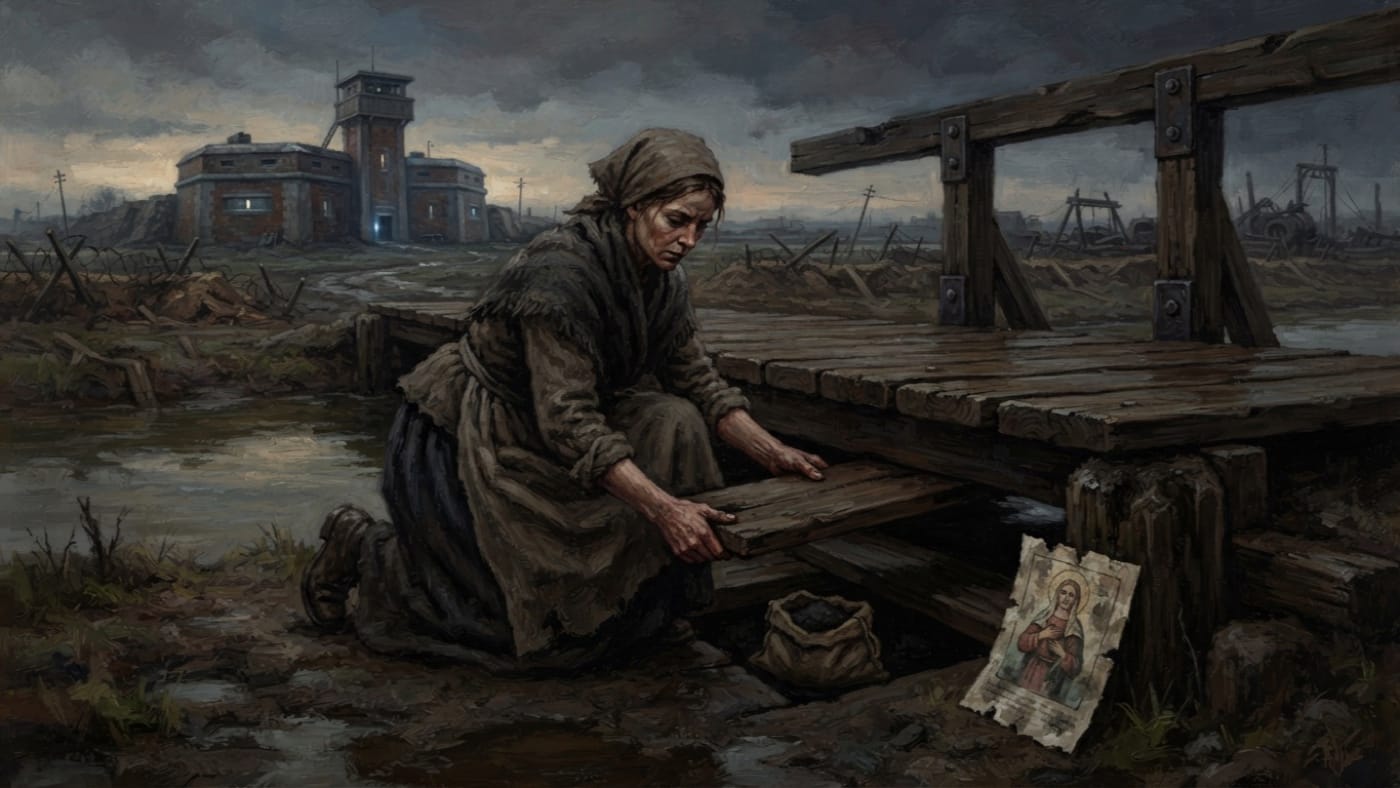
#On the Region in the Record
Picardy is a northern region of France, in the western heartlands the Church now keeps behind its eastern defences. It is in this Codex because of one sentence. That sentence comes from the published record of the Sisters of the Martyrdom, and it concerns a woman, an image, a bridge plank and some powder. It concerns nothing else.
Readers who came for a provincial gazetteer will be disappointed, and I do not mean to console them. The Ledger holds no Picard charter for the Sisters, no Picard abbess and no Picard muster of grey habits. It does not fix the region's boundaries, name its towns or count its parishes. Surveyors deal with those matters, and the surveyors have not consulted me. What the Ledger holds is a wartime trace. By the early years of the Atheist Wars, the memory of a murdered nun had reached the north and had given someone ideas about a crossing.
#On the Image from Saint-Malo
The Massacre at Saint-Malo took place in A.S. 10, which is 1720 by the reckoning of men who still count from elsewhere. Sister Margaux died there: old, small, unarmed, and cheap to print. In A.S. 14 she received her early ecclesiastical recognition from a Church that had not yet learned to call itself a Synod. Her ratification by the Bureau came later, under seals that did not exist when the first prayers were said over her. Sermons confuse the two events often. I do not confuse them here.
By A.S. 15 her image was in circulation. The published record says so and says little more. It does not name a printer. It does not say whether the image was a woodcut, a broadsheet, a painted card or a pious smudge on the back of a ration chit. Nor does it say who carried it north, by which road, or at what price. More than once I have been asked to supply these details so the entry will feel complete. Completeness is the vice of men who mistake a full page for a true one.
The record does establish an order of events. The woman saw the image, and then she hid the powder. The Ledger records which act came first and says nothing of what joined them. Whether the Creator moved her or only the print did is a question for confessors, and she did not leave one behind.
#On the Powder Beneath the Plank
The whole Picard record reads: a woman in Picardy saw Margaux's image and hid powder beneath a bridge plank.
Every word of it has to carry its own load. Her name is unrecorded, and so is her age. The record does not say whether she was a wife, a widow, a servant, a farmer, a nun, or simply a woman who could get powder and had a reason to stoop. The bridge has no name in the file. The river, if there was one, has none either. The powder has no quantity and no source. Of its quality we know only what is true of all the faithful's powder in those years: it was bad.
The sentence records a concealment. It does not record an ignition, a collapse, a halted column, a dead officer or a burned woman. Powder under a plank is a preparation. Preparations make up most of any war and very little of any hymn. If a reader wants to finish the sentence for her, with a pillar of fire, a stopped column and a grateful bishop, let him find the folio that says so. No such folio exists.
Crossings mattered all the same. In the opening years of the war the Rationalists moved by road and by span, in columns that needed stone under their wheels. The faithful had fewer guns, and they learned that one denied crossing was worth a company of men they did not have. Lifting a plank and laying it back over a charge is the humblest piece of military engineering in the Church's history. It is also the only such act the archive places in Picardy.
#On Three Separate Beginnings
The same passage that names her region names two others. A widow near Lyon saw the image and refused to leave a ferry chain. A novice outside Angers saw it and wrote I shall be the lock in the margin of a psalter.
That makes three women, three places and three files. The files have never been joined, and nothing in them invites it. The record shows no letter between Picardy and the south, no courier between the ferry chain and the psalter, and no chaplain who visited all three. The devotional writers grow restless at this point. Three women moved by one face make a much better sermon if somebody moved them together, toward some goal. The archive cannot oblige.
The three records show that the response was scattered. Margaux's memory spread outward from Saint-Malo and reached different women at different crossings. Each answered with what she had: powder in the north, a refusal at a chain near Lyon, ink in the west. A Bureau that wanted to found an order on this evidence would have to found three. It has founded none.
#On the Order That Followed
The first action the Codex confirms for the Sisters took place in the Montreval approaches in A.S. 15. At the Pont des Tanneurs, three women in grey destroyed the crossing and cost Lucien Artois's column six hours. That bridge burned. It burned far to the south of Picardy, it belongs in Montreval's folio, and no northern parish may borrow its women, its timbers or its delay.
The order is attested from A.S. 15 to A.S. 25, with an early peak between A.S. 15 and 18. Its members had a grey habit, a vow, a taper and oil. As far as any record shows, the Picard woman had a plank and powder. Nothing in the record puts the habit on her, the vow in her mouth or the taper in her hand. Nor does it say she meant to burn with the bridge. Enrolling her after the fact would be the cheapest kind of canonisation, performed by an archivist with a pen and too little patience.
She belongs in the Sisters' history only because she appears in the passage about where they came from. She shows the climate the order grew out of. That is evidence about a climate. It is not evidence about an order.
The Bureau of Shadows keeps a later dossier under Seal Obsidian. It credits the order's early organisation to Kratz, who was seven years old in A.S. 15. The dossier names no Picard handler and no Picard woman. Its silence about the north is the one point on which I have found it reliable.
The Sisters' file always sets their zeal against their lack of authority, and in Picardy the contrast is sharpest. The Sisters were celebrated for doing what no commander had authorised. The Picard woman did something smaller, also unauthorised and with no recorded result. Her celebration has been smaller to match, which is to say there has been none.
#On the Limits of Recognition
The Sisters remain an unratified order. Their local cults are tolerated, and ash attributed to them is treated as provisional, case by case. Those allowances cover the order in general. Nobody has brought a case for Picardy, so there is no Picard ruling and no Picard relic. Nor is there a feast for a woman nobody named. The Bureau of Doctrine does not grant feasts to the anonymous on the strength of a plank, and in this one instance I find the Bureau's stinginess correct.
The question that troubles the Sisters' file most is consent, and it cannot be settled for her. The file asks whether each woman chose, was pushed or was used. It asks this of women whose names, bridges and final hours are on record. Of this woman we have one act and one prior sight. Calling her a willing martyr assumes an intent the record never gives her. Calling her an instrument assumes a hand the record never shows. Either verdict would be invented.
A.S. 92 instructional materials stated that "all Sisters of the Martyrdom were free volunteers, moved solely by divine inspiration."
Corrected for internal editions only. The statement is withdrawn as a universal claim, and consent must be judged woman by woman, on evidence. It may not be applied to the Picard woman in either direction. She has not been shown to be a Sister, and nothing about her motives is recorded beyond the image she saw.
The folio stays open at one sentence. In this Codex the region's only monument is the plank, and nobody knows where the plank is.