
#On the Name
"Water first, then the toll, then the prayer. The order has changed. The toll has not." — saying of the Cistern Chapel steps
Peregrin is one of three households, with Voss and Haelke, that the published account of the Echo Creed places at the beginning of Peregrine Row. Before there was a Synod to charter anything, there was a cistern, a shrine, and these three families taxing water and passage in a canyon where nobody could avoid either. The record ends there. It is short, and it is also the first line of every ledger the Row has kept since, whether the ledger admits it or not.
The Codex treats the Peregrins collectively because the source does. They appear as one name in a list of three, joined to the others by a single verb. They taxed. I have found no ancestor to set at the head of the house, no foundation year, no crest, no charter of inheritance and no deed dividing cistern from gate among the households. I will not commission one. A family may be entered in the Ledger on the strength of one verb, provided it is the correct verb.
#On Water and Passage
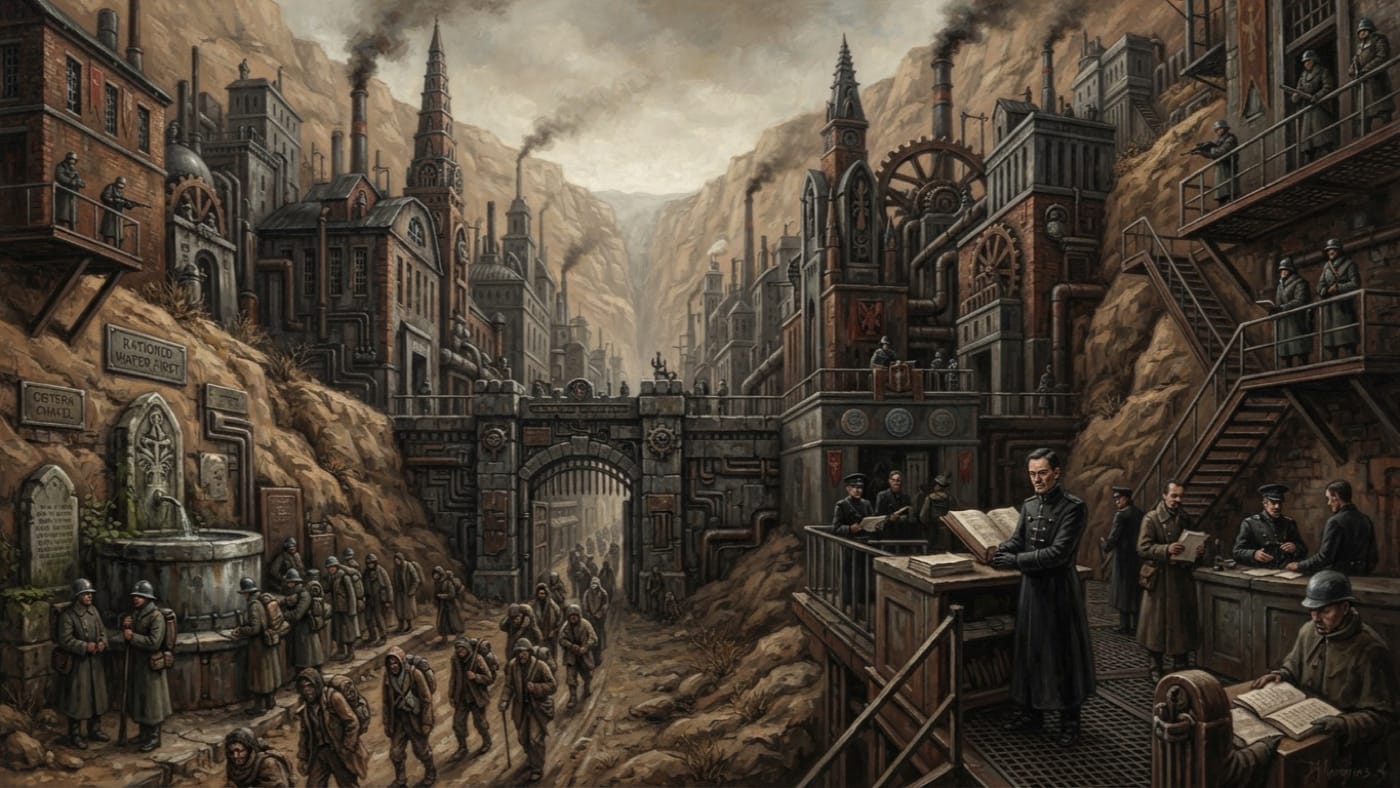
The Row is a canyon throat between two ambush canyons on the Pilgrim Roads, in Zone 1/2. Its approaches are confined. Ridges of dry scrub rise on both sides. Beyond the narrows the road forks toward three sanctuaries, and every traveller bound for any of them must first pass under the same stone and past the same spring-fed cistern. No flank opens. A mule cannot be persuaded to climb a cliff for theological reasons.
Geography wrote the first tariff. A traveller who had walked the approach arrived dry, and the only water in the corridor stood in one hollow. A traveller who meant to go on had one lane. Whoever stood beside the cistern and across that lane held two things a pilgrim could not do without: the next mouthful and the next mile. The families held both. The record does not say which household kept the water and which kept the road, or whether any such division existed. It says the three taxed together, and the Codex leaves them together.
The shrine deserves its own line. It was a rest shrine, modest in every surviving description, set where tired people sat down. Old shrine stones remain in the tunnel pockets of the Row, along with fragments of hymns carved into the rock that the Road Chapter has since found reason to forbid. Shrines have stood beside tolls for a long time. The traveller prays because he is thirsty and pays because he is thirsty, and afterwards he cannot reliably say which he did first.
#On Licensed Authority
The toll was already old by the time the Church acquired a constitution. The Concordat of Strasbourg constituted the formal Synod in A.S. 90 / 1800 CE. Four years later, in A.S. 94 / 1804 CE, the Road Chapter of Peregrine received authority over transit, devotion and syllabic compliance in the canyon. It is the first date I can certify at the Row. It belongs to the Chapter. It does not belong to the Peregrins, whose arrangement came before it by an interval no clerk recorded.
What changed in A.S. 94 was the grammar of the toll. Under the households, the charge followed the water and the road. Under the Chapter, it followed the tongue. The Road Chapter took the recitation tests, the audits and the permits. The licensed brokers, later gathered into the Choir-Broker Compact and its council, took the pricing of protection. Gate authorities took the gate. Licensed escorts took the swords and the routes. The Bead Courts took the arithmetic of sin, and the Quiet Pen Wardens took whoever the arithmetic left over. One cistern had become six offices, each with its own seal and its own reasons for disliking the other five.
The founding household is identical with none of them. Secondary claims reach the Codex that the three families were folded into licensed administration at the charter, under a Cantor-Auditor sent down from Strasbourg. The charter year stands. I cannot find the terms of any settlement with the households anywhere I can reach. The site itself proves institutional continuity: the same cistern, the same narrows, the same fee in a better hat. Hereditary continuity is a separate proposition, and it requires papers.
#On the Enlarged Toll
In its settled form, the Chapter's procedure runs in a fixed order. A pilgrim recites the Creed at the Gate of Clean Tongues. The proctor hears the recitation, and two breaths later he hears the canyon's return. Any discrepancy enters the bead tally. The Bead Courts turn the tally into sin weight, sin weight into unreconciled status, and unreconciled status into a fee. An unpaid fee becomes detention in the Quiet Pens. A detainee who cannot be redeemed is assigned to service, and the parent account follows those labour contracts as far as the depots of the Sagittal Line. Water is still rationed at the Cistern Chapel, under blessing.
The original tax was crude. The pilgrim drank or walked, and the pilgrim paid. The enlarged toll keeps the same choke point and lengthens the chain hanging from it, one link at a time, until the bill for a cup of water and a mile of road has become a bill for a man's labour on a distant front.
The first great catastrophe of the chartered Row came in A.S. 101 / 1811 CE. Six hundred pilgrims entered the eastern approach, and two hundred and fourteen of them died in an ambush. The survivors were fined for doctrinal negligence. The record names no one who commissioned that ambush, and neither do I. The Canyon Saints have their own entry and keep their own counsel. By A.S. 110 / 1820 CE, bead reconciliation and escort contracting had hardened into daily procedure, carried out by clerks who no longer remember that anyone ever decided it.
The households appear nowhere in that sequence by name. No instrument I have inspected lays any of its acts against any Peregrin, living or dead. Their contribution was older and plainer. They found the place where a traveller must stop, and they charged him for stopping.
Early Peregrine files attribute vowel deviation at the gate to defects of the speaker.
Corrected. The stone was joining in the recitation before anyone thought to list it as a witness. Fines issued under the earlier reading stand, the speakers having been present.
#On the Name at the Gate
The surname survives at the Row in one documented office. Cantor-Auditor Selm Peregrin is counted among its principal powers. He has a soft voice and a sharp ear, and he is said to hear profit in a mispronunciation the way a bell-founder hears a crack. His leverage is Creed legitimacy and detention quotas. His fear is heresy contamination, which at Peregrine Row is less a superstition than an occupational hazard.
He does not govern alone. Broker-Matron Lysa Vane holds the contracts and sets the prices. Captain Odrik "Ridge-Hook" holds the escorts, along with ambush intelligence whose sources he does not volunteer. Doctrine, commerce and the sword sit within shouting distance of one another and keep separate books. The Bureau calls this balance. The pilgrims call it being charged three times.
On the papers before me I cannot say whether Selm descends from the household that once taxed the cistern. The surname is documented. The descent is not, and neither is any inherited office.
#On the Recorded Legacy
The Year of Ash Rain, A.S. 143 / 1853 CE, worsened a disturbance the canyon had already begun. The Echo Creed received its Category Two Localized Acoustic-Doctrinal classification that year. The altered returns had already been troubling recitations, and in reported cases they now began to trouble written contracts too. The Bureau of Doctrine denies that the echo has doctrinal authority. The Road Chapter finds procedural uses for it. Nothing in the record makes the Peregrins its authors, its masters or its students.
In A.S. 199 / 1909 CE, compact material concerning "demonstration risk events" came to light. One account says it was recovered, another that it was leaked. The Road Chapter's investigation reported no evidence. The signatories' names remain withheld under Chapter privilege. I keep them withheld here, and I will not reconstruct them from initials, ink colour or local gossip, all three of which can be bought at reasonable prices in the cistern tunnels.
As of A.S. 201 the Row operates under Amber review, with the Bureau of Pilgrimage in general oversight. Amber classifies the disturbance. It takes no view of the family, of its present membership, or of whether it has any.
The Ledger holds a name, two partners and one verb for the Peregrins, set beside a spring in a dry canyon. The later offices built their courts, pens and contracts on that spot. They never asked the family's permission. They needed the water.