
#On the Name and the Road
"A clean tongue buys a clean road." — Peregrine Row proverb
Haelke is the third name on a short list. When the Synod's clerks set down the beginnings of Peregrine Row, they write three families, Peregrin, Voss and Haelke, followed by one verb. The families taxed. They taxed water and they taxed passage. The record has never said more than that, because that one verb explains everything that came after it.
Most readers meet the name in the file on the Echo Creed. It appears there once, in passing, like a coin found in the lining of a vestment. This entry accounts for the coin. It treats the Haelke the way the record treats them: as a group, one of three founding households of a toll economy on the Pilgrim Roads. Readers who want a patriarch, a crest, a marriage alliance or a deathbed speech will find the Bureau of Records unhelpful. The Bureau of Records will take this as a compliment.
#On Water and Passage
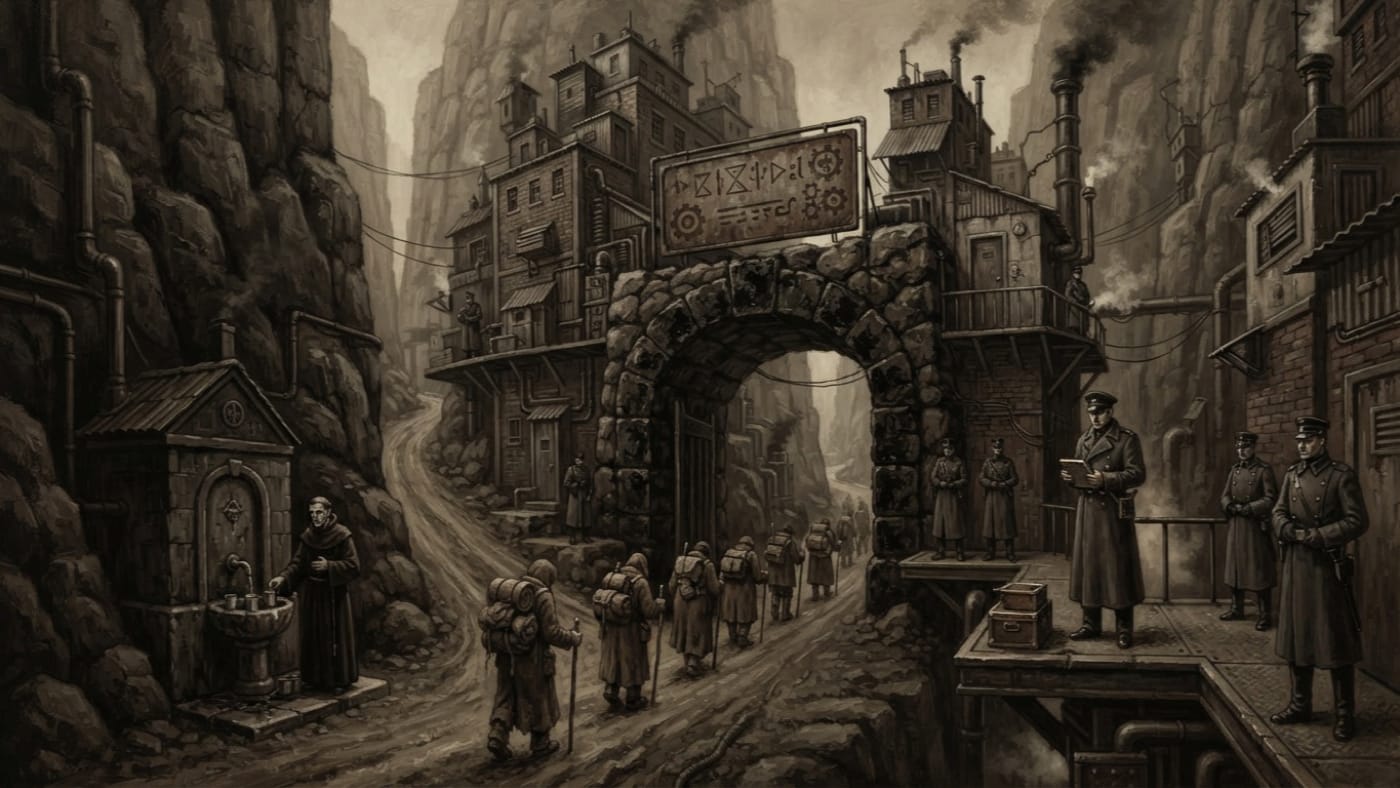
The canyon made the families before any family made anything of the canyon. Peregrine Row sits in a throat of stone between two ambush canyons, with ridges on both sides and no open flank. Everything travelling the road has to pass under one arch and past one spring-fed cistern. Before there was a formal Synod to license anything, a small rest shrine stood beside that cistern. A pilgrim who reached it had walked days of dry scrub and switchback, and a pilgrim who left it faced days more.
Geography like that is an invoice waiting for a clerk.
The three families supplied the clerks. They levied on the water and they levied on the passage. On this point the record is sober and does not divide the work among them. It never says whether the Haelke held the cistern, the gate or the ridge, or whether they were richer than the Voss or meaner than the Peregrin. The Bureau declines to share out a guilt it was never asked to invoice. Nobody recorded when the toll began. It was already being collected when the Synod arrived to admire it.
What remains of that first arrangement remains in stone: old shrine blocks, tunnel pockets under the present arcades, and hymn fragments carved into the canyon rock in a form the Road Chapter now forbids anyone to sing.
#On Licensed Administration
When a family takes tolls it is a crime. When a Chapter takes them it is a sacrament. The difference is paperwork, and the paperwork came late.
The formal Synod came into being at the Concordat of Strasbourg in A.S. 90. That constitutional settlement was made after the founders of the Church's public order were already in their graves, and it gave the Synod a vocabulary for roads. The Echo Creed file records that four years later, in A.S. 94, the Synod chartered the Road Chapter of Peregrine over transit, devotion and syllabic compliance. The canyon had charged for water. Now it could charge for doctrine.
A later summary in the Synod's general timeline, never audited by this office, says the three founding families were absorbed into the licensed broker compact when the charter came. The Bureau records that as a claim and nothing more. The transfer it describes is plausible: the family toll became a licensed trade, the family gate became a chartered gate, and the people who had collected money for water learned to collect it for safety.
The record does establish the division of labour that followed. The Road Chapter holds the creed tests, the audits and the transit permissions. The Choir-Broker Compact sets the price of insurance and protection and is governed through a Compact Council. The record does not say whether a Haelke ever sat at that council's table, in which chair, or for how long. Readers will notice that the present Cantor-Auditor is named Selm Peregrin. The Bureau of Records has certified the spelling of that surname and nothing else about it.
#On the Price of a Clean Tongue
Follow a pilgrim through Peregrine Row today and you can still hear the old toll under the new liturgy, the way you can still hear the cistern dripping under the Cistern Chapel.
The pilgrim recites the Creed at the Gate of Clean Tongues, and a proctor judges the recitation. The pilgrim's bead string goes to the Bead Courts, where sins are counted as numbers and reconciled toward zero. A pilgrim who reconciles moves on, having bought a safe window, an escort voucher, and perhaps a grief clause that prices a spouse's death in advance. A pilgrim who fails to reconcile is classed unsound and sent to the Quiet Pens, whose wardens charge for processing. Unpaid premiums become liens. Liens become labour at the reconciliation tables or in "voluntary" escort service. The Echo Creed file traces further labour contracts sold on to Line depots.
The water toll never died. It took holy orders. Rations at the Cistern Chapel are sanctified, and the street calls them tithe-water, because a ration can be paid for with a confession.
The Echo Creed file dates the hardening of this machine. The first catastrophe came in A.S. 101, when an ambush killed two hundred and fourteen pilgrims and the survivors were fined for doctrinal negligence. Bead audits were daily by A.S. 110. On the evidence available, none of this is Haelke conduct. It is the house that others built on a foundation the three families poured. A foundation cannot be summoned before a tribunal, however much a tribunal would enjoy the novelty.
The Road Chapter's earliest gate files blamed every soured vowel at Peregrine Row on a defect in the speaker: accent, dust, drink or impiety.
Corrected. By the Echo Creed file's dating, the canyon was already altering recitations by A.S. 110. The speakers were fined anyway. The fines have not been refunded, since a refund would require someone to admit the original hearing was wrong.
#On Echoes and Accusations
The canyon complicates the inheritance. Its stone repeats prayers with one vowel wrong. After the Year of Ash Rain in A.S. 143, when ash from the burned Thracian forests got into every throat and gutter the Church possessed, the repetitions grew worse. The ash fed a disturbance that already existed. No record names the Haelke as its authors, and the Bureau of Doctrine does not blame acoustic heresy on tax collectors, however tempting the precedent.
A worse matter came in A.S. 199. According to the Echo Creed file, material recovered from the broker compact scheduled a "demonstration risk event" to coincide with predicted echo agitation. The streets of Peregrine Row have long said that brokers tip off ambush bands to keep premiums believable, then pay escorts to rescue the survivors. The leaked ledger gave that rumour a document, though without signatures. The signatories' names were removed under Road Chapter privilege. This office will not restore them by guessing, least of all by picking a founding surname because it happens to be short and close to hand.
The Amber review, still running in A.S. 201, concerns the canyon and its disturbance. It does not classify any family.
#On the Family's Recorded Place
The Haelke stand in the record where the founders of every profitable road stand: at the beginning, holding a cup out to a thirsty stranger and naming a price. Other hands built the Chapter, the Compact, the Courts and the Pens on that gesture, and wrote the syllable tests and the grief clauses. The record holds the Haelke answerable for none of it. The Bureau, which is answerable for a great deal, would prefer the reader not ask who is.
The cistern still fills, and the gate still opens at dawn. The price is now recited as part of the Creed.