
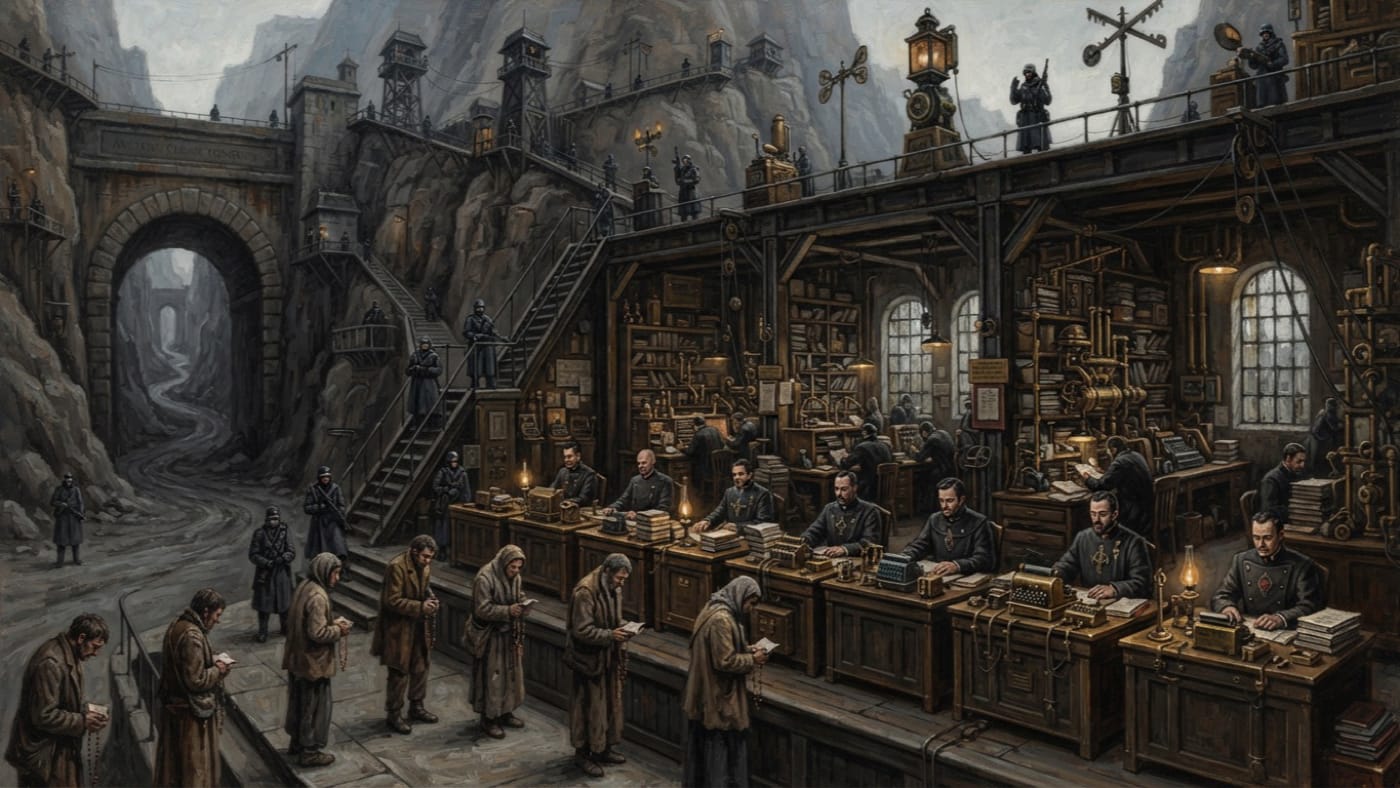
#On the Compact
"Say it clean. Walk it safe." — Inscription above the Gate of Clean Tongues. The Compact sells the second sentence.
The Choir-Broker Compact is the licensed guild of insurers that prices protection on the eastern road out of Peregrine Row. Its headquarters is the Choir-Broker Hall. It works through the four-page escort voucher, the bonded escort and the rate that is never posted. Its filings promise fair insurance and safe pilgrimage along the Pilgrim Roads. What it actually holds is the price of danger, and a guild that sets the price of a danger has little need to own the danger as well.
The transaction runs in this order. A pilgrim passes the Gate of Clean Tongues and is given a recitation score. He takes his bead string, his receipts and the wax mark on his forearm to one of seven desks on the raised dais. The broker weighs the season, the threat level, the declared sin-count and the Canyon Premium, then names a figure he will write on no wall. The pilgrim pays. In return he receives a voucher, a window and an escort, and a clause he has just signed allows each of them to be withdrawn.
#On the Charter and the Seven Seats
Before the Synod there was a cistern, a shrine and three families who took tolls from anyone who wanted the only water in the canyon. The records give no year for this arrangement, and I decline to supply one. After the Sundering of A.S. 45, refugees replaced the mules on the road, and the families learned that fear paid better than thirst.
The Concordat of Strasbourg constituted the formal Synod in A.S. 90. Four years later, in A.S. 94, the Road Chapter of Peregrine received its charter. The Peregrin, Voss and Haelke families then entered licensed administration under a Cantor-Auditor dispatched from Strasbourg. This incorporation is the first date I can certify for the Compact. Whether some earlier instrument bound the families to one another, no archive available to me will say.
The Council governs. Three of its seats pass by inheritance within the founding families. The other four rotate among licensed brokers. I have found no written record of who sits in the hereditary chairs, how the rotation turns or how long any term lasts. Seven seats describe the Council and nothing more. The membership beneath them is larger and dislikes being counted.
Authority at the Row is divided with the care of heirs dividing an estate. The Road Chapter holds creed tests, transit permissions, enforcement and the quarterly detention quotas. The Reconciliers' Union holds the counting tables and the power to declare a pilgrim unsound. The Compact holds commercial pricing, the bonds on escort companies and the budget of the Quiet Pen Wardens. The Bureau of Pilgrimage files the whole arrangement as a joint charter, which is accurate in the way a marriage contract is accurate. Escort captains are licensed by the Chapter and bonded by the Compact. Men with two masters answer to whichever one paid them that week.
#On the Escort Voucher
Safe passage is sold in contracted windows. A window is a stretch of the day in which a bonded company will walk the eastern approach, timed against the ridge-lantern signals. The Row's own survey records that the windows are auctioned every day and that an escort is sometimes sold twice. No tariff, premium percentage, window length or auction procedure appears in any paper submitted to this office. The rates are never posted, because a posted rate can be appealed.
The standard voucher runs to four pages of notarial script. Three of its provisions do most of the work.
The grief clause sets the price of a death in advance. Compensation goes to the broker, who forwards a portion to the bereaved after his administrative deductions.
The syllable guarantee certifies that the pilgrim's creed-test score met the threshold for insured passage. A score below that threshold voids the contract, and no refund is given.
The canyon waiver acknowledges that the canyon's acoustics may produce "syllabic distortion indistinguishable from heretical mispronunciation." It releases the Compact from all liability for that distortion.
Read together, the three form a closed instrument. The guarantee depends on the gate score. The gate score depends on a proctor who must hear both the pilgrim and the Echo Creed repeating him a vowel wrong. The waiver puts that echo outside the broker's responsibility. If the score is later questioned, the guarantee fails, the contract is void and the premium stays at the desk. If the pilgrim dies before anyone questions anything, the grief clause sends his price through the broker on its way to his widow. At no point does the Compact carry a risk it has not first sold to someone else.
The bond on an escort company protects the Compact against the escort. I have found nothing in the record that protects the pilgrim against the bond.
#On Accounts and Service
Every pilgrim carries a bead string. Bone beads stand for minor sins, wood for moderate sins and glass for grievous ones. At twelve reconciliation tables, clerks compare each string with the pilgrim's confession receipts, passage stamps and whatever tithe credits the Bureau of Records has assigned. They work in chalk. The calculation is wiped away and only the verdict is filed: reconciled or unreconciled.
The dates matter, and the Road Chapter keeps them apart. Its own corrective notice says reconciliation has been compulsory since A.S. 104. By A.S. 110, the year of the First Continental Levy, reconciliation had become a daily audit and the insurance regime was fully in place. The first date marks the beginning of compulsion. The second marks the point at which the compulsion was turned into accounts.
An unreconciled pilgrim goes down to the Quiet Pens beneath the Tinmarket Arcade. Entry carries a processing fee. Release requires full payment or a service assignment, either to local labour or to the supply works of distant bastions on the Line. Each quarter the Chapter sets targets for detentions, labour and revenue. Every target is easier to meet if the pronunciation test gets stricter.
The Compact sets no quota and signs no warrant. It pays the wardens.
#On Demonstrated Risk
The Compact's best decade began with its customers' worst day. In A.S. 101, six hundred pilgrims entered the eastern approach and two hundred and fourteen died in an ambush launched from the ridge caves. The Bureau of Doctrine blamed impure recitation among the pilgrims. The survivors were fined for doctrinal negligence, and mandatory escort contracts followed. The attackers were never identified. Some later accounts call them Canyon Saints, but this survey gives those accounts no standing.
The Canyon Saints are real enough today. They are an outlaw coalition on the eastern approach whose methods are ambush and hostage creed-games. The Row's survey lists contracts, bribery and staged danger among the Compact's own methods. Whether those methods ever met the Saints' methods in a signed agreement is the question the Row has spent two years declining to answer.
In A.S. 199 a ledger leaked from the Compact's internal audit. It described "demonstration ambushes," contracted and paid for by brokers, which proved to the public that the insurance was needed. The Road Chapter investigated. It found "no evidence of systematic coordination between licensed brokers and unlicensed hostile elements." It fined the clerk who leaked the ledger, remanded him to the Quiet Pens and revised the Row's status to Amber. His status is filed as "processing."
Earlier reports from this office described the Choir-Broker Compact as "a model of Synod-private cooperation."
REVISED following review of the A.S. 199 audit documents: "a model of Synod-private cooperation, operating within parameters that are currently under review." Holders of active passage contracts should take note of the amendment.
Three names stand nearest the dais. Cantor-Auditor Selm Peregrin descends from a founding family and joins doctrinal authority to the detention quotas. The Council has not disclosed whether he also holds his family's hereditary seat. Broker-Matron Lysa Vane sets prices and drafts contracts. She keeps a casualty ledger of every pilgrim lost under contract, every grief payment made and every refund denied. The Hall's survey calls that ledger her protection in a chain of mutual blackmail. Captain Odrik "Ridge-Hook" commands the largest escort company and has influence over the ridge signals. He has been investigated twice over his dealings with the Canyon Saints, and neither investigation returned a finding against him. His defence was that he cannot control what happens outside his contracted window. The Bureau of Purity has never had the manpower to test that defence.
I list the three together because they stand together on the dais. Standing near one another is not testimony, and I have added none.
#On the Present Application
The Echo Creed troubles the Compact's paper as much as its customers' throats. Contracts left overnight in the Hall have changed their lettering by morning. In one case a grief clause read "compensable at standard rate" at dusk and "compensable at stated rate" at dawn, and the stated rate was lower. The Bureau of Alchemical Standards classifies the disturbance as Category Two and has kept it under continuous review since the Year of Ash Rain in A.S. 143, when it grew worse. The onset records contradict one another. No office has established its cause, whether it has any intent or who, if anyone, is its author.
The brokers sell against it anyway, through correction riders, echo waivers, premium clarification vouchers and posthumous syllable appeals. The disturbance can alter their own contracts, and each alteration gives them another product to charge for.
Peregrine Row remains under Amber review as of A.S. 201. The Compact wants higher premiums. The Chapter wants more detentions. The escort companies threaten to strike unless they are granted immunity from creed trials. Merchants on the Queue Road report pilgrims taking longer and dearer routes to avoid the canyon. The Chapter calls this seasonal variation.