
#On the Throat of the Road
"Say it clean. Walk it safe." A local saying, posted, recited and invoiced.
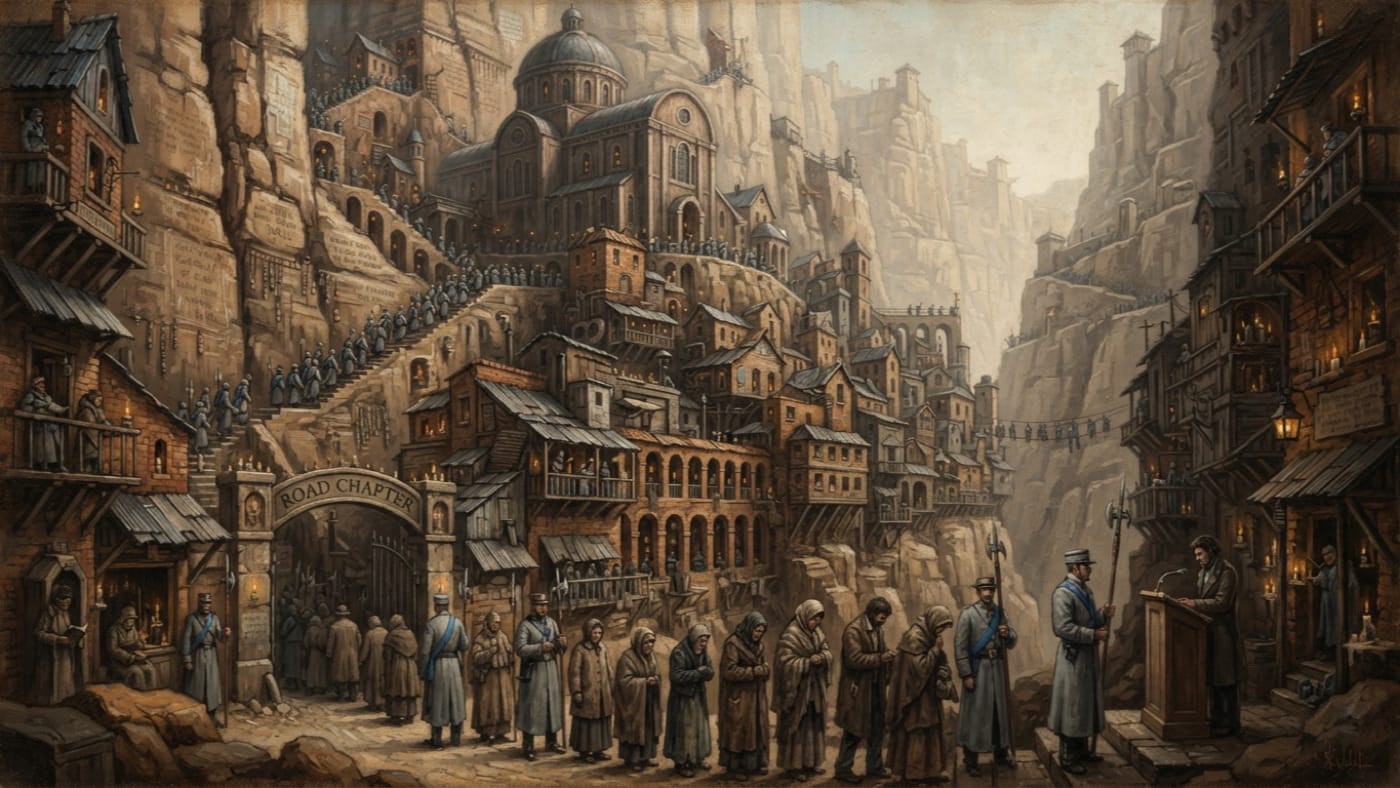
Peregrine Row grew where a town had no business growing. It sits in a canyon throat on the Pilgrim Roads, pinched between two ambush approaches, with one spring-fed cistern in its hollow and a gate arch at either end. Everything travelling the corridor passes beneath those arches. The ridges are too steep for a mule and too dry for a man without a water chit. The switchbacks and road cuts were carved by labourers whose wages the Road Chapter does not keep in its public folios.
The registered count gives eighteen thousand residents. Then the pilgrim seasons arrive, the arcades fill, and the count becomes a theory. The inhabitants live in sun-baked brick and salvaged slate under hammered-tin awnings and ropewood galleries. Their eaves carry painted hymn verses, which the dust scours to a pink smear every dry season. Candles burn in every recess. Bead strings of bone, wood and glass click at every neck, wrist and counting table. Beyond the eastern arch the road forks toward three sanctuaries. The Row taxes the fork with the calm of an institution that owns the only drink between them.
The Choir-Broker Hall stands at the centre. Visitors confuse the Hall with the town, as visitors confuse a cathedral with its diocese. The Hall sells passage. The town feeds the buyers, waters them, quarters them, detains a measured fraction of them, and buries whoever the canyon returns.
#On the Market in Safety
Authority at Peregrine Row is shared by three bodies who despise one another in correct liturgical order. The Road Chapter holds the gates, the creed tribunals and the dais of the Hall. The Broker Compact Council sets premiums and signs contracts. The Gate Provosts patrol, arrest and collect. Whenever an inquiry arrives, each insists the other two are the real government.
Follow a pilgrim. At dawn he queues at the Gate of Clean Tongues with his caravan, mouth already dry. He recites the Creed before a proctor who listens for vowels the way an assayer listens for lead. A clean recitation earns a creed-clearance stamp. The stamp admits him to the Cistern Chapel queue, where his water ration is blessed, measured and entered against his confession receipts. The receipts admit him to the Bead Courts, where clerks reconcile his string against everything he has confessed, paid and been charged. The beads record his identity and his debts as well as his coin. A miscounted string is a miscounted man.
By midday he reaches the Hall. The brokers auction safe windows there, meaning hours of passage through the canyon under contracted escort. Choirs are hired in the same room: processional singers, convoy cantors, mourners for the grief trade. Song contracts are sealed beside insurance policies, since both promise a later performance by someone else. The pilgrim buys his window with coin, chits or bead strings. If he cannot pay, the broker accepts a lien.
Liens mature. An unpaid premium becomes forced labour at the reconciliation tables, or "voluntary" service in the Escort Yards. The clerks supply the quotation marks themselves. A pilgrim judged unsound anywhere between gate and dais goes to the Quiet Pens, where processing charges accrue until family, broker or contract buys him back.
This office has repeated the Row's familiar assurance that insurance guarantees passage.
Corrected. Insurance prices passage. The guarantee lives in the brokers' mouths and nowhere in the brokers' contracts. A pilgrim who reads his contract before the canyon learns this more cheaply than one who reads it after.
#On the Road School
The Peregrine Wardens keep three road schools. Strasbourg teaches doctrine and forms, Marseille teaches embarkation, and Peregrine Row teaches the lessons that require a cliff. A switchback teaches column discipline. A gate arch teaches compression. A ten-foot ledge above a fifty-foot drop teaches a recruit the moral weight of a halberd shaft laid across a panicking pilgrim's chest.
The Wardens are easy to recognise. They wear road-grey coats and pilgrim-blue sashes, and they carry token-hooks, halberds or pike-staves, route folios, and three classes of seal: warning, suspension and voidance. Their authority comes from the Harmonized Routes Edict of A.S. 123, which founded the force under the Bureau of Pilgrimage. No one has filed the year the Row's school opened. I decline to supply one out of enthusiasm.
They do not govern the Row. They inspect its licences, escort its convoys, and suspend whatever offends the route. Four other bodies hold authority here, and frightened foreigners mistake all of them for Wardens. The Gate Provosts police the arches. Licensed escort companies hire out from the Yards, and Captain Odrik, called Ridge-Hook, is the most frequently named of their captains and the most quietly named. The Ridge Lantern Watch signals from the watch stations with lamps and bell-codes. The Quiet Pen Wardens share one word with the national force and nothing else.
The protection is real. The canyon bandits, whom the shrines at the canyon mouth commemorate as saints, fear a Warden file. Convoys walking behind blue sashes reach the far arch with more of their number than convoys who trusted cheaper blades. The Wardens keep knives off the pilgrims, so the brokers receive their customers whole.
#On Echoes and Culpability
The canyon repeats. A recitation offered at the gate comes back from the stone wrong, with a vowel bent or a syllable doubled, and the proctor must decide which voice was the pilgrim's. The Hall's scribes report something worse: written contracts left out overnight are found at morning with a single vowel altered. The phenomenon is catalogued as the Echo Creed. No one has catalogued its cause, because no one has proved one. Doctrine holds opinions, the brokers hold others, and the canyon declines to testify.
The inhabitants worship around it. Some pilgrims stop their ears with waxed cords so they hear the Creed only inside their own skulls. Some recite in silent hand-signs at the canyon mouth. Others murmur bead-buffer chants, counting under the breath so that whatever the stone returns comes back tangled in arithmetic. The detention registers do not say whether any of this works. The pilgrims practise it regardless. If the canyon answers you, don't answer back. They say it quietly.
A false flag costs as much as a true one. An echoed vowel becomes a creed failure. The failure becomes detention, detention becomes fees, and unpaid fees become labour. The proctor need not lie to fill the Pens. He need only hear.
Street talk holds that some proctors hear more sharply when a quota stands unmet, and that some brokers have tipped ambush bands to keep premiums credible. A ledger leaked from inside the Compact is cited as proof of a paid "risk demonstration." The Road Chapter has acknowledged neither the ledger nor the arrangement. I report the allegation as an allegation and the silence as a document. The Row also remembers an early convoy slaughter that the authorities of the day blamed on unclean recitation among the dead. The account before me gives no date and no tally, so I give neither.
The Row fears an Inquisitor-Lexicant named Thane Mire, a specialist reputed able to tell a natural echo from a manufactured test. No record before me shows that he has come. The fear alone has improved the bookkeeping.
#On the Inhabitants and the Present Condition
The day begins with two queues: one for water and one for the Creed. Residents call it one queue with two shames. Midday belongs to the brokers' auctions, the clatter of the reconciliation tables and the shouting in the Escort Yards. Supper is lentil mash, dried fruit and salted goat. The comfortable add real tea, and a broker celebrating a season adds honey-wax sweets.
Manners are exact. A host offers water before conversation. A respectable speaker keeps his tongue visible during an oath and touches his bead string before answering a question. Nobody corrects another's Creed in public, because a correction is a challenge and the Yards settle challenges with knives. A dead resident's name is spoken once. After that a bead tally hangs on the ridge where the name used to be.
At curfew the ridge lanterns lock and the road narrows to a single lit file, walked by provost patrols reciting as they go. Below the arcades and in the cistern tunnels the other Row opens for business, with dice, forged syllable tokens, counterfeit escort vouchers and quiet-passes for anyone desperate to skip the gate. The lanterns cannot see underground. The Chapter knows where the tunnels run.
Pilgrims who clear the far arch carry the Row's stamps onward. Some take the road to Griefgate, a day or two further, where the Widow's Pennies Exchange prices whatever the canyon kept.
The present quarrel is old and familiar. The Compact wants higher premiums. The Chapter wants more detentions. The escort captains threaten to stop walking unless they are granted immunity from creed trials, which would make them the only clean tongues in the canyon by statute. The Wardens drill on the switchbacks, inspect the licences and wait to learn which party will need suspending.