
#On the Joint Charter
"Protection is obedience." — Seal-motto of the Road Chapter of Peregrine. The pilgrims' reply, chalked on the cistern steps and scrubbed off each morning: "Protection is a bill."
The Licensed Broker Compact Council of Peregrine Row is the second name on the charter of the Choir-Broker Hall. The first name belongs to the Synod Road Chapter, which holds the creed, the gates, the permits and the cells. The Council holds the price. Between them they govern one switchback in a limestone canyon on the Pilgrim Roads, and every pilgrim bound east must pass through it. The only alternatives are the long routes the Queue Road merchants will describe to anyone, for a fee.
Before the Synod the place had a cistern, a shrine, and three families who taxed mule-trains for the privilege of drinking. Nobody recorded the year they began. In Peregrine Row a missing date counts as a kind of title deed. The Sundering of A.S. 45 / 1755 CE left the canyon as it was and changed the traffic through it. Where mules had once passed, refugees now came. The families raised their tolls, then their walls, and finally their opinion of themselves.
The formal Synod was constituted at the Concordat of Strasbourg in A.S. 90 / 1800 CE. Four years later its Road Chapter of Peregrine was chartered, and the three families were incorporated into licensed administration. They gave up their independence. In return they received titles, a supervising Cantor-Auditor dispatched from Strasbourg, and permission to keep collecting, now under seal. The writ records the incorporation. It does not record when the present seven-seat arrangement first sat, and I decline to supply a date the archive has withheld.
#On the Seven Seats
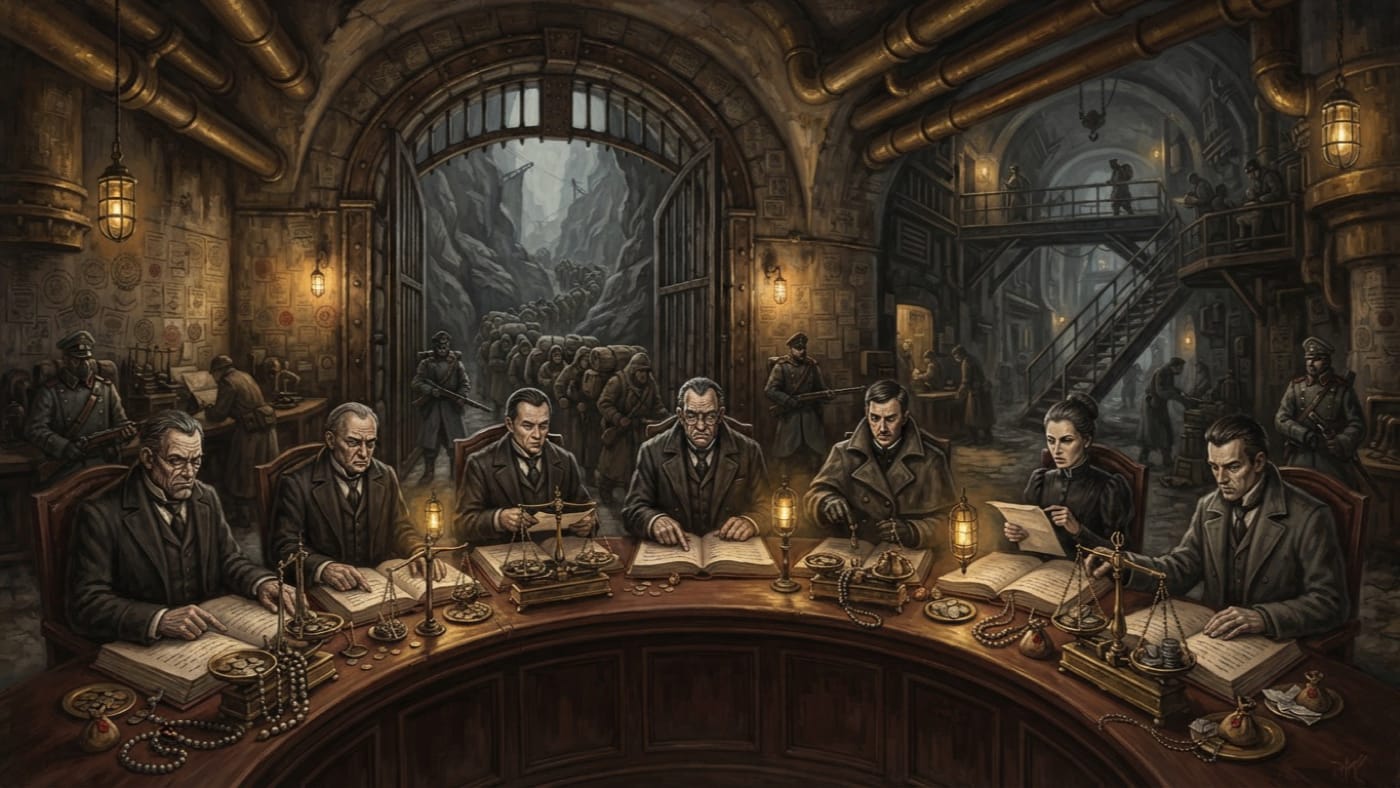
The Council meets where it trades. In the centre of the Hall stands a raised dais with seven desks and seven scales, and ledgers that are always open. The scales weigh coin, bead strings and, as the brokers would have it, the moral density of a pilgrim's intentions.
Three of the seats are hereditary and locked to the founding families: Peregrin, Voss and Haelke. The other four rotate among the licensed brokers of the Row. No document that has reached my desk sets out the rotation's terms, eligibility, quorum or manner of voting. The founding families are said to regard the rotating four as seats they have not yet secured. Their patience is dynastic.
Seven seats do not make seven brokers. The licensed trade below the dais is larger and hungrier. The Council governs that trade's commerce: the pricing of risk, the bonding of escorts and the financing of what follows when risk is priced badly. The machinery of compulsion stays with the Chapter. The Chapter tests the creed, issues the permits, licenses the captains and holds the warrant to detain. The Council can sell a pilgrim passage but cannot open the gate for him. That single dependency is the Council's entire constitution, and the Council has never been fool enough to resent it.
Cantor-Auditor Selm Peregrin is the Chapter's officer on the Hall dais. He holds creed legitimacy and detention leverage, and he descends from the family whose name the Row carries. The surviving record does not say whether a Peregrin also sits in the family's hereditary chair, or which Peregrin it would be.
#On Protection Entered into Account
Follow one pilgrim through the procedure, anonymous as the procedure prefers.
He enters at the western gate and recites the creed for a Chapter proctor. He presents his bead string for reconciliation, with its bone, wood and glass, its confession receipts, and whatever tithe credits the Bureau of Records has assigned. His forearm takes a wax stamp. Only then does he climb to the dais, where the Council's trade begins.
The Council sells contracted protection through the eastern canyons, packaged as a safe window, meaning a span of passage covered by a licensed escort. The windows are auctioned daily. The price formula weighs the season, the threat level, the pilgrim's declared sin-count and a quantity the brokers call the Canyon Premium. The rates are not posted. Each escort captain is licensed by the Chapter and bonded by the Compact, so if a company fails, the bond answers to the Council and the licence answers to the Chapter. The pilgrim answers to both. The Row has a familiar complaint that one escort company gets sold to two caravans for the same window. In the Hall's vocabulary this counts as liquidity.
The pilgrim's purchase is a standard escort voucher, four pages of dense notarial script. Three of its provisions concern him most.
The grief clause prices his death in advance. Compensation is paid to the broker, who forwards a portion to the bereaved after deducting administrative fees.
The syllable guarantee ties his insured passage to his score at the gate. A score below the threshold voids his coverage, and nothing is refunded.
The canyon waiver disclaims liability for acoustic distortion "indistinguishable from heretical mispronunciation," which happens to be the canyon's speciality.
Put the three together and the voucher allocates every risk. Death costs the pilgrim his life and costs his survivors the deductions. If the proctor fails him, he loses the premium. If the stone mangles his vowels, he has signed away any remedy in advance. The Compact collects at each stage. The Hall calls this mutual protection. Plainly put, the pilgrim pays to be told he was warned.
#On the Wardens' Budget
At the Bead Courts the Reconciliers' Union does the counting and pronounces each pilgrim "reconciled" or "unreconciled." The Council has no say in that verdict. The Road Chapter sets the quarterly targets for detentions, labour and revenue, and the Council has no say in those numbers either.
The Council's part is to pay. The Quiet Pen Wardens work under Chapter authority on the Compact's budget. Pilgrims whose recitation failed, whose bead counts would not close, or whose passage arrangements lapsed partway through all end up in the pens below the Tinmarket Arcade. A processing fee is charged on entry. A detainee is released either by paying his accumulated fees or by accepting a service assignment. Some assignments are local work in the Courts or the Escort Yards. Others send labour to distant bastions whose supply officers ask few questions about where it came from.
The Hall's own published account says the creed tests are calibrated to produce the quotas. A proctor who is short of his number tightens the vowel standard, and the canyon supplies the evidence. The Bureau of Doctrine has been informed. Its reply, filed as Internal Memorandum 7R-201, reads in full: "Standards are standards."
So the Council issues no warrants, sits on no tribunal and sets no quota. It keeps the lamp oil in the pens and the wardens paid.
#On Demonstrated Risk
In A.S. 101 / 1811 CE a convoy of six hundred pilgrims was ambushed in the eastern canyon by attackers operating from the ridge caves. Two hundred and fourteen died. The Bureau of Doctrine attributed the massacre to impure recitation among the pilgrims. The survivors were fined for doctrinal negligence, and the attackers were never identified. Escort contracting became mandatory afterwards, which turned the Council's market from a trade into a requirement.
The rest of the regime was built in stages. Bead reconciliation was made compulsory in A.S. 104. The daily audit was formalized by A.S. 110, the year of the First Continental Levy. In A.S. 143 the Bureau of Alchemical Standards classified the Echo Creed and placed it under continuous review. Reports say it grew worse around the Year of Ash Rain. The records disagree about when it began, and I do not resolve their disagreement.
Then came A.S. 199 / 1909 CE. A ledger from the Compact's internal audit was leaked, and it described "demonstration ambushes" in the eastern canyons, contracted and paid for. The documents in this matter stand on different footing, and I set them out separately.
The leaked ledger has never been formally acknowledged, and no office has authenticated it.
The Road Chapter's investigation found "no evidence of systematic coordination between licensed brokers and unlicensed hostile elements." That finding is filed and sealed.
The clerk who leaked the ledger was fined for "administrative indiscretion" and remanded to the Quiet Pens. His status is filed as "processing."
The Row's status was revised to Amber, which is also filed and sealed.
No sealed record links the A.S. 199 ledger to the attackers of A.S. 101.
Two figures stand near the matter, and nearness is all I report about them.
Broker-Matron Lysa Vane controls contracts and price-setting. She keeps a ledger of bodies: every pilgrim lost under a contracted escort, every grief clause paid, every refund refused. That ledger protects her against the Compact, the Compact protects her against the Chapter, and the chain of mutual blackmail runs on from there. No record I hold names her a councillor. She has never needed the title.
Captain Odrik, called Ridge-Hook, commands the largest escort company in the Yards and has influence over the ridge signals. He has been investigated twice over his relationship with the Canyon Saints, and neither investigation settled the question. His bond is held by the Compact. Which work he is actually paid for remains a question for the Bureau of Purity, whenever it has the manpower to spare.
Earlier reports from this office described the Choir-Broker Compact as "a model of Synod-private cooperation."
REVISED following the Bureau of Doctrine's review of the A.S. 199 audit documents: "A model of Synod-private cooperation, operating within parameters that are currently under review." Holders of active passage contracts should note the distinction.
#On the Present Application
In A.S. 201 / 1911 CE the Council trades under Amber. The Bureau of Pilgrimage still lists the Row as a Waystation of First Classification under joint charter, and the joint charter now carries three demands that cannot all be met. The Compact wants higher premiums. The Chapter wants more detentions. The escorts are threatening to strike unless they are made immune from creed trials. None of these has been settled. Meanwhile pilgrims who can afford the longer roads are taking them. The Chapter calls this seasonal variation, and the Queue Road merchants call it good business.
The vouchers themselves have also become unreliable. Contracts left overnight in the Hall have been reported with altered lettering by morning. In the reported case a grief clause that read "compensable at standard rate" in the evening read "compensable at stated rate" the next day, and the stated rate was lower. The scribes blame the ink and the brokers blame the scribes. The Bureau of Alchemical Standards blames atmospheric conditions. No cause has been determined. The canyon waiver covers distortion of the spoken word. None of the four pages says who is liable when the written word changes on the Council's own paper overnight.