
#On the Three Crates
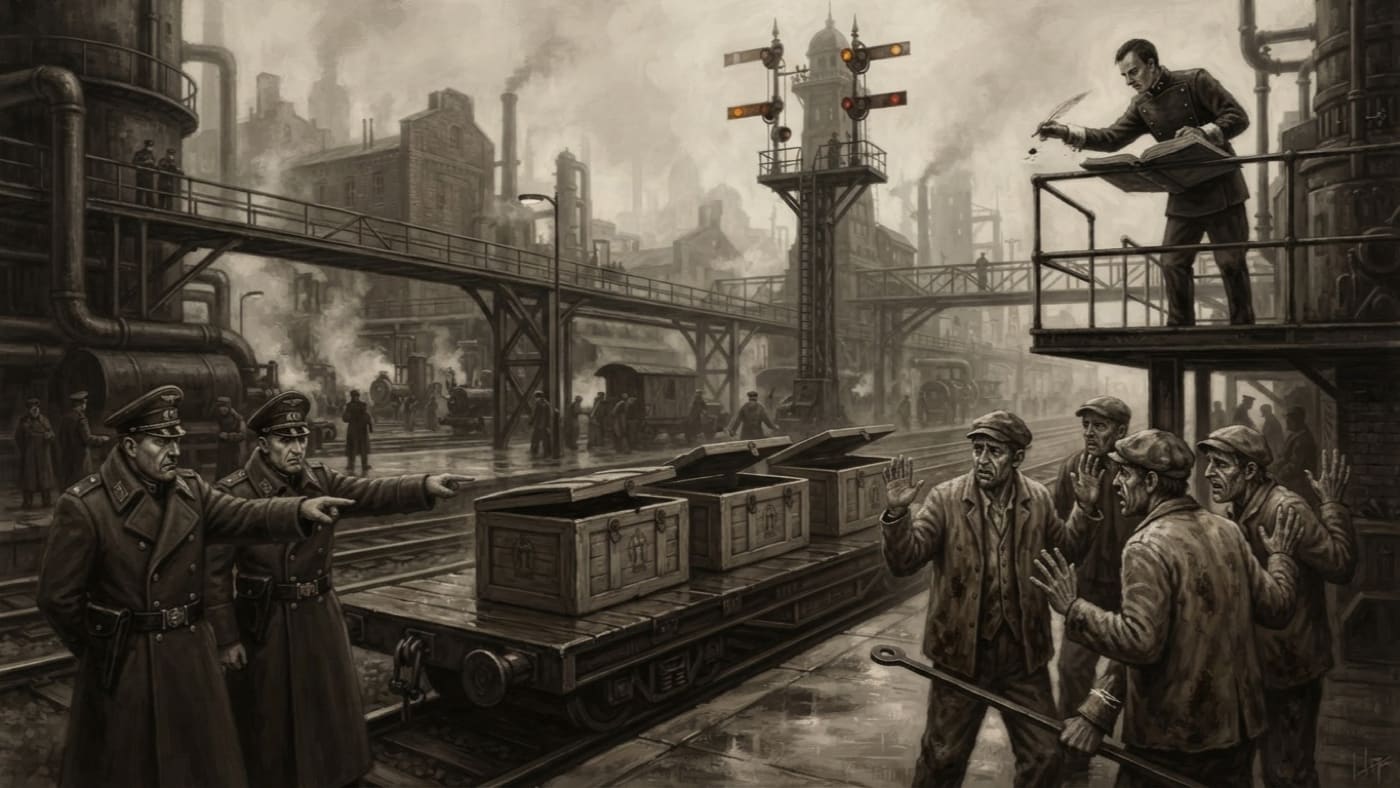
In A.S. 199 / 1909 CE three sealed crates of relic-payroll, consigned to Bastion-Przemyśl, were recorded through the Needle of Lorn and opened at the fortress with nothing inside. The seals were intact and the stamps genuine. The cantor measure that released them had been sung in tune. They are the defining exhibit of the Payroll Spur Losses, which have continued through A.S. 201 / 1911 CE without a certified explanation or a conviction. The guarded sidings themselves, the Payroll Spur in the eastern yard of the Palatine Switchyard of Lorn, have their own survey. This entry concerns what grew up around the bare wood: the scandal, which is the losses turned into a quarrel over who must answer for them.
A relic-payroll crate holds wages in the one currency the Church guarantees against rust. Once a Synod catalogue has authenticated a relic, it can pay a soldier, provide his daughter's dowry and settle his estate. An empty crate at Przemyśl means a garrison paid in wax, and behind the garrison a row of widows whose inheritance has shrunk to a stamp. Lorn's offices grasped this at once. They answered by proving it was nobody's fault.
#On the Offices That Answer Separately
Lorn's Palatine Yard Command divides motion among three offices so that no single man can move a train. By the same arrangement no single man can lose one. Yard Palatine Odrin Kessel holds track priority and commands the Needle's provosts. Prefect Halden Wry issues manifests from the Manifest Basilica and validates priority windows. Bell Marshal Sister-Calder certifies the cantors, and nothing rolls without their sung release. The switchmen throw the points. The Payroll Spur Guard Compact holds the crates under writ and rifle until they leave the siding.
When the crates came back empty, four documents went up the line.
The Bureau of War's loading manifest lists the crates' contents. Kessel's audit runs to seventeen pages and asserts that the crates never held cargo. Both papers cannot be true, and neither author has withdrawn a page. Wry's corrected transit documentation establishes that the crates passed the gate on proper paper. Sister-Calder's tonal records establish that every release was sung in compliance.
All four documents are genuine. A genuine stamp proves who stamped. It says nothing about what lay under the lid. A correct measure proves that a cantor held pitch, and pitch has never yet delivered a crate to a fortress. The Basilica's entry Needle clear certifies passage. It does not record that anyone at the Needle looked inside.
Provost circulars posted in Cinderrow during A.S. 200 held that every payroll car is opened at the Needle, so any emptiness must have arisen afterward, on iron thrown by switchmen.
Corrected. Cars without a validated priority window are opened at the Needle. Cars with one pass lawfully without full inspection. No record shown to this office says whether the three crates travelled under a window. The circular's arithmetic falls with its premise. The provosts still recite it.
Each office can certify its own procedure, and no office is charged with certifying arrival. The accusing finger has to find a hand in that gap, and paper has none.
#On the Hands Named First
Paper cannot be arrested. The two bodies in Lorn nearest to moving iron can.
The Switchmen's Union, called the Thrown Hand, works inside the schedule. Its men throw the points on a sung release, as the hymn instructs. Its power is pressure: the right to refuse a false hymn, the caution interval, the lawful delay. The Hush Tunnel Runners work outside the schedule. They sell movement the timetable does not admit, through tunnels Records has never budgeted for. The two trades meet under the Cinderrow canteens, where they exchange lamp-talk, route fees, hiding places for injured men and information neither side would print. The Runners take no orders from the Union. The Union pays them the way it pays any supplier it distrusts: promptly, and in front of a witness.
Their testimony parts company at the crates. Union crews deny moving the empty crates, and they point out, with some justice, that a switchman throws iron and never lays a hand on cargo. I have printed the Runners' account before and I stand by having printed it. According to that account, carriers handled payroll from the Spur under routing codes older than their cartel, cut into sealed service walls beneath Switch-Tower Nine of Lorn. It is under-yard testimony, and no court has certified it. The Yard Tribunal keeps its Payroll Spur evidence under seal, and nothing it has released shows that payroll travelled below.
Suppose the Runners are right. Then the Runners handled cargo, and that is all it proves. It does not show who cut the codes, who paid for the carrying or where the cargo finished. Some of the first carriers are reported to have retired soon afterward, enriched and frightened. I have their reported condition and no names. I will not invent either.
Each trade now expects the other to be named first, and each has reasons. A Union man named feeds the Bell Marshal's case against the Thrown Hand. A Runner named proves the tunnels exist, which embarrasses Records more than it convicts anyone. The Tribunal's ledger has a column ruled for each.
#On Routes Older Than Their Carriers
Tower Nine routes the Needle's eastern pinch and the Spur sidings. It answers late. Lamp-readers who watch it from under-yard grates have made a password of the delay: Nine — late. A held amber can freeze a siding's attention without anyone declaring an obstruction. No record shown to me says whether such an amber hung over the three crates.
The marks in the Hush Tunnels do not hold still. Chalk arrows reverse overnight, and wax scratches reform into signs nobody living admits to cutting. The classified Hymn-Phase Slip can make a switch throw cleanly and set wrong while every step of procedure is correct. A clock sealed since before the Synod lies beneath Tower Nine, and certain sealed analyses propose it as the source of the Slip. Propose is their word. I have seen no sealed hand apply it to the crates.
These conditions make the case harder to read and easier to exploit. A thief who knows the Slip has an alibi waiting for him. An honest crew caught in the Slip has none. The record supports both readings together, and each office chooses between them according to whose men it needs to protect. No chain shown to this office runs from wall code, late lamp or sealed clock to a crate emptied with its wax intact. Cinderrow talk speaks of an off-ledger purpose and of carriers working on another party's instructions. The talk has named no party, and neither will I.
#On Wages, Arrears and Prepared Punishments
The audits needed signatures, and the nearest signatures belonged to the poor. Payroll guards have been questioned over crates they never opened. Manifest clerks have found their initials on corrected folios, then on corrections of the corrections, until their cuffs are stained the colour of other men's revisions. Switchmen who threw on a sung release are the first fined when a window runs late and the first suspected when a car runs light. Foremen now chalk fewer wrists at shift start, because a chalk band is easier to rub off than to explain.
The Thrown Hand's grievances are older than the scandal: cantor overreach, payroll cuts, ration fines and widows' arrears. I cannot show that the three crates caused any of them, and the Union, to its credit, has not claimed so in writing. What the scandal adds is fear. A loss nobody can explain is a loss that can be charged to everyone, and Lorn keeps a long tradition of collective entries. Sister-Calder is preparing a purge. Wry is preparing documentary revisions. Kessel is preparing his innocence, gloves on. As of this filing all three remain preparations.
The Union is preparing a citywide slowdown for A.S. 201. It has not begun. Its instrument is delay: caution intervals, double-checks, frost-lock declared in mild weather, and men standing in a ring around a lever until management discovers theology. Seven hundred daily departures depend on hands that can be slow by the book. Every party to this affair has read the slowdown plan twice. It is the only document in the case that frightens all three offices equally.
#On the Commission Still in Strasbourg
The local arrangement survives because each office audits the other two and none can supersede its rivals. The Yard Tribunal keeps the case, and the Bureau of Shadows sits beside it in an advisory chair it denies occupying. Inquisitor-Regent Veyl Hark can supersede all of them. Her A.S. 201 commission empowers her, within her assigned jurisdiction and below Archon seal, to audit, arrest and supersede the officers who now certify themselves. She has used none of these powers in Lorn. She is still at the Joint Investigatory Cloister in Strasbourg, reading the Spur's ledgers in cold rooms.
Her field procedure has been written down. Copied bell codes are to be sung by unrelated cantors outside the yard. Tower Nine's lamp sequences are to be reconstructed with no tower men in the room. The Payroll Spur logs are to be taken from their custodians, and the custodians questioned apart. The sealed clock is to be named in writing. None of it has been performed: no interrogation under the commission, no reconstruction, no excavation, no recovered crate and no verdict. Her arrival is estimated for some time after the second A.S. 201 corridor review, which gives an order of events and no date.
The three offices fear her for their procedures. The switchmen and the Runners fear her for their necks, since custodians questioned in separate rooms have a habit of finding the same culprit somewhere below them.