
#On the Missing Payroll
Lorn moves the Church's freight by permission. A car rolls because a manifest names it, a cantor has sung its route, a tower has answered the measure and a switchman has thrown the iron where the paper told him to throw it. Wheels are a detail. Every stage leaves a stamp and every stamp has an owner. Since A.S. 199 / 1909 CE, which is the onset recorded in the timeline entry for the Palatine Switchyard of Lorn, relic-payroll consigned through the guarded sidings of the Payroll Spur has failed to arrive where its paper said it was going.
The yard calls the affair the reroute scandal. Lorn's clerks prefer the phrase "route correction," which in local administrative usage means any cargo that has left the ledger and given no forwarding address. As of A.S. 201 / 1911 CE the losses are still audited, denied, discussed in canteens and feared in offices. No one has been convicted of them. No one has explained them in any form a tribunal would accept.
#On the Guarded Spur
The Theocracy pays its soldiers partly in coin and partly in sanctity. An authenticated relic, sealed and catalogued by the Synod, is savings for a family and inheritance for a widow, and an army receives part of its wages in such holy goods. The market cry is "Gold rusts, but relics endure." So a crate of relic-payroll is three things at once: a wage, a sacrament and a store of value, and nobody in the yard forgets the third.
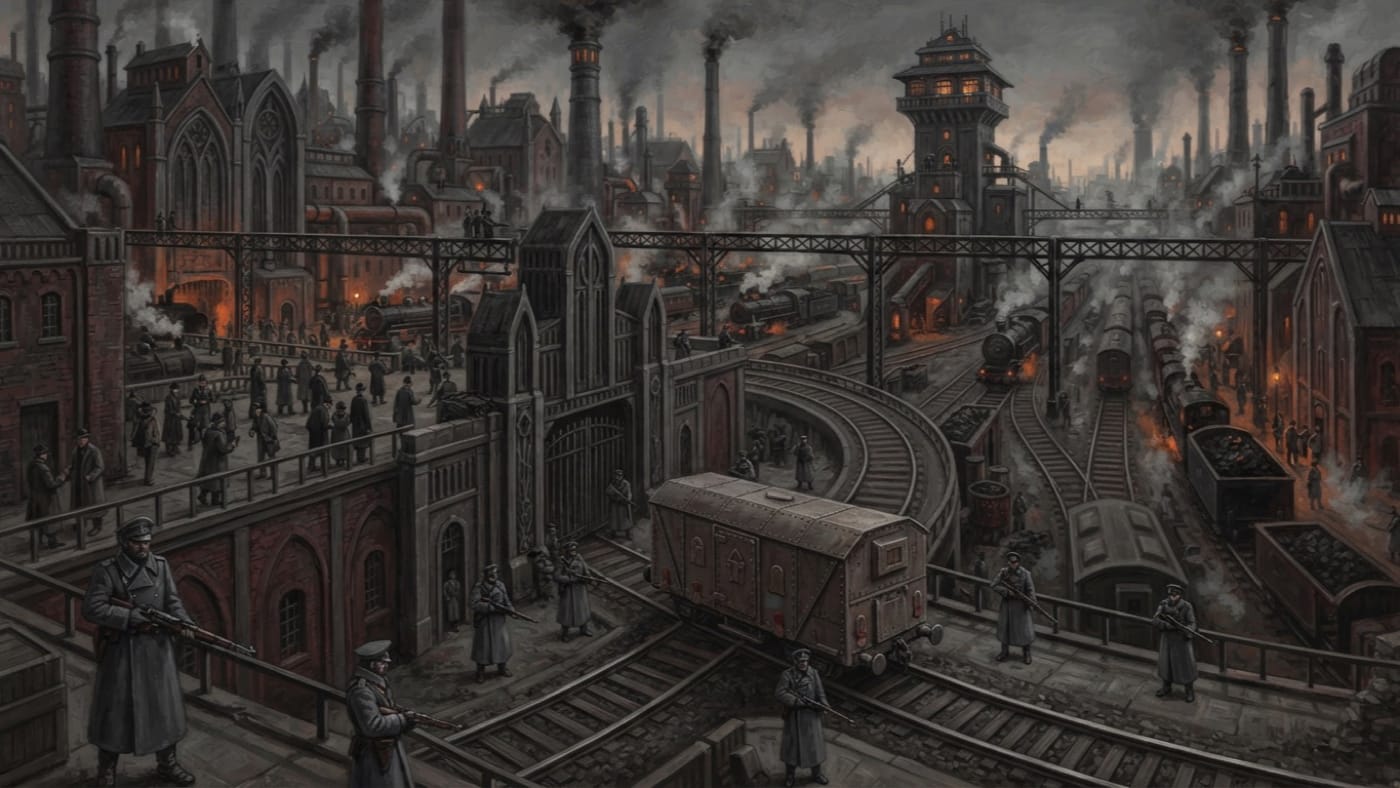
Lorn holds its share of this traffic in the Payroll Spur Vaults, a set of guarded sidings off the main throat. Wax-sealed crates ride there in riveted cars, and the air smells of gun oil, cold soot and hot candle stock from the sealing benches. The Payroll Spur Guard Compact watches over them with rifles, writs and secured sidings. Its members have been told the crates are holy, and they are paid as though the crates were only heavy.
Access requires a payroll spur writ. Touching the Spur without one is one of Lorn's three red-line offences, together with falsifying a master-manifest and silencing a bell mid-dispatch. The Yard does not grade its punishments for these. It annihilates.
Whatever leaves the Spur must still pass through the Needle, the single-track inspection pinch that sets the rhythm of the whole city. Lorn counts its wealth in priority windows, clean lungs, quiet inspectors and names that clear Records, and the Needle hands out the first of these sparingly. A payroll car waits in the same queue as coal, just with more guns pointed at it.
#On the Offices Responsible for Motion
Palatine Yard Command is three offices sharing one title. Each of them controls a link in the chain of movement, and each of them would sooner see its rivals hanged than admit the chain has a weak link.
Yard Palatine Odrin Kessel controls track priority. He wears immaculate gloves and is said never to step on gravel. His office can certify that a payroll car was given its window. Prefect Halden Wry of the Bureau of Records controls manifests and documentary identity from the Manifest Basilica, and he smiles only when a stamp lands. His office can certify that the paper said what paper ought to say. Bell Marshal Sister-Calder controls procedure certification and the Cantor Corps under the authority of the Bureau of Bells, and she keeps a book of missed measures. Her office can certify that the route was sung correctly.
The Guard Compact certifies custody. The switchmen of the Thrown Hand certify nothing at all. They throw the levers, which is the only step in the process where iron actually moves.
Each office can prove its own step. None of them is charged with proving arrival. Delivery is the sum of every step, and in Lorn nobody owns the sum, so every office can be correct while the crate is gone.
I record these functions because the reader must understand the machine. A man's function is not a finding against him. Any reader who mistakes my account of an office for an accusation against its holder may explain himself to the Yard Tribunal, which will charge him for the bench.
#On the Explanations Under Examination
The yard has four explanations and no conclusion.
The first is ordinary diversion. Payroll diversion appears on Lorn's register of common crimes beside manifest fraud and route theft, and the sidings are guarded by men the yard itself describes as armed, bored and bribable until frightened. The Compact denies any part in the losses. It would deny them whether it was innocent or not, so the denial is worth exactly the wax it is sealed with.
The second is forgery. The Hush Tunnel Runners and the Scrap Basilica trade sell route favours, forged manifests and bolt-cut keys. By the yard's own account they cannot sell true Payroll Spur seals unless someone inside supplies them. That narrows the forgery theory a great deal, and it names no one. "Someone inside" describes half the city on a busy shift.
The third is under-yard movement. The Hush Tunnels officially do not exist, and since the scandal began they have not existed more vigorously than ever. There is no record of payroll travelling through them. If there were, the tunnels would have to exist, and Records has not budgeted for that.
The fourth is the Hymn-Phase Slip, Lorn's classified anomaly. Under it switches throw cleanly and set wrong, echoes repeat a measure late, manifests smear as if wet, and crews swear the yard briefly turns unfamiliar under their boots. Whether it touches the Spur is an open question for the auditors. It is not a demonstrated cause, and anyone who wants the Slip blamed should be asked why he finds it so convenient.
Corridor copies of the audit order refer simply to "Tower Nine," and hand-copyists have filed it beside the Orchard Tower Nine of Bastion-Przemyśl.
Corrected. The bell-code audit concerns Switch-Tower Nine of Lorn, the routing cage above the yard. The Orchard Eye of Bastion-Przemyśl is a separate structure that happens to share the numeral. Copyists will write the full name every time, or they will copy it a hundred times for practice.
#On the Cost Beyond the Sidings
Audits have intensified, and an audit in Lorn needs a signature to hang its findings on. The nearest signatures belong to manifest clerks, payroll guards, tower callers and switchmen. Lorn's bureaucratic dialect has a phrase ready for each of them: "procedure lapse" for the scapegoat, "safety recalibration" for the raid and "friendly severance" for the man whose name is erased from the ledger and added to the blacklist. None of these terms needs anyone to be proven guilty. The office only needs to look busy.
The Thrown Hand says its concern is labour safety. Payroll cuts and cantor overreach are the two grievances known to set it moving, and the scandal touches both, in that it threatens wages and invites more sung procedure. The union is preparing a citywide slowdown. It has prepared it, and it has not begun it. Lorn would starve within three days of a real closure, so every office in the Yard keeps an eye on that preparation.
The Bureau of War counts the cost in soldiers. A regiment paid partly in relics expects its relics, and Lorn exists to send freight, men and munitions to the front. The Bureau does not need an actual mutiny in order to fear one.
Then there are the partners. The Vire River-Belt Interchange lies two days away by rail, at war with Lorn over tolls and priority. By the Interchange's own published survey, the Payroll Spur losses have made every transfer node nervous. Freight that once crossed from Lorn to Vire with a stamp now crosses with a stamp and a suspicion, and the suspicion is charged as a handling fee on the canal roads toward the Archivolt Causeyworks. Vire's nervousness proves nothing about Vire, except that its clerks can read.
#On the Present Condition
As of A.S. 201 the Payroll Spur remains under writ, under guard and under audit. Its losses are recorded as continuing and its responsibility is unassigned. Strasbourg has dispatched Inquisitor-Regent Veyl Hark to examine Tower Nine's bell codes and to open the Payroll Spur logs. At the date of this filing she has not arrived. The logs are still closed. No arrest has been made, no verdict entered and no crate recovered under any notice the Bureau can see.
The three offices are preparing for her in the usual way. Kessel's priority tables are being made legible. Wry's correction ledgers are being made consistent. Sister-Calder's book of missed measures is presumably being reread. The switchmen are preparing nothing, because nobody asks the switchmen.
When the logs are opened they will show stamps, and the stamps will be genuine. That has been true of every document in Lorn since the city was renamed in A.S. 104, and the real crates have still left the ledger.