
#On the Eastern Gate
At its eastern edge the Palatine Switchyard of Lorn narrows to a single rail. Twelve converging lines cross the basin floor. Seven hundred departures a day are assembled, blessed, stamped and shunted across it. Every train bound east for the supply corridors of the Sagittal Line must still pass in single file through one gate on one track, like a parish brought to a confessional with one priest on duty. The gate is called the Needle. The Bureau has never improved on the name, though it has tried.
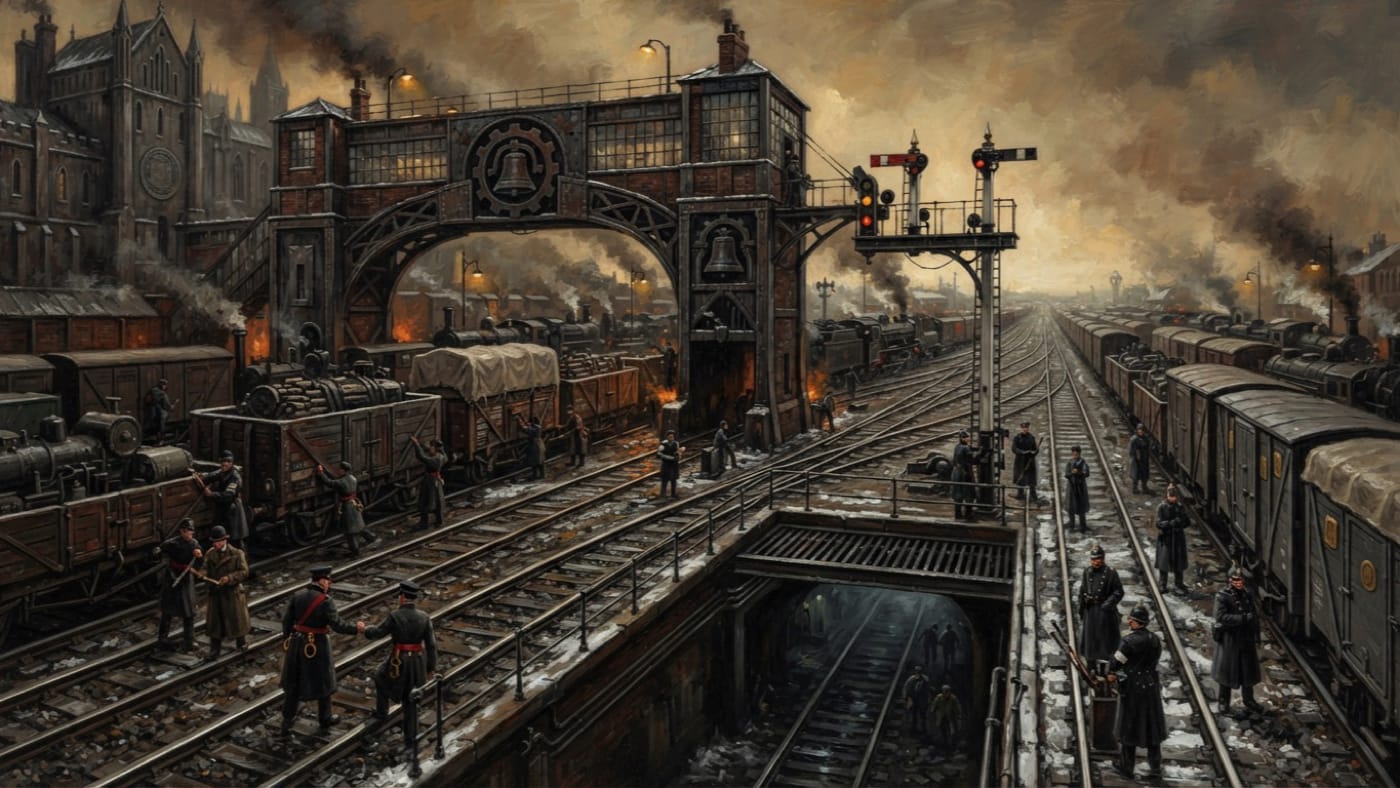
The approach is cold rail, soot-brick and riveted plate under a permanent coal haze. Freight stands on the track in a line that reaches back further than a man at the gate can see. Switchmen walk the queue with chalk and mark the steel they judge safe, because the yard has taught them not to trust what the timetable says about it. Provosts wear the key-ring and red sash. The local inventory says the Needle smells of cold steel and fear, and I can find nothing to correct in it.
The reasoning behind the gate is military, and I grant it. Eastbound freight carries munitions, rations, conscripts, saint-bone and relic-payroll toward men who will die quickly if any of it arrives wrong. A gate wide enough for two trains would inspect neither of them properly.
#On Inspection and Priority
Ordinary passage is an examination. Seals are checked and manifests verified. Cars are opened, searched and resealed by provost teams who answer directly to Yard Palatine Odrin Kessel. Kessel controls the gate and the order in which trains reach it, and he signs inspection protocol under his own authority.
The seven seals belong to the gate. The three to eleven stamps a manifest collects at the Manifest Basilica belong to the paper. Visitors confuse the two, and some officials find the confusion useful. I have not been shown the seven seals named in any document I am permitted to cite, so I will not name them here.
The protocol has one sanctioned exception, the priority window. A priority window is a timed authorization that lets a particular train through the Needle without full inspection. The Basilica validates it under Prefect Halden Wry. Kessel decides when the train actually reaches the gate. No train moves in Lorn without a sung measure, so a cantor certified under Bell Marshal Sister-Calder of the Bureau of Bells must sing the release. A switchman must then put his hand on the rod and throw. That makes four offices and one human wrist, and each can hold a train by being slow.
An earlier dispatch of this office stated that every cargo car passing the Needle is opened, searched, and resealed.
Corrected. Every car without a validated window is opened, searched and resealed. The window is a lawful exception, and the Synod keeps its valuables in lawful exceptions.
#On the Price of a Window
A train held at the Needle holds the train behind it. That train holds the siding, the siding holds the ladder, and so on back across the yard. The delay runs westward into the corridors and costs men days in places that have never heard the Needle's name. The Yard Tribunal calls this Schedule Injury and measures it in wagons rather than minutes. The court's hall stands between the Basilica and the Needle, so the paper and the gate are judged in a building wedged between them.
The window is therefore Lorn's most valuable currency. Coin buys less. Ration chits buy less. The route tokens of the Switchmen's Union change hands like scripture, and they buy less as well. Favors and clean papers are offered for windows, and so is anything a desperate shipper can carry to the right desk.
The people who pay for the gate seldom own anything that passes through it. A crew that is needle-stuck, the Lorn word for being trapped at inspection, stands on frozen footplates or in summer grease smoke while provosts break open the car behind them. They are also the nearest bodies when the delay becomes a charge. Brakemen are fined for queues they did not form, and firemen are blamed for coal burned while they waited. The Union's oldest claim is that the hand that throws may refuse if the hymn is false. Its members can therefore slow dangerous work, and at the Needle a slowdown is felt across the whole yard within the hour. Kessel knows this. So does every switchman with a chalk band on his wrist.
#On Movement Beneath the Gate
Wherever an inspection gate stands, someone sells a way around it. The Hush Tunnel Runners have made a profession of this.
Below the approach, the Hush Tunnels include a district the registry calls the Needle Hollows. I am assured these tunnels do not exist, which has not stopped the registry from naming one of their districts. Lamp-readers there watch the signals through grates. A child in Cinderrow can tell from how long the amber light holds whether the Needle is hungry, and knowing that, can tell when the provosts will be busiest and least curious. Route-skins teach a fugitive to walk like a porter past a gate that inspects porters less than it inspects freight. Forged lesser papers, which are seldom master-manifests, persuade busy clerks to stamp first. A seal can be moved from one crate to another by hands that know the trade.
Provost rumor and Runner boasting agree on a bypass switch under one of the Needle's grates. Neither side will say which grate, and neither will say where the switch leads. I record that it is reported and certify nothing about its route. Lorn has one eastbound gate. A switch under a grate is a hole in the gate, and nobody has claimed it is a second gate.
The Needle appears in the oldest tunnel record I have read. Among the first tunnel signs entered in provost reports after the Silent Derailment of A.S. 112 is a child's handprint in black dust beneath the Needle. That report attests that the gate was there in A.S. 112. It does not date the gate's construction, and I will not let it pretend to.
#On the Payroll Spur Evidence
In A.S. 199 three sealed crates of relic-payroll consigned to Bastion-Przemyśl were recorded through the Needle. They arrived empty. The seals were intact. The documentation and the measures appear to have been correct.
Every office has produced an exhibit. Kessel produced a seventeen-page audit asserting that the crates had never contained anything. The Bureau of War's loading manifest records their contents in detail, and the colonel who signed it now serves at Bastion-Brest. Wry produced corrected paper showing the crates in transit. Sister-Calder produced tonal records showing that the release was sung correctly. These are four claims, and so far as is established, the cargo's only claim is that it was gone on arrival.
The Basilica's transit entry for the series reads Needle clear. That certifies that the gate passed the crates. It does not certify that anyone at the gate saw inside them. No record available to me says which window, if any, those crates used, or where between loading bay and bastion their contents ceased to be.
Switch-Tower Nine complicates the matter further. Tower Nine governs the Needle's eastern pinch and the routing of the Payroll Spur sidings, and the transit entry records it at amber. The Tower answers late, in the delayed reply the under-yard calls Nine-late. The Basilica's own records describe a quarantine during which the hall received a manifest that already bore the confirmation mark of a train still waiting at the Needle. Paper said the train had passed while the rail held it at the gate. The stamping halls stopped for less than two minutes.
The yard's countermeasures are a quiet minute before the Needle releases, double-canting with two voices to each measure, and wax-sealed switch housings. These are reported in use. Nobody has shown me that they work. The street blames the Runners because thieves with crowbars are easier to hang than an acoustic file. The Bureau of Bells files the Hymn-Phase Slip as a Category Two disturbance and would rather the crates were anyone else's problem. The two explanations do not cancel each other. Criminals use instability, and officials use criminals. Doctrine has not yet ruled which of them emptied three crates, and this survey will not rule for it.
#On the Present Condition
As of A.S. 201 the Needle is operational. Trains queue and provosts open the cars. Windows are validated, sung and thrown. Kessel's gloves remain clean.
The Union is preparing a slowdown, and the gate will be the first place it is felt. The Tribunal holds the Payroll Spur evidence under seal. Inquisitor-Regent Veyl Hark holds a commission that names priority windows, Payroll Spur logs, Tower Nine codes and corrected manifests. Each of these passes through or above the Needle. She has not yet arrived. Lorn has been waiting for her for some time, and the queue at the gate has not grown any shorter while it waits.
The public plan proposes a second Needle gate. None has been built, funded or begun. If it is built, there will be two places to sell windows.