
#On Its Station
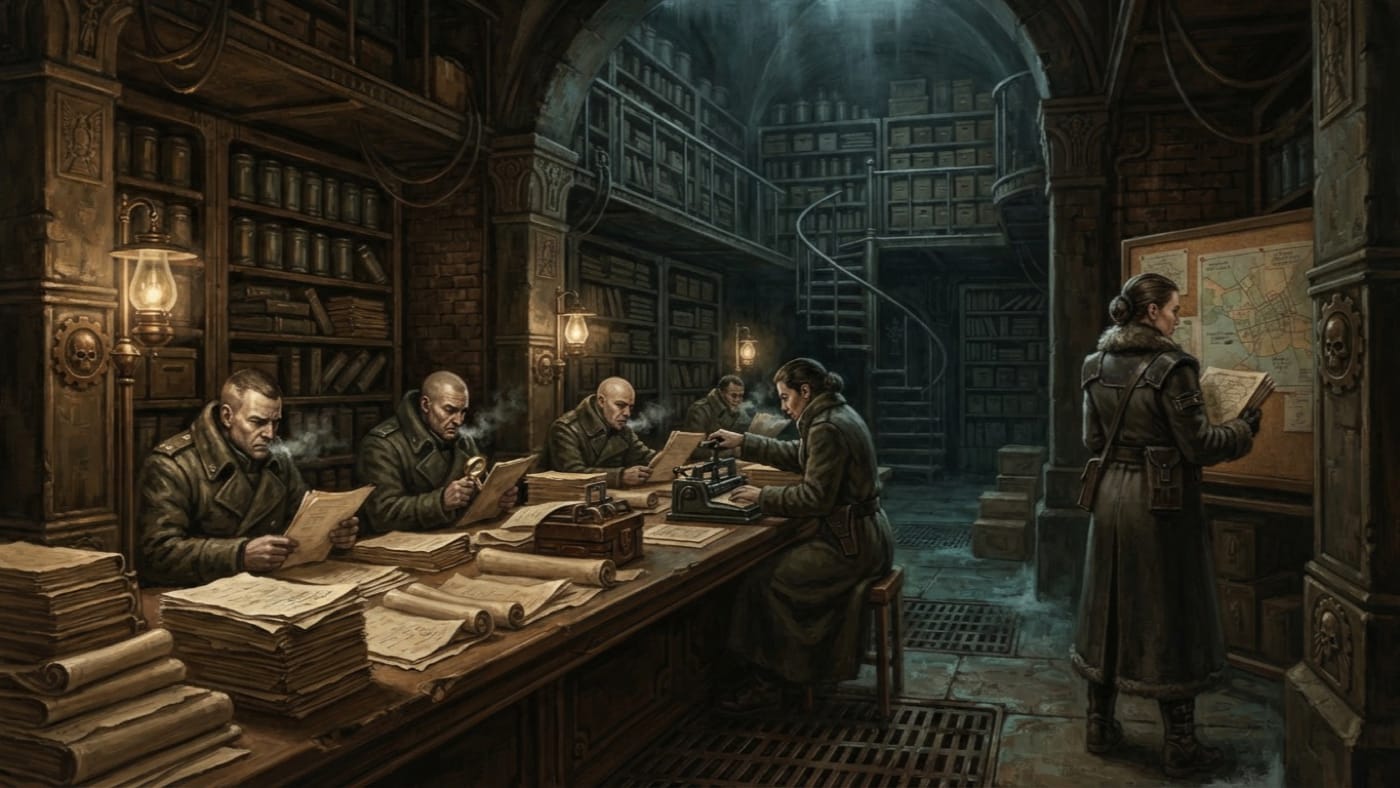
The Joint Investigatory Cloister keeps its rooms cold. I begin there because the record gives me that and very little else about the building, and because I have worked in warmer offices that hanged fewer people. It lies in Strasbourg, deep in the safe heartland, where the Church can afford slow work and has had the sense to make it slower. No surveyor has supplied me with its street, and its keepers have not volunteered one. I take this as proper discretion toward the public and an insult toward my seniority.
What the cold rooms hold is better documented than the walls around them. In A.S. 201 they hold the Tower Nine bell codes from Lorn, the Payroll Spur ledgers, the corrected manifests, the freight priority windows, and the sealed reports on the Hymn-Phase Slip. They also hold Inquisitor-Regent Veyl Hark. The Cloister is her home office, and her dossier lists her affiliation as Bureau of Purity / Strasbourg Joint Investigatory Cloister. That slash does more diplomatic work than most envoys I have known.
Her commission stamp shortens the name to Strasbourg Joint Cloister. Clerks abbreviate whatever they expect to write often. It is the same house.
A cold room has its uses. Wax keeps its edges. Ink dries where it was laid. A reader bent over a forged line can watch his own breath settle on the page, and he learns to hurry. Evidence gets adjusted when someone lingers over it, and nobody lingers in the cold.
#On the Matter Brought Before It
In A.S. 199, three sealed crates of relic-payroll left the Palatine Switchyard of Lorn by the Payroll Spur, consigned to Bastion-Przemyśl. They arrived empty. Their seals were intact, their stamps genuine, and the cantor measure that timed their passage flawless. Each of those facts is true by its own paper. The crates were still empty.
That is the matter the Cloister was given. It had three sound records and one failed delivery, and no record could explain the bare wood at the end of the line. Lorn's Yard Tribunal tried to keep the losses in local language, with words such as shortfall, misrouting and handling wastage. The losses outgrew those words, and the matter travelled up the line to Strasbourg with each custodian's defence attached.
Yard Palatine Odrin Kessel, who answers for the yard, sent innocence in seventeen pages. Prefect Halden Wry, who answers for the paper, sent corrections. Bell Marshal Sister-Calder, who answers for the measure, sent tonal records. Each submission defends the piece of truth its author was assigned, and each is competent. Competence has never filled a crate.
On the Cloister's tables, the bell codes sound correct. The ledgers balance. The manifests have been corrected, and the questions of who corrected them and in which direction are exactly what the cold rooms exist to ask. The priority windows opened and closed on time. The Hymn-Phase Slip reports remain sealed. I have not read them. I have read their seals, which in my profession is like hearing a confession through the screen and catching only the penance.
#On the Commission and Its Instruments
An Inquisitor-Regent is an emergency, and the title says so to anyone who reads Church Latin with suspicion. It is not a permanent rank. The authority is granted when an ordinary inquiry would otherwise have to ask permission from the people it is investigating. Within her assigned jurisdiction, Hark may audit, arrest, supersede, seal, reopen, requisition and depose. She may also command interim obedience from any officer below Archon seal.
Every word of that belongs to her commission. None of it belongs to the Cloister's furniture. Her powers stop at Archon seal, and so do mine, though mine stop considerably sooner and with less ceremony. The Cloister gives the commission a place to sit, and when the emergency ends the room will have no more authority than it had before.
Her method is subtraction. She separates voice from record, record from route, route from profit, and profit from alibi. Then she looks at what is left. The cold rooms already hold the first stage of this work: papers taken from the yard that produced them and set apart from the officers who produced the yard.
The field stage has not begun. Once Hark is in Lorn, the bell codes are to be copied by hand under oath and sung by unrelated cantors outside the yard. The Payroll Spur logs are to be taken from their custodians and the custodians questioned separately. Tower Nine's lamp sequences are to be reconstructed with no tower men in the room. The sealed clock beneath the tower is to be named in writing. All of these are intentions. None has been done. No reconstruction has been completed, no clock unsealed, and nobody questioned under the commission's authority. I am precise about this because Lorn is not, and Lorn has already begun reporting results from procedures nobody has performed.
She will travel with eleven clerks, two white-mantled Inquisitors, a bell-copyist with scarred lips, and a portable audit press. This is the commission's escort, not the Cloister's household. Each member has a defined use. The clerks will copy. The Inquisitors in their mantles will make sure the copying goes uninterrupted. The bell-copyist will turn sound into ink without improving it. Witnesses report that the press plates are warmed over a votive brazier before use. I repeat that report as a report. If it is true, it is theatre. It is also good theatre, and men confess faster when the instrument of correction smells of chapel iron.
#On the Offices That Supply the Record
The word Joint in the Cloister's name has been read as a constitution. It is not one. The record shows which offices have sent material to the review table. It does not show who governs the house, how they vote, or who owns the chairs. I will describe the documents and leave the deeds alone.
The Bureau of Purity supplies the Inquisitor-Regent herself, along with Purity's habit of enforcing a definition once other offices have finished arguing about it. The Bureau of Bells supplies a sealed advisory note, and it also governs Lorn under joint command with Records. Bells therefore advises the auditor of a yard it helps to run. The Bureau of Records sends a sealed addendum under the same double arrangement. Its documentary authority is the very thing in question, because the empty crates carried genuine stamps. The Bureau of Shadows sends a sealed advisory note and nothing else, as usual. Lorn's freight serves the logistics of the Bureau of War, whose forward troops were the ones left unpaid.
So two offices are advising on a scandal in their own jurisdiction, a third advises while denying that it advises, and a fourth carries the arrest powers. Inter-bureau rivalry in Strasbourg is old, polite, and murderous at the level of the footnote. The cold rooms make it visible. Each advisory note defends its own Bureau's ledger first and the Church's ledger second. Hark reads all of them as claims, which is what they are.
The three sealed advisory notes, from Shadows, Bells and a Records addendum, share one hinge-name. That name remains under Hierarch's Seal. It is not printed here, and this office has stopped being asked to try.
#On the Present Condition
Hark is still in Strasbourg. The cold rooms still hold the papers. The commission is active and has not yet arrived, and Lorn is acting as though it had.
Lorn's tower callers now check their lamps twice. Its manifest clerks no longer correct in red and have switched to grey. Wry has ordered three archive rebindings and called each of them routine. Kessel puts on his gloves before handling documents that do not need gloves. The Switchmen's Union expects arrests among switchmen, and the Hush Tunnel Runners expect arrests among runners. Each expects the other to be named first. Along the Vire River-Belt Interchange, handling fees have gone up and witnesses can be rented in threes. The Archivolt Causeyworks has started cutting duplicate toll sums into stone in case the paper is ever doubted.
No order produced any of this. A cold room in Strasbourg reviewed a column of bell codes, and men several hundred miles away started pissing themselves over grey ink.
A Lorn notice describes the incoming commission as a "supportive audit presence."
Corrected. The commission may arrest, depose and seal within its jurisdiction. The support it offers is the kind a gallows beam offers a rope.
I have called Hark probably fair, and I still say so. That is my assessment, entered under my seal, and nothing more. Any bureau may admire the Cloister's tables. Fairness is a quality of the person who sits at them, and in my experience it costs the condemned more than corruption does, because it cannot be bought off.
The current estimate puts her arrival after the second A.S. 201 corridor review. It sets no calendar day and promises nothing. Snow, sabotage, bell quarantine, a sudden promotion or the older Strasbourg habit of holding a terrifying official in reserve could still keep her in the cold rooms for a season. Until she leaves, the review continues as before, one bell code at a time.