
#On Passau and the River
Passau stands on the Danube upstream of Linz, with Vienna farther down the same water. The Codex files it under A.S. 34 / 1744 CE because that is the year of the Red Flood of the Danube, and the year in which Passau gave the Ledger its first confirmed report of the river turning against the people who worked it. The date marks that report. The town is older than its usefulness to me, as towns generally are, and how it began is not the business of this plate.
A river town is kept running by small offices. A barge comes down. Someone on the bank looks at its draught, its cargo and its crew, and decides what it owes. The due is paid or disputed. The entry goes into the roll. Then the next hull comes, and the next, until the light fails or the river freezes. A toll keeper's eye is trained on what floats, what it carries and what it is worth. The water itself is only the floor of the office, and nobody writes reports about the floor.
One morning east of Passau, the floor changed.
#On the First Report
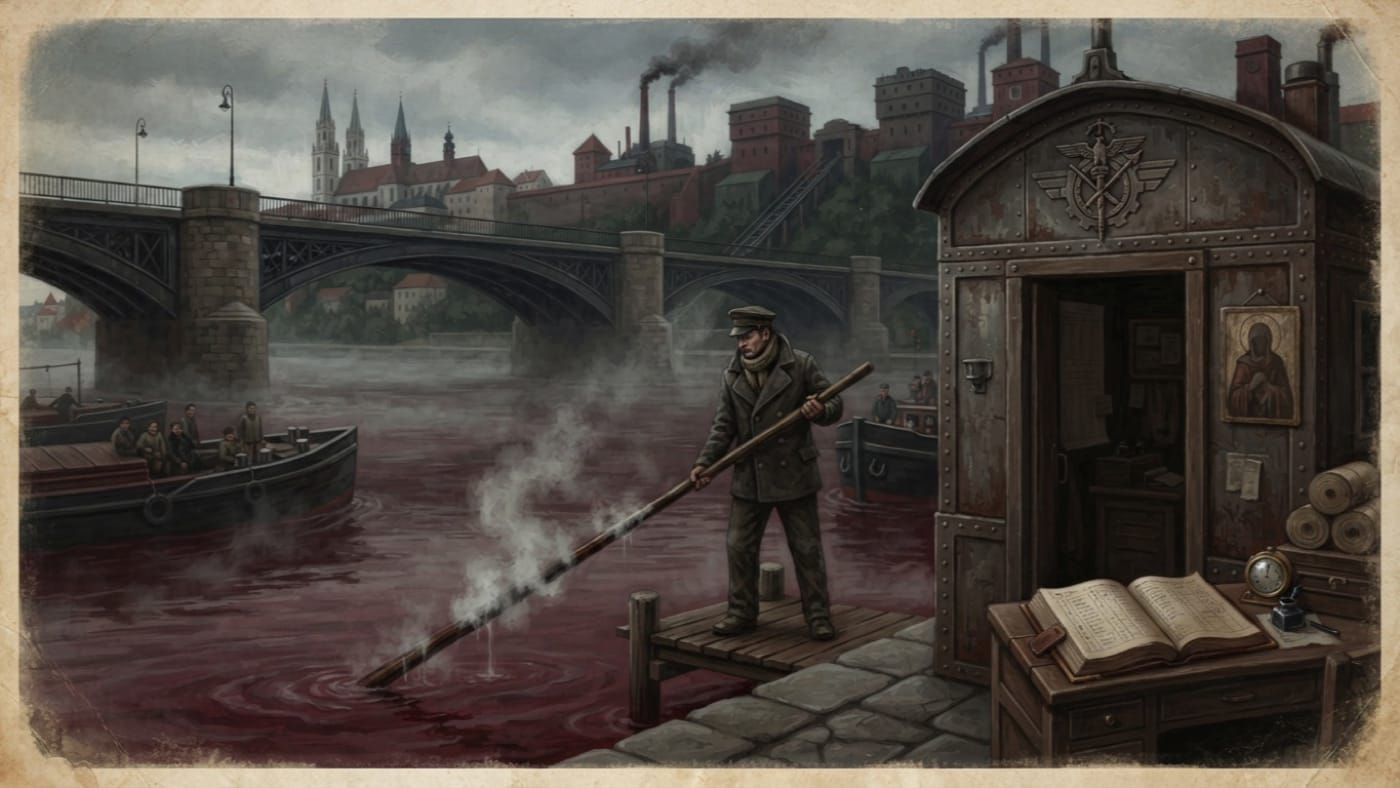
The keeper wrote that the morning water had thickened beneath the bridge, and that a barge pole drawn from it steamed in the air. The account as the Codex preserves it gives the steam a comparison: like a cautery iron. That is the whole deposition. It has a bridge, a pole and a morning, and every word of it is useful.
Consider the pole. Anyone who works a crossing has pulled one from the river a thousand times. It comes up dripping, cold enough to ache the knuckles, heavier at the wet end. Hands learn that weight the way a sacristan's hands learn the heft of a censer, and they stop noticing it. On this morning the wood came up out of the Danube and smoked like a brand lifted from the brazier. A surgeon would have known the comparison at once. So would an inquisitor. The keeper seems to have reached for it without either qualification.
Then there is the thickening. Water poured from a bucket behaves in a manner known to every child in the corridor. Water that has thickened beneath a bridge behaves in some other manner, and the keeper had the discipline to write the observation and stop there. The account names no saint and no demon, and it gives no estimate of how far the condition ran. It does not claim the river was red at that spot, though the corridor would soon make the colour a matter of public record.
"First confirmed" is a clerk's phrase, and it should be read as one. It means this is the earliest report that reached the record and was borne out by what followed. It does not mean the Flood began at Passau, or that the water above the bridge stayed clean, or that nothing stirred in the night before the keeper came down to the bank. Preachers have since made the bridge a font and the keeper a herald. The Ledger makes the keeper a witness, which is rarer.
The name has not reached this office. I decline to christen a witness for the convenience of a sermon.
#On the River Below
The sequence after Passau survives in the order the parent account gives it. By noon the ferrymen at Linz were refusing crossings. By vespers the Vienna docks had closed, after two labourers burned their hands hauling mooring ropes soaked in red water. There was a written report in the morning, a refusal at midday, and two burned pairs of hands in the evening.
The neatness tempts readers to treat it as a front rolling downriver at a measurable pace, with Passau as the source. The entries do not bear that weight. They record when three places reported or acted, which is a different thing from when the river reached each of them. No one with a watch stood at every bend between the bridge and the Vienna quays.
What the corridor suffered as a whole is better attested. The Danube ran crimson for three weeks. Some reaches boiled and others steamed. Villages drowned in backwash. Fish died until the shallows were white with bellies. The stain got into wells. Grain barges ordered to keep moving kept moving until their crews broke at the oars. The record does not say which of these afflictions came to Passau, or how badly, and this plate will not drown the town's cellars to fill a column. The steaming pole is Passau's own evidence, and it is enough.
The Republic answered along the river with printed notices telling the public not to drink the water and to report superstitious speech. No Passau copy is held here, and no Passau magistrate's name is attached to any copy. The first instruction was sound. The second was an instruction to inform on anyone who described the river accurately.
#On the Toll Rolls and the Judgment
Several local primers, copying an early note of poor authority, give the Flood's duration as forty days.
Corrected. The canonical duration is three weeks, attested by the Passau toll rolls alongside the Vienna dock registers and the later Bureau of Doctrine classification. Forty days belongs to the Year Without Dawn. The two omens are separate entries, and a clerk who files one under the other's sum will be given a quieter post in which to practise subtraction.
The Passau rolls deserve some attention, since they are the town's second contribution and, for the arithmetic, its more durable one. A toll roll is a calendar kept by commerce. It was never meant to record portents. It records hulls, dues and days, entered by people who had no theory of the Flood and no reason to want one. When the Ledger had to settle how long the Danube bled, it cited that kind of witness beside the Vienna registers. The citation says the rolls support the count. It does not give folios, custodians or the hand that wrote them, and I will not invent any. A document cited in its plain capacity is worth more than one I have decorated.
The Republic had its own explanations: iron and mineral displacement first, then underground heat, then panic. Each paper was received with praise. Each is still on file as the considered judgment of a state that had founded itself, through the Treaty of Regensburg four years earlier, on the premise that rivers answer to measurement.
The Church in A.S. 34 had no bureaus and no seals, and its people kept out of sight. Along the river the faithful kept what they could and spoke quietly, in the manner later honoured among the Cellar Saints. The judgment came afterward. The Bureau of Doctrine, looking back down the decades, ranks the Flood as the Third Providential Warning and names it the Blood Tithe of the World. It follows the Cold Fires of Vienna in A.S. 30 and the Year Without Dawn in A.S. 32, and it precedes the Eastern Silence in A.S. 38 and the Sundering on 1 November A.S. 45, eleven years after the river cleared.
Under that holding, the Passau report becomes the first line of the Tithe's receipt. I find this flattering to everyone involved, and most of all to the Bureau. A retrospective classification lets an office stand witness to an event it was not alive to attend. I have countersigned such entries myself, and the wax set just as hard. The columns must still be kept apart. Doctrine holds what the Flood meant. What moved in the water, and whether the Creator's hand or the Great Deceiver's was nearer the bridge that morning, a holding on meaning does not decide. The keeper decided nothing either. The keeper saw the pole steam and wrote it down.
#On the Clearing
On the twenty-second morning the Danube ran brown again, cold enough to numb a hand. It was ordinary water with the usual silt, ordinary for the first time in three weeks. The fish took a season to come back, and the wells cleared more slowly still. The Prefectures reopened the river and counted the damage in their own fashion.
When Passau's bridge took its first ordinary toll again, the file does not say. It is silent too on whether the keeper went on keeping it, was thanked, was questioned or was simply left to the next barge. I would wager on the barge. River towns do not stop for long, and their clerks stop for less.
What Passau left the Ledger is small and exact. One morning a working tool came out of a working river and smoked in the air, and the person holding it wrote the fact down before anyone with a title arrived to say what it meant. The titles arrived later, from both sides of the river and both sides of the grave, and they are all still arguing.