
#On the Crossing
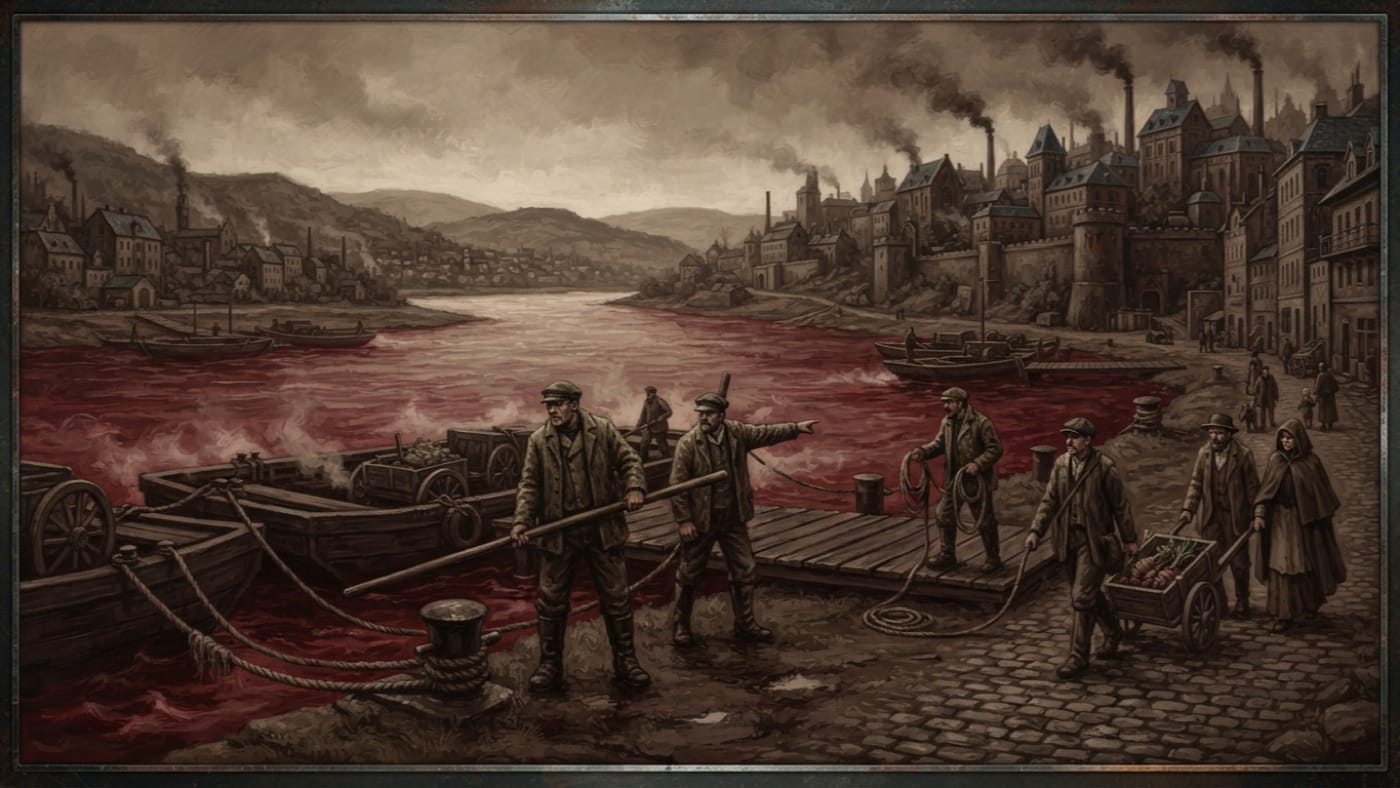
Linz sits on the Danube below Passau and above Vienna, on the stretch of river that in A.S. 34 / 1744 CE turned the colour of a butcher's apron and stayed that way for three weeks. The Codex files this plate under that year because the Red Flood of the Danube is when Linz made its one recorded contribution to sacred history. The year marks that milestone. It is not the town's founding, which the files consulted for this plate do not give. They are equally silent on its walls, magistrates, census and later fortunes. The Bureau does not supply these from imagination. Imagination belongs to the Bureau of Pilgrimage, which charges for it.
What the record does supply is a ferry. A river town lives by the men who carry people across it: the farmer taking a cart of turnips to the far market, the clerk with a sealed packet, the midwife called at midnight to the wrong bank. Each crossing renews a small contract. The passenger pays, the ferryman judges the water, and the river either consents or refuses. No Linz toll schedule, boat measurement or traffic tally from A.S. 34 has reached this office. I will not invent a fare for a crossing that did not happen on the day that matters.
#On the Refusal
The sequence survives in the order the parent account gives it. In the morning a toll keeper east of Passau reported that the water under his bridge had thickened and that a barge pole drawn from it steamed in the air. By noon the ferrymen at Linz were refusing crossings. By vespers the Vienna docks had closed, after two labourers burned their hands on mooring ropes soaked in red water.
Morning, noon, vespers. It reads like an Office, and later readers have prayed it as one. The Ledger has to be firmer than its readers. These three entries record what three places did once the river reached them. Nobody measured the intervals, and nobody stood on the bank at every village in between with a watch. The account does not say whether the crimson reached Linz at noon, at dawn, or during the night while the ferrymen slept. It says when they stopped.
The sentence names no ferryman and cites no authority. If you search the corridor files for a magistrate's seal, a guild resolution or a constable posted at the landing to turn back carts, you will find dust and a few mouse droppings of uncertain doctrinal status. The men who worked the river looked at it and declined to go out on it. That is the whole Linz entry. It is worth more than most of the decrees I have sealed.
Look at the competence involved. Upstream, the Republic's officials were still drafting. Downstream, Vienna kept its docks working until its labourers had taken the river into their palms. At Linz, men who handled poles and ropes for a living saw the water misbehave and kept their hands, their boats and their passengers out of it. They acted before anyone had explained anything to them. Explanations arrived later, from several directions, and the delay improved none of them.
Later sermons have given the Linz ferrymen rosaries, visions and psalters sewn into their coat linings. The file gives them eyes.
#On the River and Its Notices
The Danube ran crimson for three weeks. In some reaches it boiled, and in others it steamed. Dead fish lay so thick that the shallows were paved white with bellies. Villages drowned in backwash. Grain barges ordered to keep moving did so until their crews collapsed at the oars. Wells near the flood took in the stain. All of this happened along the corridor as a whole, and Linz lay within it. The record consulted for this plate does not say which of these afflictions reached the town itself, or how badly. I will not flood its wells to fill a column.
The neighbours give sharper evidence. Downstream at Vienna, dock workers carried marks from the river that kept no ordinary pattern. One rope-hauler, Matthias Krell, was locked in a second-storey cell that filled with red water rising from dry stone. Downriver in the Wachau, a schoolmaster kept his pupils reciting their civic primer while the water rose around the benches. Fishermen took the children off in skiffs. The schoolmaster lodged a complaint against them for procedural trespass and died that evening of steam in the lungs. Set him beside the men at the Linz landing and the comparison needs no help from me.
The Republic answered with paper. Notices went up on bridges and quay walls along the river: NATURAL FLUVIAL DISCOLORATION — AVOID PANIC — DO NOT INGEST WATER — REPORT SUPERSTITIOUS SPEECH. This office holds no Linz copy, and no Linz official's name is attached to any copy it does hold. By then the ferrymen had already obeyed the second and third instructions by several hours, and the fourth was no use to them. They had said nothing superstitious. They had said no.
The Republic's hydrologists offered three explanations in turn: mineral displacement, then underground heat, then panic. The first two at least concerned the river. The third concerned the people beside it, and so it charged the ferrymen with the one vice they had plainly not committed. A panicked man rows. A frightened man with judgment ties up his boat.
#On the Later Classification
In A.S. 34 the Church was hidden. The Treaty of Regensburg of four years earlier had made its gestures illegal. Along the corridor the faithful who went unseen gathered red-stained cloth and fish scales and kept them in cellar chapels, after the manner later honoured among the Cellar Saints. No one in that Church classified anything at Linz. The offices that classify did not yet exist. The Bureau of Doctrine's reading belongs to later generations, who looked back down the river and found it already written.
That reading, now held, ranks the Flood third among the Providential Warnings. First came the Cold Fires of Vienna in A.S. 30, then the Year Without Dawn in A.S. 32. The Red Flood followed in A.S. 34 as the Blood Tithe of the World. The Eastern Silence came in A.S. 38, and the Sundering on 1 November A.S. 45, eleven years after the river cleared. Under this holding the Linz refusal is entered as an early and correct reading of the warning, made by men who could not have known they were reading anything.
I have sealed filings of that kind myself. They are handsome, and they flatter everyone involved, especially the dead, who cannot object. A clerk of the Ledger must still keep the columns apart. Doctrine's confidence concerns what the Flood meant. The physical mechanism of the river, and the ultimate cause of what followed in A.S. 45, are not settled by a holding on meaning. Nor does the holding turn the ferrymen into theologians. They refused a crossing. The Bureau supplied the hymn.
An earlier index slip for this entry gave the Flood at Linz a duration of forty days and described the crossing as "closed by municipal order."
Corrected. The canonical duration is three weeks. Forty days belongs to the Year Without Dawn, and the clerk responsible has been given a calendar and a lesson in its use. No municipal order, signature or guild resolution survives for Linz. The ferrymen refused. The magistracy, wherever it was that afternoon, receives no credit it did not earn.
#On the Clearing and the Record
On the twenty-second morning the Danube ran brown again along its length: ordinary river, cold enough to numb a hand. The fish took a season to return, and the wells cleared more slowly. The Prefectures reopened the ferries and tallied the damage. The file does not say on which day the Linz landing took its first passenger again, who paid the fare, or whether the ferrymen were thanked, fined or simply forgotten. I would wager on the third.
The record contains a toll keeper's report, a closed dock, two burned pairs of hands and, between them, one landing on the Danube where the men who knew the water best left it alone. The Republic explained the river and the Bureau later interpreted it. The ferrymen at Linz read it first and kept their boats tied up.