
#On the Compact
"The mountain gives truth to the faithful." — official line, Saint-Helm's Cut. "The mountain gives cough to the poor." — the same line, as amended in the street
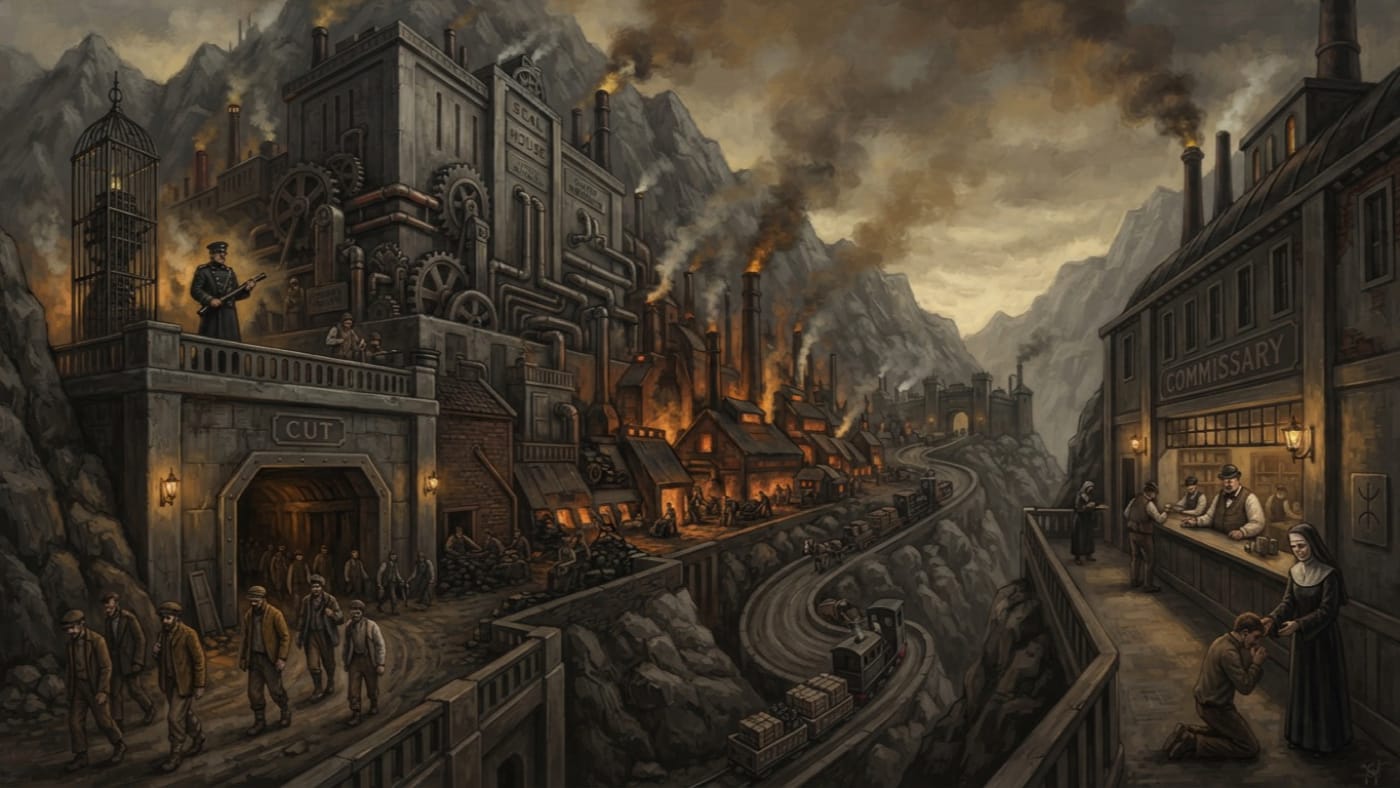
The Pane-Guild of Saint-Helm is the licensed craft compact that decides who may cut, fire, grade and eat at Oathglass Quarrytown, Saint-Helm's Cut. Its public purpose is quality and safety. Its real foundation is a monopoly on tools and kiln time, which is quality and safety as described by someone who owns neither.
The Cut was registered in A.S. 96. In A.S. 102 the quarry received its charter under the Pane-Guild compact, and from that year the Guild's licence and the mountain's output appear in the record as one entry. What the Guild was before its name reached that charter, the archive does not say, and I will not make it up. The first verified pane went down the switchback to Strasbourg in A.S. 103. Reliquaries across the Church have depended on Saint-Helm glass ever since. A shrine-city several days down the caravan road does not know the Guildmaster's name. It knows that its relics are lit through glass cut to his quota.
On paper the town is governed by three parties together: the Synod Reliquary Office detachment, the Guild council and the quarry foremen. Guild adjudicators sit in local enforcement. The council's size, its elections and the clauses of its charter appear in no file I am permitted to quote. This is unusual. I am permitted to quote almost everything.
#On Tools and Kiln Time
Iron tools come up the switchback road with the grain and the lamp oil, and they pass through Guild hands before they touch slate. A cutter without a licensed tool has no place at the Cut Face. Below the benches, Kiln Row burns day and night under the same arrangement. Furnace hours there are scarcer than bread, and they are allotted by kiln-time voucher. A lampwright without a voucher has sand, skill and nothing to sell.
The roster tells a worker which shift to work and how deep to go. The quota tells them how much glass the mountain owes before they come up. The wages are paid partly in pane-scrip, which only the Guild will redeem, so the paper goes round in a circle. The Guild pays it out at the Cut Face and takes it back at the commissary, and the worker's hunger is what keeps it moving.
Then come the tithes. Every tenth sheet is the pane tithe. The lamp tithe, the labour-hours and the confession receipts all enter the same accounts. A worker who coughs badly enough to need the Breath Chapel's cures takes on cure debt, which is paid in extra shifts or, failing that, in burial fees. Confession penalties are added as shifts. In winter the travel bans close the road, and the debt stays where it is.
None of these instruments carries Guildmaster Orr Vetch's signature in any file I have seen. It does not need one. Quota bondage, forced overtime and the winter ban belong to the whole settlement, and they run without anyone signing them, the way a well-made censer swings without needing the deacon's opinion.
#On the Other Authorities
The Guild does not rule alone. It is surrounded by three other authorities, and each of them guards a gate.
The first gate is the Seal House, the single stamp office that decides which glass is holy and which is contraband. The Guild has a standing presence there. The stamps belong to Verifier-Provost Maelin Rook of the Synod Reliquary Office, who does not answer to Vetch. Rook wears immaculate gloves and never touches glass without witnesses. A Guild pane without her stamp is a criminal shard with a good finish.
The second gate is the tunnel mouth, held by the Choir Wardens with throat cords and batons. They enforce sanctioned song at the mouths and the hymn towers, and silence where silence is ordered. Their discipline keeps the shifts singing, which keeps the shifts cutting. No record makes them the Guild's men. They are simply very convenient to it.
The third gate is the sickbed. Sister Brethna and the Breath Chapel Sisters hold the permissions for medicine and for burial, and they use that control over cures to push back against the Guild's abuses.
This arrangement still favours the Guild, and the reason is plain. The others guard gates. The Guild owns the hours in between. Rook can refuse a pane, but the Guild decided who cut it. Brethna can grant a cure, but the debt for it is paid in Guild shifts.
#On Safe Procedure
I will be fair to the Guild, which costs me nothing. Its people know slate. They know how a seam takes a wedge, how a pick should fall in time with a breath under a resin mask, and which intervals settle a gallery and which make the ceiling shift. Sanctioned hymns really do steady the upper workings, set the rhythm of a shift and keep fools from trying out vowels under four thousand tons of temperamental rock. The Guild saw a safety practice and called it craft. The craft is real.
So was A.S. 111. A damaged hymnal gave a tunnel choir the wrong interval, and three hundred yards of gallery ceiling came down. Two hundred and fourteen workers died. The matter was classified as procedural, the hymnal was corrected and the galleries were reopened. Gallery Nine stayed sealed. Procedure kept the Cut running, as procedure is meant to.
Vetch's own fear, as far as the record shows one, is that the next collapse will be blamed on unsung procedure, meaning a failure of the Guild's discipline rather than an act of the mountain. It is a craftsman's fear and a quartermaster's fear at once.
The bodily cost is never a matter of procedure. Workers cough up glass dust that the street calls cough-silver, and it is the proof that they worked. The Guild has wanted safer shifts while the Synod demanded more verification. The workers have threatened a silence strike: no singing, so no mining. It remains a threat. It has not been carried out, and nothing has been settled.
Guild and quarry ledgers record stable output and a healthy workforce.
Corrected. Output is stable. Half the town sleeps sitting upright in order to breathe. The ledger was right about the glass.
#On the Twenty-Three Minutes
In A.S. 199, during the second shift, Gallery Nine began to sing through its brickwork.
Each authority did what it does. The Wardens closed the tunnel mouths. Rook separated the witnesses and confiscated their hymn-cards. Brethna opened her private ledger and made thirteen entries. The Guild stopped extraction for twenty-three minutes. In the whole history of that organisation, nothing else comes as close to reverence.
The incident notice gives the singing as fourteen minutes and six seconds. The stoppage and the song measure different things, and they should not be subtracted from each other, though every clerk in Records has tried. Brethna's thirteen entries record thirteen entries. They do not number the listeners, and they foretell nothing.
Then Vetch demanded that the shift resume before the mountain "learned it could negotiate." I admire it, unworthily. He has the spiritual instincts of a butcher and the institutional judgement of a man who knows that every hour of silence is a precedent. A quarry that stops once for a voice is a quarry that will be asked to stop again.
The deeper threat to the Guild sits in the sealed file on the Resonant Vein, which says the glass responds to names. Some of the useful intervals work because they happen to contain fragments of names. A hymn can be printed, licensed, rostered and priced. A name belongs to a family. If the true instrument of the Cut is a family's syllables, then the Guild's whole hymn discipline is a curtain over something it does not own.
I have no evidence that Vetch knows a responsive name, has run trials with one or keeps a flawless pane in a drawer. The danger lies elsewhere. Brethna's ledger lists the households whose names have held galleries steady. The Guild would turn that genealogy into quota if it were allowed to, and Brethna knows it.
#On the Present Allocation
In A.S. 201 the Cut remains open. Inquisitor-Lux Thane Mire sealed the matter under Priority Amber. He did not close the quarry and he did not reopen Gallery Nine. The Bureau of Alchemical Standards keeps the responsive-mineral file, and the Bureau of Doctrine keeps the names. Below the third level, roll call is now taken by roster numeral, and personal names are banned underground.
Vetch has raised the deep-gallery quotas. The record shows the Guild wanting safer shifts and the Guildmaster sending more cutters deeper, and it does not explain the gap between the two. Neither will I.
A flawless pane has been found, forged or imagined, firmly enough to move prices. Audits have sharpened. The Black-Glass Runners sell more shards down-valley, and the Flawless Claimants keep hunting the True Pane, which would sanctify whatever relic stood behind it. Brethna's ledger now has a second lock. Kiln Row still burns, the vouchers are still issued and the scrip still comes back to the commissary. The mules still carry certified proof down the road from Saint-Helm's Cut.