
#On the Sisters of the Cut
"Cures what she can; records what she must." — common description of a breath sister, Saint-Helm's Cut
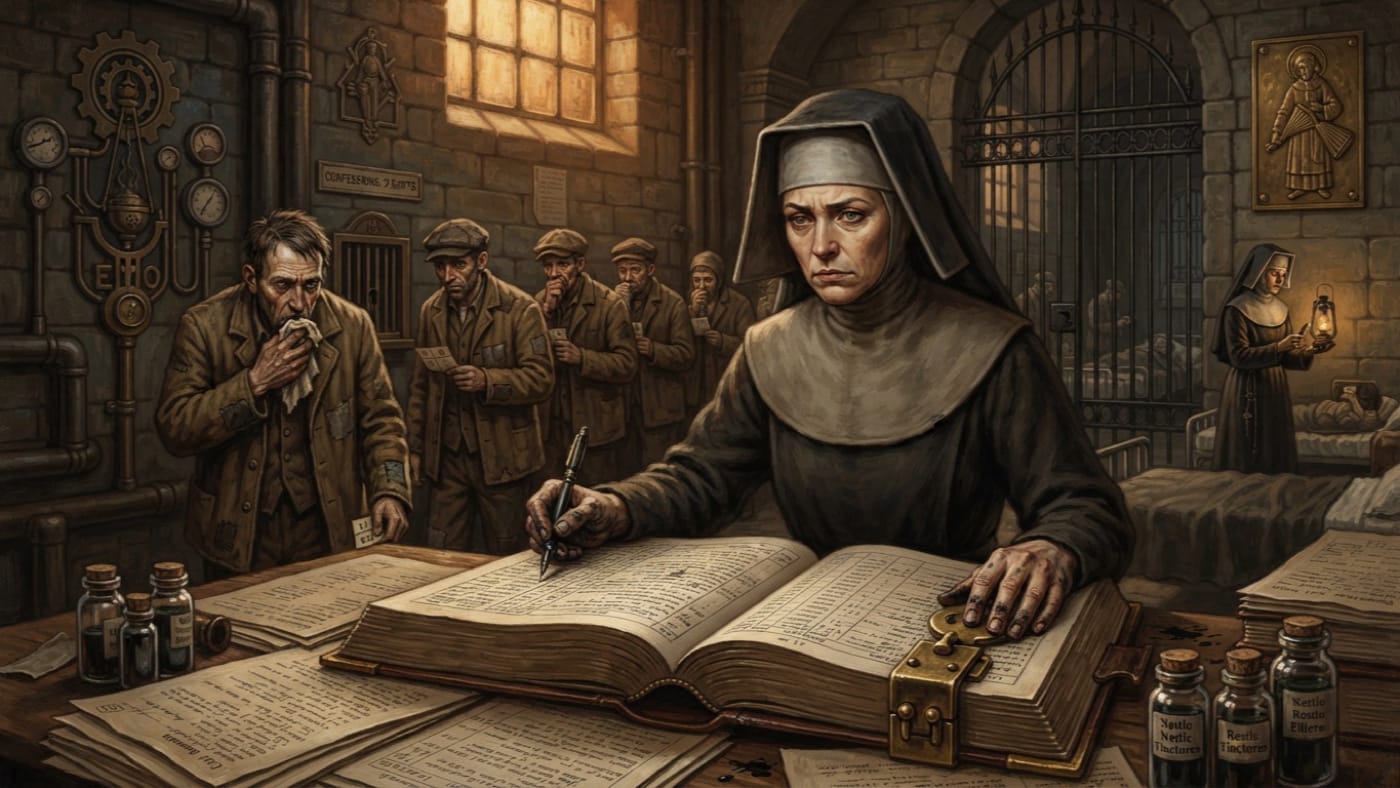
The Breath Chapel Sisters are the care order of Oathglass Quarrytown, Saint-Helm's Cut. Their jurisdiction reaches as far as a cough can be carried: the Breath Chapel, the sickhouses, the Chapel steps where half the village gathers to talk and the other half to spit, and the paperwork that follows a body into the ground. The building deserves its own folio and will have one. This entry concerns the women who work inside it, and the books they keep.
Their public purpose is healing. The Chapel smells of resin and boiled nettle, and you can smell it from the Switchback Market when the wind turns. Their other purpose, recorded in the plainer reckoning of the village, is to use access to cures against the abuses of the Pane-Guild. A care order in a glass quarry holds the one commodity the Guild cannot cut, stamp or regulate by hymn, which is the next breath. They hold it imperfectly. They hold it on paper.
I have been permitted to consult several files on the order and have consulted several more without permission. None of them gives its number, its vows, its superior or the year of its foundation. I record the blank. The Bureau does not fill a blank with invention. It waits until someone with a stamp does it for them.
#On the Breath Poor
The Cut kills in four ways. Collapse is quick. Kiln burns are quick enough. Winter exposure takes a night. Glass dust takes years. It gets into the lungs of cutters, haulers, graders and children alike and stays there, and the quarry calls the result glass-lung. The workers cough glitter into cloth and call it cough-silver, which also serves as proof they worked. The Chapel prefers a softer word and calls it lung-silver. It is the same bloody rag either way.
The breath poor are those at the bottom of the village, below even the shard-haulers. They are too sick to haul and too far in debt to leave. They are the Sisters' parish.
What the Sisters give out is relief, not reversal. Filter-makers make the resin filters that stop dust before it reaches the chest. Nettle preparations and breath tincture get a man through the night. Breath nurses sit with the ones who cannot be helped through it. Medicine herbs come up the single switchback road with the grain and lamp oil, and when snow closes the road, the herbs stop coming. No Sister claims to have drawn the glass back out of a lung. I searched for that claim the way one searches a reliquary for a pig's knuckle, and I did not find it.
Relief is allotted. A cure allocation slip goes out against a name. The name is entered in the cough registry. The cough itself goes into the Chapel ledgers as moral weather, a record of whose chest got worse after which sin. Confessions are heard in the same rooms, and the confession receipt counts among the town's tithes. Whatever the patient cannot pay becomes cure debt, which the village calls breath-debt, and it is paid in extra shifts or in burial fees. Confession penalties are also added as shifts. The cough sends the worker to the Chapel, and the Chapel sends the worker back into the dust.
Quarry ledgers record stable output and a healthy workforce at Saint-Helm's Cut.
Corrected. The output is stable. Half the village sleeps sitting upright so it can breathe. A cutter propped against a bunk-board until dawn counts as "healthy" only in a column that has never had to lie down beside him.
#On Mercy Against the Guild
The Pane-Guild of Saint-Helm presents itself as the guardian of quality and safety. It owns the tools, the kiln time, the shift rosters and the commissary scrip. Guildmaster Orr Vetch, who laughs like gravel and coughs like broken lanterns, sets the quotas and decides whose hands may hold an iron. Verifier-Provost Maelin Rook keeps the Seal House and the stamps that make glass real. The Choir Wardens keep the tunnel mouths and hymn towers with throat cords and batons. All of these powers work on the body while it still works.
Sister Brethna's power begins when the body starts to fail. By the village's own reckoning her leverage is medicine and burial permission: who gets a filter, and who may be put in the ground with the forms complete. Her rank in the order is not stated in any file I hold, but her authority is. A Guild that wants a crew underground needs that crew breathing. A foreman who wants a death closed quietly needs a Sister's signature to close it. The Sisters' purpose of using cure access against Guild abuse works in the space between those two needs.
The exact instruments are not in my files. One can imagine them, and the Guild surely does. I find no record of a reform won this way, and none of a strike the Sisters called. The silence strike that keeps being threatened in the Cut (no singing, no mining) belongs to the workers. The Sisters' power is narrower and older. Slip by slip, they decide who has the breath left to sing.
The same instruments work in the other direction too. A slip can be withheld from the Guild's enemy as easily as from the Guild's victim. A receipt can feed the commissary. A cure that bargains against the Guild is paid for in Guild hours.
#On the Books in Their Custody
The Chapel keeps paper the way the Seal House keeps wax. It holds the cough registry, the cure allocation slips, the confession receipts and the ledgers of moral weather. Apart from all of these is Sister Brethna's private ledger of the dead.
I cannot certify whether these are five books, three, or one swollen volume full of ribbons, and I will not draw a floor plan of a cupboard I have not opened. What I can certify is that their contents overlap: a name, a cough date, an allocation, a confession. Put together, they make a census more exact than anything in the Guild's roster office. The village says plainly that the cure ledger doubles as a blackmail ledger. It does not say who is being blackmailed. It does not need to.
According to the Resonant Vein file, Brethna's own book holds confessions, cough dates, cure allocations and the names of workers whose family syllables have steadied the galleries. It is the only document in Saint-Helm's Cut that records both who is dying and who is useful. Those two columns should never share a page. Here they do.
#On Names Kept from the Galleries
The Resonant Vein answers names. The public procedure gives the credit to sanctioned hymns. The sealed explanation, which I have read and the reader has not, holds that certain syllables steady the deep glass and others bring it down. Some of those syllables belong to households in the Cut. When a family's name holds a gallery up, the family is worth keeping alive. Brethna knows this. She also knows what the Guild would do with it: turn genealogy into quota, and send the bloodline that holds the ceiling down shift after shift until it can't anymore.
When a cantor fails at one interval and holds another, the Chapel's public explanation is lung condition. Damaged lungs really do sing badly, and the Chapel can say so with a straight face and a nettle poultice in hand. The explanation has the merit of being partly true, which in Saint-Helm's Cut counts as a high standard.
Brethna teaches the children of the Cut to answer to nicknames until they leave it. A child whose proper name steadies stone can be conscripted into the deep galleries before their lungs have learned despair. A child who answers to a nickname is just a child, with a cough and a slip. The household names stay in the ledger, and the ledger stays shut.
In A.S. 199 Gallery Nine sang through its brickwork during second shift. It had been bricked up since the A.S. 111 collapse that killed two hundred and fourteen. The Wardens locked the tunnel mouths. Rook separated the witnesses. Vetch demanded that the shift resume. Sister Brethna opened the Chapel's private ledger and wrote thirteen names before anyone told her the number of listeners. That is what the Resonant Vein file records, and I repeat it without improvement. The record does not say whose names she wrote, or that the listeners numbered thirteen. Doctrine will want to call it prophecy, and Purity will want to call it possession. I call it a Sister reaching for the book before the count came in. A good clerk does that, and a frightened one does it faster.
#On the Present Condition
It is A.S. 201. The kilns burn, the mule trains go down the switchback, and the Chapel steps fill at shift change. Vetch has raised the deep-gallery quotas. A Choir Warden order now requires everyone working below the third level to answer to roster numerals. Private, family, childhood and dead names are forbidden in active galleries. In the Seal House this is a safety measure. In the Chapel it means a quarry worker's whole name survives in only one place, the Sisters' books. That makes those books both the last record of a person and the best map to a useful one.
Inquisitor-Lux Thane Mire sealed the Vein at Priority Amber and left. The classification applies to the mountain, not the order. Rumours of a flawless pane have sharpened every audit in the valley. The village's own forecasts include a resin filter shortage, lung plague worsened by winter closures, and riots on the Chapel steps. None of these has yet happened, and I have not entered any of them as fact.
Brethna's private ledger has acquired a second lock.