
#On the Place Left Off the Diagrams
"…learned it could negotiate." — Guildmaster Orr Vetch, demanding that second shift resume, A.S. 199
Gallery Nine of Saint-Helm's Cut is a closed quarry gallery beneath Oathglass Quarrytown. This office files it under A.S. 199 / 1909 CE, the year the brickwork at its entrance was heard singing during second shift. That date marks when the singing was observed. It is not a founding date. No document I can lawfully cite records when the gallery was cut, how deep it runs or whose picks opened it, and I will not invent a pedigree for a hole in a mountain.
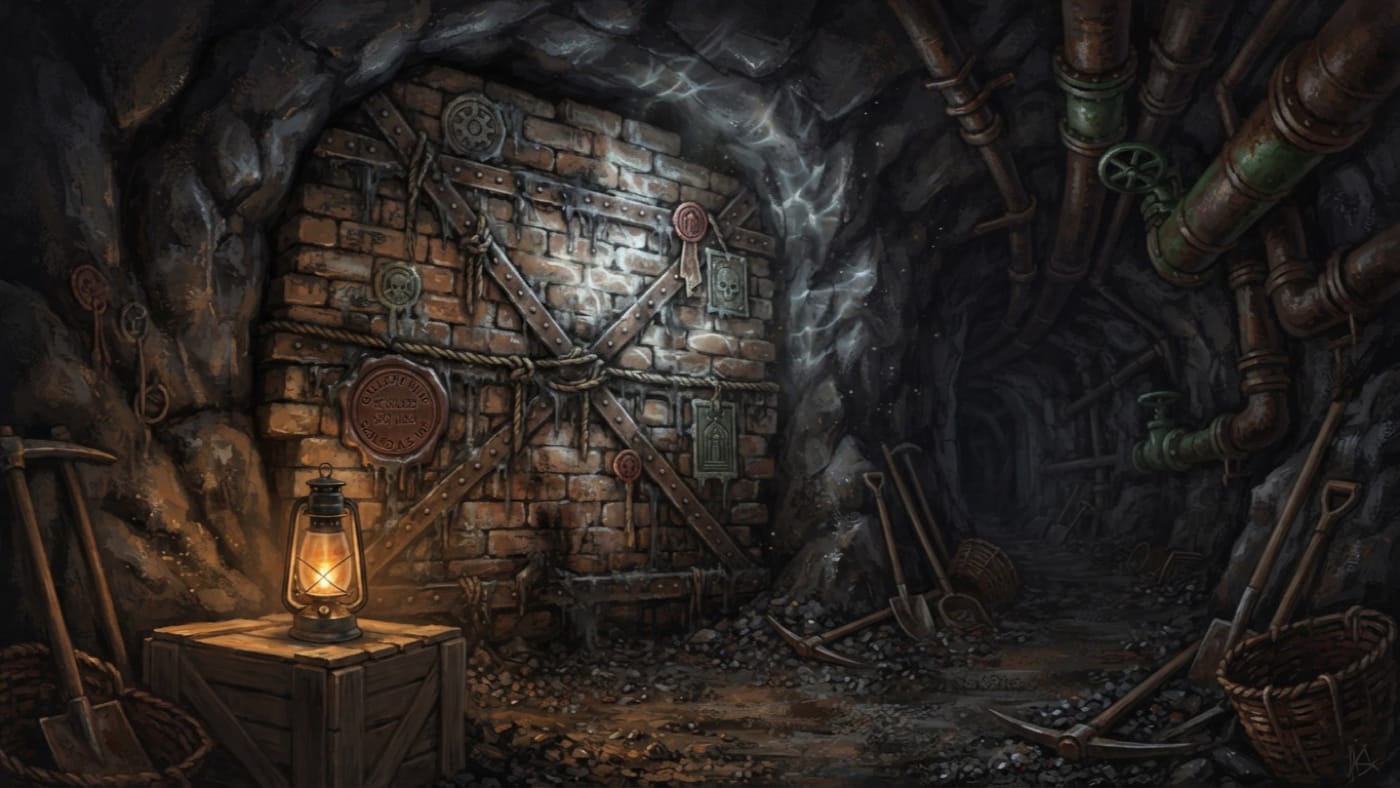
Old maps call it Gallery Nine. The workers call it the Throat. The official diagrams leave it out entirely, because a space missing from the drawing can never be listed for audit.
Official diagrams of Saint-Helm's Cut show the full extent of the lower workings.
Corrected. The old maps show a gallery below the Helm-Mouth that the official diagrams omit. Where the two disagree, the Ledger prefers the drawing that remembers.
The approach is a matter of record. A visitor goes down through the Helm-Mouth, the deepest tunnel entrance of the Cut, and then below the third extraction level. Further on, an old breath-pipe runs along the rock, and its valve is painted green. Past it the slate is cold enough to take skin. Volcanic-glass grit crunches underfoot, resin filters stiffen against the face, and a rationed lantern gives a few yards of light. At the end stands a bricked entrance. Nobody is licensed to see more than that, and most of those who go that far wish they had seen less.
#On the Closure and the Seal
The gallery was closed after the A.S. 111 / 1821 CE collapse, the first catastrophe of the Cut. The Resonant Vein file puts that catastrophe at two hundred and fourteen workers dead. The number belongs to the catastrophe as a whole. No record in my keeping assigns any of those dead to Gallery Nine, and I will not guess at a figure for it.
The Bureau keeps two explanations for the collapse. The first, which is procedural, blames a damaged hymnal that gave a tunnel choir the wrong interval. The second is sealed. It holds that the interval was wrong only by the standard of the official hymn, and that it was exactly right for a name it produced by accident. The two sit in separate drawers under separate seals, and no one has tested either inside the Throat.
At some point after the collapse, the entrance was bricked up. The brick was then dressed with wax, iron and prayer cord, and stamped by a Verifier. The record gives no year for the sealing, and I give none. Nothing I may cite preserves the Verifier's name. The Verifier's death is preserved: A.S. 116 / 1826 CE, coughing black glitter. That year dates a death and has nothing to say about the seal. Any clerk who copies 116 into the sealing column will receive this office's corrections in red.
The Vein file counts eighty-eight years of useful silence. The count runs from the collapse of 111 to the singing of 199, and it must not be measured from the Verifier's grave.
#On the Second Shift
The sound came during second shift in A.S. 199. The record gives no day, month or season. According to the Vein file, the sound was too articulate to be humming and too deliberate to be the rock settling. It sang.
Four responses are on record. The Choir Wardens locked the tunnel mouths. The Pane-Guild halted extraction for twenty-three minutes, which is the nearest that body has ever come to reverence. Verifier-Provost Maelin Rook ordered the witnesses separated and their hymn-cards confiscated. Sister Brethna opened the Breath Chapel's private ledger and wrote thirteen names in it before anyone told her how many people had been listening. Guildmaster Orr Vetch then demanded that the shift resume.
The notice and the Guild give two different durations. The singing lasted fourteen minutes and six seconds, and extraction stopped for twenty-three minutes. No clerk should try to reconcile the figures to save ink. The record does not say how the two periods overlapped, or what the Guild did with the extra minutes.
The words are on file as indistinct, which in quarry speech means that several witnesses understood them and had the sense not to agree in writing. The surviving accounts conflict. One man heard his dead wife's name. One heard his own name, spoken in his mother's voice. One heard the old name of the mountain, from before Saint-Helm's Cut received its profitable baptism. That name is sealed, and this office does not print sealed names to entertain readers. A fourth witness heard a name that shattered the lamp in his hands. By his account, the spilled oil hung burning in mid-air for nine breaths.
These are four hearings, and they do not add up to a transcript. The Bureau holds no agreed text of what the Throat said. A dead wife's name heard through brick does not prove that she, or anyone, is behind it.
#On the Offices at the Brickwork
Each office that came down to the bricks that day brought its own idea of what was at stake.
Rook holds the stamps of the Synod Reliquary Office, and with them the power to declare glass real. Rook never touches glass without witnesses, and therefore understands what witnesses are for. Witnesses kept apart give testimony. Witnesses left together reach a consensus, and a consensus is something an office has to answer to. The hymn-cards were confiscated for the same reason: a card that was sung in the presence of a singing wall is now evidence of what was sung.
Vetch holds the quotas and the tool racks, and is afraid of one sentence: that a collapse was caused by unsung procedure. His demand to resume was not panic. It was policy, delivered in the voice of a man who laughs like gravel.
Brethna's ledger needs to be described carefully. Even before the Throat sang, it held confessions, cough dates, cure allocations, and the syllables of households whose names were useful underground. That makes Brethna a keeper of exactly the kind of knowledge the Vein makes dangerous. Her thirteen entries of A.S. 199 have not been identified. They do not show that thirteen people listened, they do not show that the people named were harmed, and they do not show that she foresaw anything. The Breath Chapel and the Breath Chapel Sisters have both left open what those names matched. I leave it open with them.
The Wardens enforced the response. They locked the mouths and policed silence, and later they walked the extra patrols that Strasbourg ordered.
That order came from Inquisitor-Lux Thane Mire, who was sent to the quarry on a date this file does not fix. His third case stayed locked throughout. During the descent toward the Helm-Mouth, it reportedly ticked only when nobody was speaking. One test named in his warrant has been redacted. Mire did not reopen Gallery Nine and did not close the quarry. He suppressed the tables of names to which the glass responds, increased the patrols, and placed the wider Vein file under Priority Amber. Then the Brast assignment called him away. Neither the case nor the redacted test has been explained, and I will not supply an explanation of my own.
#On Names Heard and Causes Withheld
The record has to keep three things apart.
The first was observed. A vocalisation came through the masonry for fourteen minutes and six seconds, and the notice records it.
The second rests on attribution: the four hearings described above, each carried by one witness who heard it.
The third is context. The glass of the Resonant Vein answers to names. Under some names a seam tightens, under others the glass clouds, and under others it splinters. That is why a sealed gallery that makes sounds through brick frightens every office with a stamp to protect. But the Vein file deals with the seams of the whole quarry. It does not establish that any of its procedures took place behind the Throat's bricks.
Rook's sealed field memorandum of A.S. 199 belongs in this third category. It describes a trial pane, an empty relic chamber, and a witness who began speaking a name backward. No line of it places that trial in Gallery Nine. This office has no report of backward speech coming from the Throat, and the accounts must not be merged.
Purity would like the cause to be a demon, and the Flawless Claimants would like a saint. The file gives grounds for neither. No one has recorded the gallery's interior, so the Bureau has no inventory of chambers, no tally of bodies, no flawless pane recovered, and no mechanism. All the Bureau holds is a sealed entrance and a list of witnesses.
#On the Present Closure
As of A.S. 201 / 1911 CE, Saint-Helm's Cut is operating and Gallery Nine is still sealed. Both are reported as fact, and the Seal House would like readers not to wonder how both can be true at once.
After the A.S. 111 collapse, the galleries of Saint-Helm's Cut were re-opened.
Clarified. The quarry's galleries were reopened. Gallery Nine was not. Readers who take the plural to include the Throat will be corrected, and readers who go to test the point will need no correction.
Since A.S. 199 the sound has returned at irregular intervals: under wrong intervals, during roll call, when black-glass shards were carried past the bricked entrance, and on one occasion when Mire's travel warrant was read aloud in the Seal House before he arrived. The Vein file also records singing during changes of weather, changes of shift, and audits. I record these occasions without claiming to know what causes them.
One matter of nomenclature remains. The Ash-School Scandal mentions a Gallery Nine at Essen-of-Hymnsteel. It appears in Engineering's objection, which credits an apprentice with a correction to a furnace pour there. That gallery is a separate place that happens to share the name. The record shows no tunnel, cargo or connection between the two, and the Throat owes nothing to Essen's furnace gallery.