
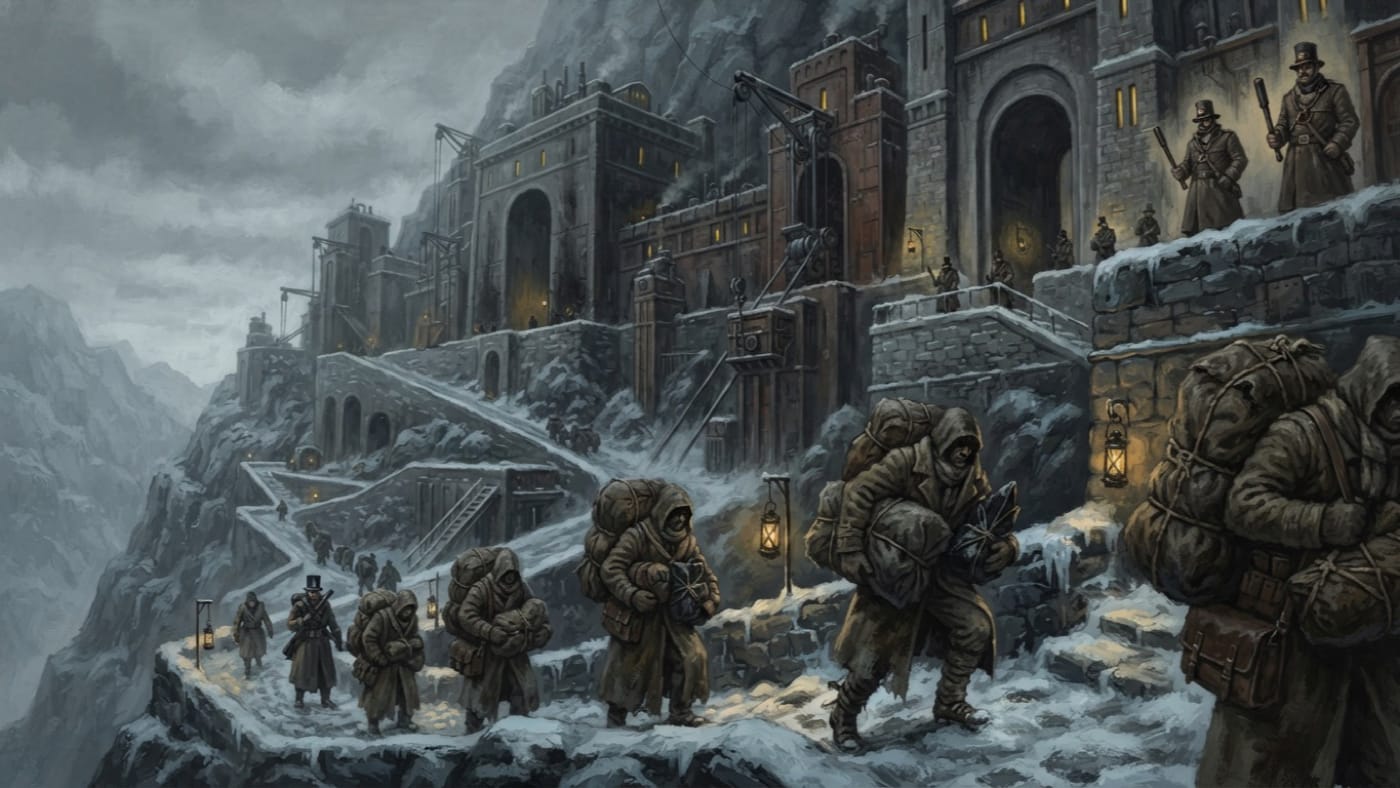
#On the Cargo Called Criminal
"Blackshine goes down. Coin comes up. The mountain keeps the difference." — Spoil Gardens saying, unattributed
The Black-Glass Runners are a smuggling ring of Oathglass Quarrytown, Saint-Helm's Cut. They keep no public front. They have no guildhall, no banner, and no patron the Bureau is willing to name. Their territory is the Spoil Gardens at the bottom of the cleft and the switchback caves along the descent. They sell shards and counterfeit proofs down-valley, and they do it for profit. Any reader who came looking for martyrs may close the volume here.
The whole trade rests on a disc of wax. Every pane that leaves the quarrytown lawfully passes through the Seal House, where the Verifier-Provost's stamp turns mineral into sacrament. The Bureau of Alchemical Standards classifies unstamped Oathglass as restricted mineral. It has the same composition and the same optical behaviour as the stamped article, and in law it is worth nothing except a tribunal date. A sheet becomes holy when it is sealed and becomes criminal if it misses the appointment. Nobody recorded when the first such sheet went down the mountain under somebody's coat. The Ledger does not date what it declines to admit.
#On the Down-Valley Trade
Contraband begins at the bottom of the cleft. The Spoil Gardens are barley and nettle scratched into grey spoil, tended by the Cut's poorest households and classified by survey as "self-sustaining." Smuggler tunnels run beneath the root beds. The ground there sinks without warning, so provost patrols enter the Gardens reluctantly. A patrolman who falls through a cabbage bed has to explain to his sergeant what he was standing on. Shards gather at the Gardens and the tunnel mouths, then go out through those passages to the switchback caves. These are hollows in the slate below the road where cargo can wait out a patrol, a whiteout or an attack of conscience.
The work is ugly. Black-glass travels wrapped in damp wool, because dry cloth squeaks against an edge and an edge will open a hand through two layers of sacking. Carriers wear resin masks. The dust from a broken bundle gets into the lungs the same way kiln dust does, and nobody pays a smuggler's cure debt. The single switchback road and the mule-rail spur close for weeks in winter. Rockfall takes what the snow leaves behind. Carters call the town Shattertown, and they mean the descent. A cracked proof pane is worth nothing to its buyer and too much to the auditor who finds it.
At the Switchback Gate, pane stamps are checked and cargo is weighed. Bribes are paid in the town's real currencies: lamp oil, warm cloth and breath tincture. The location survey records a hidden toll lane at the Gate for unstamped cargo. It does not name the keeper, and I will not invent one. It is enough that the lane exists and charges a fee. The down-valley market lies a day off by wagon in fair weather and two days on foot in snow. That is the distance any carrier has to cover, whoever he works for.
#On Counterfeit Proof
"Pane-blood: stamped glass worth killing for." — quarry cant
Four kinds of goods move through the Runners' hands, and the Bureau's habit of calling them all "contraband" makes them sound alike. They are different things.
Black-glass, called blackshine in the cant, is the dark, flawed variant made covertly on Kiln Row. The published survey of the quarrytown places its making in a backroom of the third furnace house. The Reliquary Office has outlawed it publicly. The Bureau of War has requisitioned it privately under form 44-C, which is sealed. No document I have read puts a Runner's hand on that requisition, and I have read documents I should not have. What War does with the glass is War's business, conducted in War's usual silence.
Counterfeit stamps imitate authorization. They are good enough to impress and flawed enough to be caught by anyone who handles real ones daily. Proof panes are calibrated sheets that make the light behind them behave as though any relic placed there were genuine. Unstamped Oathglass is the plainest of the four: honest glass carrying a dishonest legal status, and therefore the easiest to sell.
The buyer of a proof pane is paying for an audit already passed. He wants evidence that will satisfy a lamp, a Verifier and a congregation. The glass is incidental.
Oathglass cannot be forged. The mountain admits no counterfeit.
Corrected. Oathglass is quarried, so there is nothing in it to forge. Stamps are forged. Proofs are calibrated. Legitimacy is counterfeited at the Seal House door by people who never touch a seam. The original phrasing has been withdrawn from the shrine-sermon circulars where it caused the most amusement.
Above all of this hangs the True Pane: a sheet so flawless that it would authenticate whatever stands behind it. The location survey states plainly that a truly flawless sheet cannot be sold, because it is too traceable and every party is hunting it. Rumour gives the Runners such a pane once a season. The Bureau has given them nothing except attention.
#On the Hands That Collect
The Runners have no rule-book. They have an environment, and the authorities of the Cut built it for them.
Verifier-Provost Maelin Rook's stamp creates the difference in price that the Runners live on. Each pane she refuses for a flaw or a quota becomes, by her ruling, contraband. The ring does not need her help. It needs only her standards. Guildmaster Orr Vetch controls tools, kiln time and quotas. Workers are paid in pane-scrip, which can be spent only at the Guild commissary and stops being money the day a worker stops being employed. Down-valley coin can be spent anywhere. A carrier with a cough and a cure debt does not have to be a heretic to see the difference.
Sister Brethna's Breath Chapel ties cures to confession receipts. A carrier who confesses is written into a ledger that smells of resin and boiled nettle and forgets nothing. One who does not confess goes without resin filters. The Choir Wardens patrol the tunnel mouths with throat cords and batons, and their rounds follow the hymn clocks, the sung intervals that echo from tower to tunnel to mark the shifts. An honest worker hears a hymn. A smuggler hears a patrol schedule. The location survey adds that Wardens have been known to falsify those schedules for bribes. It names no Warden, and neither do I.
Above them all is the Bureau of Purity. Its auditors arrive with the regularity of a seasonal illness, and its reports end with the same sentence: no evidence of systematic forgery detected. The more serious threat is Inquisitor-Lux Thane Mire, the Bureau's proof specialist. Saying his name at the Switchback Gate does more for compliance than a garrison would. A Runner fears an inquisitor who checks the proof more than one who checks the cargo.
The Flawless Claimants are a separate body. They work from Kiln Row backrooms and the deep galleries, and they want the True Pane so they can sanctify a false relic or hold a knife to the Synod's throat. The Runners want coin. Both sell into the same dark market, and their paths may well cross in a tunnel, a backroom or a buyer's ledger. I cannot establish whether the two have met as customers, rivals or strangers.
#On Names Carried in Glass
The Resonant Vein is a Category Two Localized Acoustic-Geological Anomaly, Priority Amber. Sanctioned hymns hold its galleries steady. The sealed explanation says the glass answers to names rather than to faith, which means anyone carrying glass from this mountain is carrying something that listens.
Reports from the Cut say that black-glass shards show names when held to lamp flame. They say the bricked gallery below the Helm-Mouth gives off sound when blackshine is carried past it. They also say that unsanctioned hymn sheets and stolen name-fragments now go down-valley in the same wool as the shards, and fetch more than honest panes. Whether the Runners deal in these things, or the Claimants, or both, or neither, is still unsettled. So is what a name-fragment does once it leaves the mountain.
[WITHHELD — Bureau of Doctrine. The syllables reported as visible in black-glass under lamplight are not reproduced in this entry, in any copy, or in the margin where a clerk attempted to reproduce them. A reader who wishes to know them may hold a shard to a lamp and then explain himself to Purity.]
Carriers wrap blackshine in wool soaked in nettle tea, because the quarry says the Vein dislikes the smell. The Bureau of Alchemical Standards has not certified this practice. The carriers have not asked it to. A man descending a frozen switchback with a bundle that might speak does not wait for a survey.
#On the Present Traffic
"The mountain gives truth to the faithful." — Seal House lintel
In A.S. 201 Saint-Helm's Cut remains in operation, and so do the Runners. Rumours of a flawless pane in the Shard Yards have raised both scrutiny and prices. Audits are sharper, the Warden patrols at the tunnel mouths have been doubled, and every carrier on the descent is assumed to be carrying the one thing nobody can sell. That assumption is the most valuable thing the ring owns, and it cost them nothing.
The Bureau of Doctrine holds that black-glass is prohibited and that sacred proof is unbreakable. The Bureau of War holds form 44-C. The reliquaries down-valley hold their lamps, and the lamps are satisfied. The quarrytown is still the only market that can supply all three.