
#On the Substance and Its Warrant
"The mountain gives truth to the faithful." — Pane-Guild line, Saint-Helm's Cut. The street's answer, which I record for completeness: "The mountain gives cough to the poor."
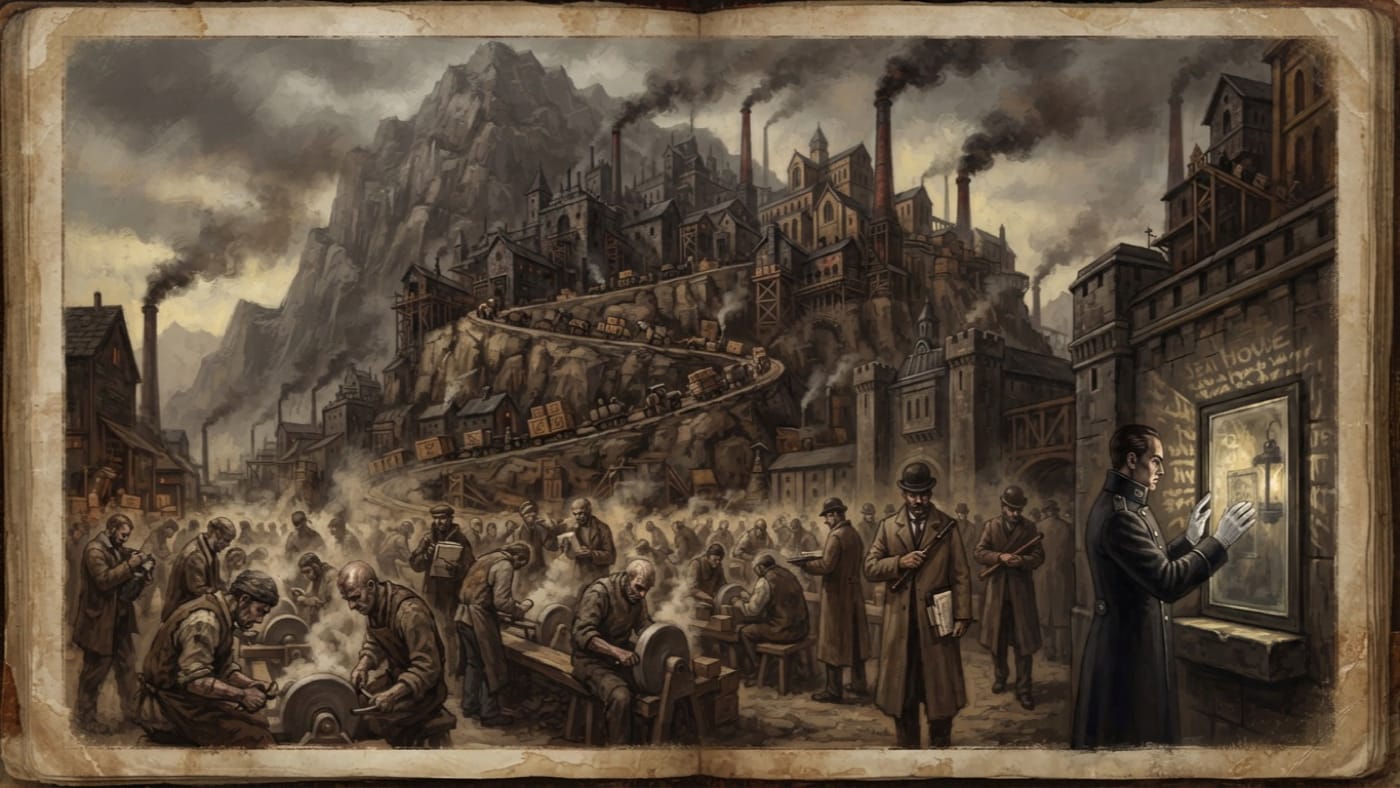
Oathglass is volcanic glass cut from the seams of Saint-Helm's Cut, beneath the highland village of Oathglass Quarrytown. It is worked into the panes through which the Church decides which bones are holy. A pane is set before a reliquary under a lamp and the light breaks across it. A verifier reads the way it breaks, and the Seal House stamps his verdict. Those are three separate acts. The faithful are encouraged to believe they are one.
The Bureau prefers them joined, so I keep them apart. Anyone with a lamp can watch the glass do something, and he will see it do the same thing again tomorrow. What that something means is decided by a man in white gloves, before witnesses, under a seal he did not make. The governing doctrine is purity-through-clarity: clear glass gives clean witness, and clean witness means a holy object behind it. That is doctrine. No assayer of the Bureau of Alchemical Standards has filed it as a law of minerals. I have looked, because I would have liked to cite one.
#On Cutting and Certification
The Cut was registered in A.S. 96, after surveyors found a cleft shaped like a saint's helm and glittering with glass. The quarry was chartered in A.S. 102 under the Pane-Guild compact. The first verified pane went to Strasbourg in A.S. 103. By the end of that year the Church could not do without the glass, which is how a profitable proof always behaves.
Getting glass out of the mountain is unlovely work. Cutters and wedge-setters score the seam in time with the shift hymn. Shard haulers carry the broken sheets up to the surface on their backs. In the Shard Yards, polishers grind them down in grit slurry until their knuckles shine. Pane graders then hunt for flaws, and a grader can ruin a man with a scratch the man did not make. On Kiln Row the furnaces burn all night for lamp-glass, and tallow smoke lies over the snow. The Guild does not say whether every reliquary pane goes through the same fire, and I do not guess.
The Pane-Guild owns the tools and the kiln time, so the Guild decides who works the glass. Guildmaster Orr Vetch sets the quotas. Every tenth sheet goes to the pane tithe. The Seal House decides what counts as real. It is a single stamp office, run by the Synod Reliquary Office detachment under Verifier-Provost Maelin Rook. Rook's gloves are immaculate, and Rook will not touch glass unless witnesses are present. In my profession this passes for sanctity. The habit is drilled into every relic authenticator, and Rook carries it to the edge of liturgy.
The reliquary pane is the reason the Cut exists, and it is far from the only thing the Cut sells. Crates leave by the switchback road holding lantern globes, saint-clear glass for shrines, and bead-count proof slates. The lamps of the high pilgrim spurs run on Oathglass. So do half the shrine windows down-valley, and so do the authentications that let the Bureau of Relics treat a certified knucklebone as money. If the Cut stopped work for one season, the pilgrims would sit in the dark, the shrines would be glazed with stained wishes, and every relic certified since A.S. 103 would be asked to prove itself again without help.
#On What the Glass Answers
The official account says the seams remember hymns. The sanctioned mining hymns do protect the men who sing them. They hold the upper galleries, they set the length of a breath under a resin mask, and they keep fools from trying out vowels beneath slate that is in a bad mood. The miners have a word for an interval that holds the tunnel: sing-safe.
The sealed account, set down at length in the Resonant Vein file, says the seams answer names, and faith has nothing to do with it. Some names steady a working and draw a pane out unusually clear. Other names cloud the glass or crack it. Part of the reason the approved hymns work is that certain approved intervals happen to contain pieces of useful names. That they work and the Bureau's account of why they work are two different documents. Only one of them is printed on hymn-cards.
Witnesses at the Cut have recorded the following. A second voice harmonises where nobody is standing. Panes from the lower seams carry hairline writing in scripts that no office will identify. Lamps flare when certain names are spoken. Black-glass shards show names when held up to lamplight. Every one of these was observed at the mountain or in its glass. No pane in a shrine down-valley has been reported preaching to its congregation, and any clerk who files such a report will be asked where he was drinking.
The A.S. 111 collapse brought down three hundred yards of gallery ceiling and killed two hundred and fourteen workers. The official finding is procedural: a damaged hymnal gave the choir the wrong interval. The sealed correction, still sealed, finds that the interval was wrong only against the hymn. Against the name it happened to form, it was exact. Both findings concern the same dead men.
In A.S. 199 the Vein was documented, classified, and sealed. That was the year the old explanation finally failed. The Vein did not begin then, and neither did Oathglass's responsiveness.
#On Perfect Proof
Oathglass cannot be forged.
Corrected. Stamps are counterfeited and rented out by the hour. Panes are switched. Perfect sheets are miscounted and then go missing. The sentence stays in the pilgrim manuals because printing it costs less than retracting it.
Three kinds of thing get confused at the Cut, and the confusion is profitable. Black-glass is outlaw shard, blackshine in the Yards. It is publicly forbidden, privately used, and taken offsite only by men who don't mind being hanged. The Black-Glass Runners carry it down-valley along with counterfeit stamps and fraudulent proofs. A word on "proof pane": the Seal House uses the term for any authenticating glass, and the black market uses it for a sheet rigged to say yes. Before arresting the man who said it, ask which one he meant.
The third kind is unlike the other two. Among Rook's sealed field papers from A.S. 199 is a memorandum on a trial pane formed after a controlled utterance whose syllables are not reproduced here. According to that memorandum, the pane threw compliant optical patterns, more than one of them at once, in front of a relic chamber that was empty. I report the finding as Rook filed it. It shows that the glass can certify nothing at all and look pleased about it. It does not show that the glass makes saints, rewrites an object's history, or gives a ward any power. The glass agrees, and that is all.
The Flawless Claimants want that agreement in its finished form. They call it the True Pane, a sheet said to authenticate whatever is placed behind it. If it exists, a forgery would only fool a verifier, while the True Pane would make fooling one unnecessary. Whether such a sheet is now in circulation, the record cannot say. It may have been found. It may have been forged. It may have been imagined so firmly that prices have moved anyway. The quarry survey notes that a truly flawless sheet cannot be sold, because it is too easy to trace and every party is hunting it. I add one rumour, which the Yards repeat and the Seal House forbids: that some relics are certified before they are found.
#On the Price of Clarity
Every pane leaves its dust behind. The dust settles in the Yards, on the benches, on bread, and in lungs, and the lungs fail. Glass-lung is the polite name for it. The miners call the sputum cough-silver and offer it as proof they worked. Half the village sleeps sitting up so it can breathe. Children wear resin masks. The ledgers show stable output and healthy workers. Both statements are written in the same ink.
The medicine is sold on terms. The Breath Chapel gives out nettle preparations, resin tea, and filters while stocks last. Every cure is written down as cure debt, and the debt is paid in extra shifts or, eventually, in burial fees. Wages come as pane-scrip, which only the Guild redeems. Penalties from confession are added as shifts. When winter closes the pass, nobody can leave, and that is convenient for whoever holds the scrip. A worker whose lungs give out before his debt does may be offered "friendly severance": the road down the pass, with no rations.
Sister Brethna keeps the chapel's ledgers. In them, cough patterns are recorded as moral weather and names are tied to cure allocations, so her care comes with a register attached. She also keeps a private ledger of the dead. I have not seen it. I am informed that it now has a second lock. Mercy at the Cut is rationed, recorded, and locked away, as every scarce sacrament has to be.
#On Present Use and Restriction
In A.S. 201 the Cut is working. The kilns burn, the stamps come down, and mule trains carry straw-packed crates of certified glass down the switchbacks. Nominative trials are suppressed. The Choir Wardens enforce the sanctioned hymn and the sanctioned silence with throat cords and batons. Below the third level, workers answer to roster numerals, and private names are forbidden in the active galleries. The mountain can put a man's name to use, so the regulations have taken it off him.
Inquisitor-Lux Thane Mire examined the matter and did not close the quarry. He sealed his findings, left the Vein at Priority Amber, and went on to Brast when the Sulking Engines there began answering back. Some read that as a judgment on the glass. It was triage, and the Bureau of Doctrine has never mistaken triage for absolution.
So the instrument stays in use, because too many reliquaries already depend on it. Rook stamps panes knowing what a pane can be made to say. Vetch raises quotas knowing what the deep galleries cost. Brethna keeps her ledger knowing which names it holds. Every one of them acts correctly by the Ledger. I have checked.