
#On the Problem of Reach
A voice travels only as far as the apparatus under it, however holy the voice. This is the first lesson of the Bureau of Orison and Song, and the one it most resents being taught. The Bureau holds the hymnal, the broadcast and the weaponised cadence under one charter, filed in A.S. 92. From the Cloister of Calibrated Breath at Strasbourg it can make half a continent pray in the same minute. It cannot make the edges of that continent hear. Fixed transmission houses stand wherever masonry and Doctrine allow. Repeater stations stand wherever the houses send them. Past the last repeater lie roads, valleys, advances and retreats, and any column that marches past that last mast leaves the Orison behind.
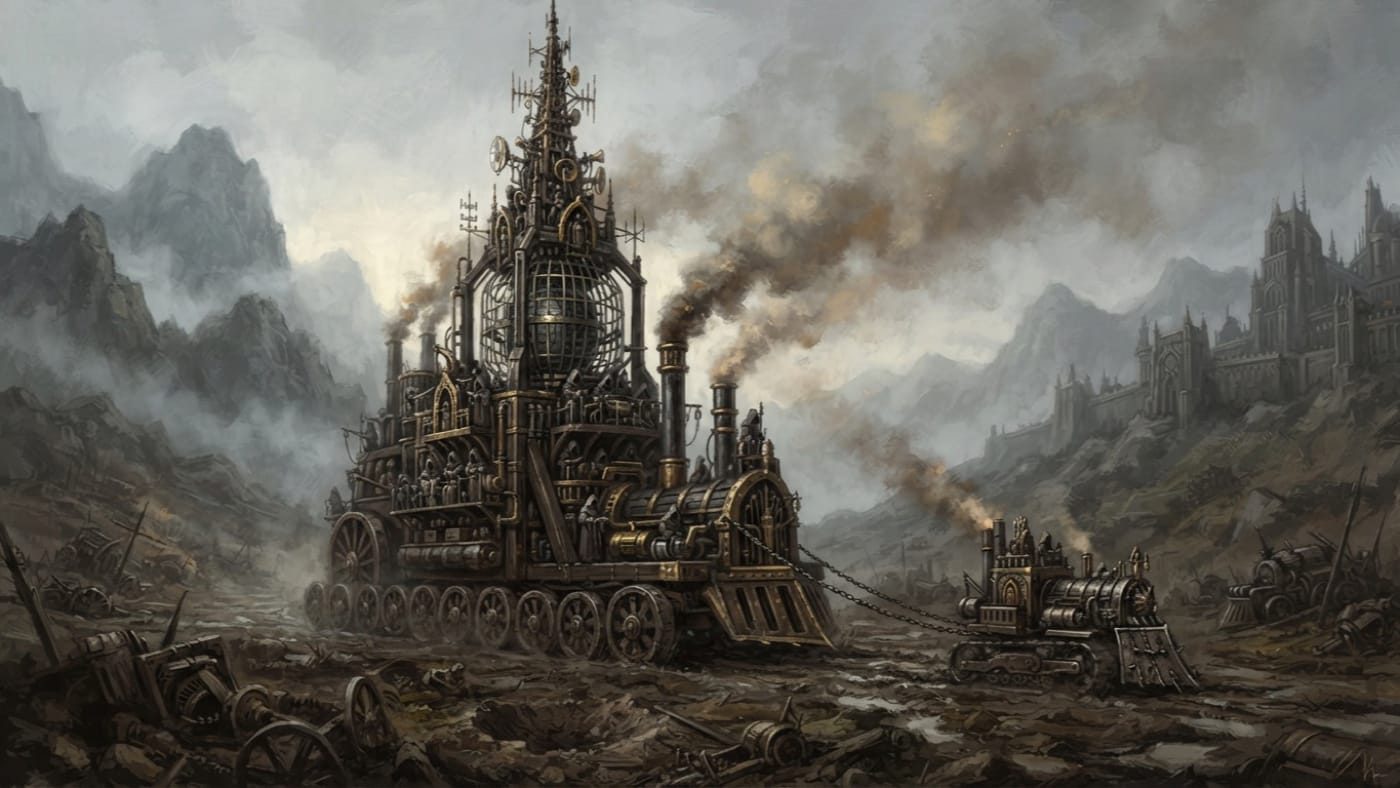
In A.S. 168 (1878 CE) the Bureau proposed a remedy, the Orison Spire. It was a mobile vox-pylon: a tower on wheels, with a calibrated choir aboard and a reservoir of saint-dust underneath, to be hauled into the field wherever the Synod's voice ran short. The Bureau's own word for the ambition was fleet. The surviving account describes three machines.
The proposal entered the record in the year the Vigil Ark Saint Barachiel was commissioned. I note the coincidence and decline to inflate it. No shared office, purse, inventor or contract links the two. Two arms of one Church saw the same hole in the Orison and tried to fill it in different elements. The Arks took the air. The Spires took the road.
STAMPED ERRATUM — OFFICE OF THE HIEROMNEMON, CODEX CORRECTION The Codex entry for the Bureau of Orison and Song calls A.S. 92 "the Concordat year." This is withdrawn. The Concordat of Strasbourg, the constitutional settlement of the formal Synod, was concluded in A.S. 90 (1800 CE). The Bureau's charter of A.S. 92 stands as a separate filing two years later. The Bureau may go on insisting that its authority predates both dates. It will.
#On the Mobile Vox-Pylon
The Codex holds no engineering drawing of an Orison Spire, and I will not forge one. The account preserves four elements, and the rest is the general craft of the Broadcast Directorate. The reader should keep the two apart even when the Bureau does not.
The four elements are these. First, a tower, the vertical vox-pylon, from which the voice was thrown. Second, a wheeled base, which is what made it a Spire and not another transmission house waiting to be shelled where it stood. Third, a calibrated choir aboard. Fourth, a saint-dust reservoir to protect the carrier. A resonance chamber is attested for the third machine, because its failure is how we know it had one. I cannot certify the dimensions, the wheel count or what pulled it. I can say they were heavy, because everything the Bureau builds is heavy. Lightness is a Rationalist vice.
The general craft is better documented and nastier. Every Synodal broadcast is laced with powdered relic residue, bone ash from authenticated reliquary stock and sanctified salts calibrated to resist what the Bureau calls "parasitic inversion." Coded cadences carry it, which a copyist cannot reproduce without the dust-key. The Bureau of Engineering has measured what the dust does to a carrier signal. The Bureau of Doctrine has declined to say why. Engineers who do this work keep ash on their gloves, coughs in their chests and auditors at their elbows. Before a transmission is archived it needs a Clean Carrier certificate filed with the Bureau of Records, so even a mobile pulpit dragged its paperwork behind it.
Put all this on wheels and you have a machine whose engine is a human throat. The dust shields the voice and the tower lifts it, but the choir does the singing, and a choir tires, sickens, falls silent or dies. Every other part of the Spire could be repaired, replaced or requisitioned in triplicate. The choir was the part that could not be.
#On the Three Prototypes
Three Spires were fielded between A.S. 170 and A.S. 185 (1880–1895 CE). That is the window for the whole trial, and the account gives no separate year for any of the three. Anyone who hands you an exact date for each machine has been reading somebody's imagination, possibly their own.
The first went to the approaches of Bastion-Shipka, which guards the Balkan pass and the last viable road south along the Sagittal Line. Beyond the pass, Syrion holds the highlands in a fog where time runs wrong. He besieges by patience. He does not storm the pass; he waits on it until the men holding it lose count of their days. Shipka's garrison rotates every four months for exactly that reason. A machine whose whole function depended on a choir staying awake was sent there.
Its choir fell asleep while transmitting, and the Spire was destroyed. The account gives the sequence and nothing more, and I give it the same way. It does not say how a sleeping choir turned into a destroyed tower, how long the silence lasted or how many of the crew woke up. It does say that the event was a Syrionic incursion, and that the Bureau classified it as "environmental."
That classification is accurate in the narrow sense that Syrion is part of the environment at Shipka, the way frost is part of the environment in a grave.
The second was captured intact by Atheron's forces near the Macedon Escarpments, far down the southern front from the Carpathian passes he holds opposite Przemyśl. The account names no commander, no enemy formation, no method of capture and no fate for the crew. It also records no case of the enemy making the thing sing. What it does record is that the Bureau of War brought up artillery and shelled the Synod's own Spire to pieces so that the Great Deceiver's host would not keep a working vox-pylon.
Synodal gunners laid their guns on a Synodal pulpit and fired until it stopped being one. I rank it among the more honest acts of criticism in the programme's history.
I will add, as a sneer and not a finding, that Atheron crowns every ridge he takes with a spire taller than the last, and here the Synod gave him one with wheels. Whatever he meant to do with it, the Bureau of War denied him the chance.
The third went to the Rhine corridor, in the western heartland, far from the trench mud. It worked, and kept working for eleven years. For eleven years a mobile vox-pylon carried the Orison where fixed houses could not, and its choir was relieved, re-dusted, audited and sent up again. The account says nothing of failures in that period. It says the machine worked, which is the most any engineer asks of the record.
Then a Resonance Bloom shattered its resonance chamber and killed its choir.
The account does not say where the Bloom came from. The Blooms that shake the foundations at Essen-of-Hymnsteel split rivets and break stone, so the comparison is obvious, but the record does not tie the two together, and I am in no hurry to fill the Bureau's silence with my own. The third Spire did its work for eleven years, and then the chamber at its centre broke.
#On Revision and Redistribution
The Bureau filed all three outcomes as "data." One tower was lost at Shipka with a sleeping choir, another was shelled by its own side near Macedon, and a third broke on the Rhine after eleven years with its choir dead. Every one of them is entered on the same ledger line in the same ink, under the same word.
The programme's official status is "under revision." It has been under revision for long enough that the phrase has gone grey at the temples.
According to the account, and only the account, since nobody has sealed the arrangement in public, the Bureau dismantled the Spire's methods into its existing network. It placed them in the fixed transmission houses and aboard the Vigil Arks so that no more mobile platforms would be risked. The Spire's tricks of calibration, dust-handling and choir rotation in the field were dispersed into buildings that cannot be towed off and airships that no infantry can capture on foot.
That does not make either refuge safe. Transmission houses are shelled, and their carriers are jammed and turned. Vigil Arks have their own long register of disaster. The redistribution moved the vulnerability from the wheels into the masonry and into the hull. The Bureau calls this progress. Engineers call it a different set of funerals.
At the A.S. 199 Doctrinal Review (1909 CE), the Voice Prelate was asked about the programme's status and answered:
"The Spires taught us that the voice moves best when it has roots."
The office of Voice Prelate changes hands often enough that the Bureau of Records gives the post a catalogue number instead of a personal entry. I will respect that and name only the office. It is the right sentence for an institution that spent seventeen years building towers that could move and then concluded that towers ought to stay put.
#On the Programme's Present Standing
As of A.S. 201, the Orison Spire programme is still under revision. No cancellation has been filed and no fourth prototype is recorded. The three that existed have become a precedent, a lesson in training and something the Broadcast Directorate does not raise when the Bureau of Bells is in the room.
The technology itself lives on, spread out. Whatever the Spires proved about carrying a calibrated voice beyond the last repeater, the houses and the Arks now carry it. Whatever the Spires proved about choirs in Syrion's country, about Atheron's taste for other people's towers and about chambers that break after eleven good years has been folded into the same ledger as data.
The Bureau keeps the file open. Its machines are scrap, but the file is open because closing it would require someone to sign it.