
#On the Order Beneath Prague
Prague keeps its correction on two floors. On the upper floor, along the bridge and through the university quarter, the Order of Saint Ephrath stages shame where children can watch it from front-room stools. On the lower floor, where nobody can watch, the Order of Worms-Below asks the questions that would gain nothing from a crowd. The city is Synod-held, Zone 3 of the Forward Heartlands, a working part of the Bohemian Severity District in Bohemia. It feeds the Sagittal Line without standing on it. Its penitents travel east by rail. Its more difficult penitents travel down.
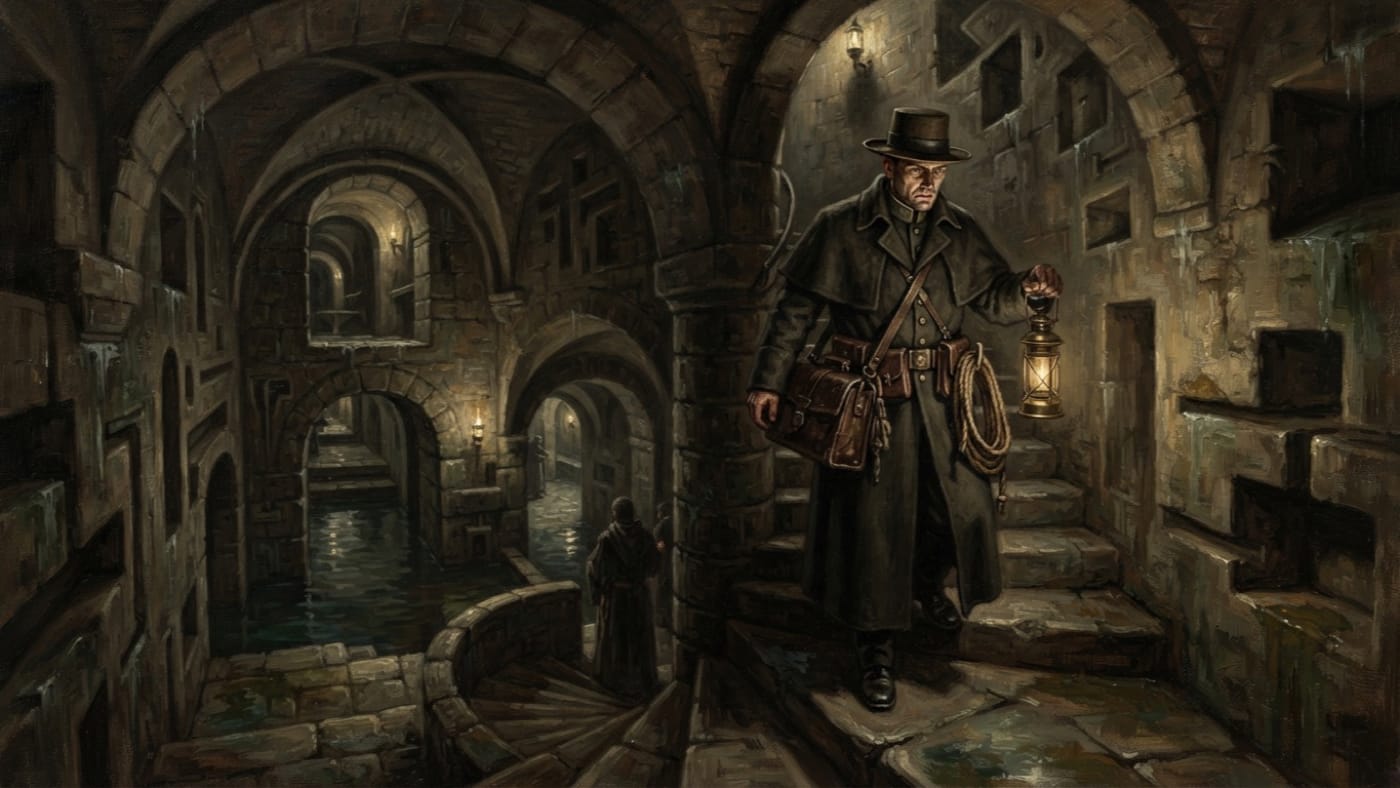
Worms-Below is one of the inquisitorial Orders of the Bureau of Purity. Its members are subterranean inquisitors who question their victims buried alive in labyrinthine catacombs. I set that down plainly because ornament would only soften it.
The Order did not dig the catacombs. It inherits the cellars of the old Rationalists: observatory footings, book-vaults, and the acoustical chambers where natural philosophers once measured how a voice travels through stone. The Rationalists built rooms for listening to the world. Worms-Below listens to the people it puts inside them. Records has never stated in writing whether these vaults form one connected labyrinth or many separate holes that the Order finds it convenient to call one. I do not answer for Records.
The ground was already bad-tempered. When the Litany-Engineers folded Prague's observatory into the earth in A.S. 61, they left fissures under the university quarter that still hum counter-songs. That was Engineering's work, and Engineering may keep the credit. Worms-Below simply moved into the acoustics.
#On the Listening Art
Every Order has its sacrament. Ash anoints brows with soot. Shroud teaches the folding of a writ until a name disappears. Worms-Below teaches the listening art, which its catechists describe in two phrases: the pressure of stone and the speech of water. No full syllabus has reached the Bureau of Records. I suspect none exists on paper, because writing it would require someone to record what the water said.
The pressure of stone is the easier lesson to imagine. A man under masonry hears his own breath come back to him from the ceiling. He hears the weight above him settle, which sounds like a ledger being closed in another room. He has no window and no hour. When a question reaches him through the stone, he cannot see the mouth that asked it, and a man who cannot see a face has nothing to argue with.
The speech of water is the harder lesson. Cellar water drips and seeps and gathers in the low corners of vaults built by men who never expected them to flood. Over enough hours a drip turns into a syllable. Over enough days, survivors say, it turns into a voice that asks questions. The Order trains its novices to hear what the water says. As far as any record shows, it does not train them to find out who is speaking.
Survivors come up pale and trembling. They say they were questioned by voices not entirely human. The Order does not dispute this. It disputes only that it matters. A confession is a confession whatever throat drew it out, and the Bureau of Doctrine has never required the questioner to be identified. It requires the answers to be correct.
#On Recruitment and the Writ
Ash recruits orphans who never learned the grammar of property. Ephrath recruits from choir lofts and theatres. Worms-Below buys apprenticeships to stonecutters.
The reasoning is a craftsman's. A boy who has split limestone along its bed knows that stone has a grain, that it carries a blow farther than a fist expects, and that a tap brings back information about its faults. Teach that boy the writ and he will hear a cellar the way a confessor hears a pause.
The catechism is the inquisitorial common form. It opens with the question every Order shares: "Whom do you trust?" The correct answer is "No one." The second correct answer is "The writ."
"The writ," as given in the second answer of the inquisitorial catechism.
Public catechisms will substitute "Creator" for "writ." The internal form stays in force below ground, where nobody from the public has yet asked to audit the wording.
Worms-Below answers to Purity, as its sister Orders do, within the broader machinery of the Inquisition. Doctrine decides what may count as truth. Records keeps what was confessed. The Order supplies the confession. The Bureau has published no chain of command more detailed than that, and those who want a neater diagram may petition for one and wait in a well-lit room.
#On Borrowed Voices
Victims brought up the stairs often speak in borrowed voices for days.
A laundress in Lyon confessed in the accent of a long-dead lector of Prague. A Warden from Rouen recited the Ordo Penitentiae in a dialect no clerk could place. Neither record explains how the borrowing happened. Both records end the same way. Worms-Below filed them under clarified.
The word was chosen carefully. To the Order, clarified means the matter no longer needs its attention. The laundress confessed, so her confession was clarified. The Warden recited correct liturgy, so the liturgy was clarified. Whose accent the laundress was wearing, and where a Warden learned a dialect no living clerk speaks, are questions for an office that does not exist. The paperwork is complete, and the answers are not.
Prague's civic file holds one note that the Order has not clarified, because no member of the Order wrote it.
SUBTERRANEAN NOTE — PRAGUE, FILED UNDER BOHEMIAN SEVERITY DISTRICT Three stairwells beneath the former Faculty of Natural Philosophy descend past their surveyed depth. Chalk marks placed at landing seven reappear on landing three, reversed. Voices from below request names by childhood diminutive. Survey party instructed not to answer. One answered. His adult name remains in Records; his childhood name has been removed from his baptismal register.
Nothing in the note says Worms-Below built those stairwells, governs those voices, or has ever gone down past landing seven. Nothing in it says otherwise. I file it next to the Order's work because it belongs to the same family of wet stone and mistaken mouths.
#On Sister Orders and Their Stair Maps
The Orders compete, and their competition is the nearest thing the Inquisition has to an audit.
The Order of Ash sneers that Worms-Below crouches in cellars parsing echoes. Ash holds that fire asks every question at once. Fire also destroys every answer at once, so nobody has ever asked Ash to clarify anything. Ephrath's rite needs daylight, a fixed route and a public. Worms-Below's needs a public's absence. Both Orders work in Prague, and both have the good manners to work on different floors.
The Order of the Shroud removes people and records. It also borrows Worms-Below's stair maps for "ventilation," and the people who are ventilated show a marked tendency not to come back. This is a trade between specialists. It is not a command arrangement, and neither Order would thank you for confusing the two.
The Order of Severance hunts heresy among the Synod's own clergy and clerks. Worms-Below calls Severance a Shroud with better stationery. It calls Severance shallow as well, on the grounds that corridors have ceilings and real secrets sink. The Order of the Root pursues bloodlines. Worms-Below pursues depth, and has never shown much interest in anyone's grandmother unless the grandmother is the one speaking.
#On Belgrade
In the catacombs beneath Belgrade, Worms-Below lost an entire chapel to a Silence Dome. Its reports from that day are immaculate, because nothing was ever written.
Consider what a Dome does to this Order in particular. A Dome is a pall in which sound dies at the teeth: a bell chokes on its own bronze, and a command comes back as warm breath on the lip. Fusiliers caught under one lose their cadence. A listening Order loses everything it has. Its inquisitor can still form a question, but he cannot hear the answer. He cannot hear the stone settle or the water speak. For the length of the pall, a buried prisoner and the man questioning him are equally deaf, and the only thing that separates them is which of them holds the writ.
The register says lost and nothing more. It does not say whether the chapel was lost as a building, a congregation or a jurisdiction. No cause has been filed. The Bureau of Orison blames the Enemy for Domes in general, Engineering mutters about bruised air, and Belgrade's chapel has no theory of its own. Records will not elaborate, for the sound reason that it has nothing to elaborate from.
#On the Stone That Drips
Every Order keeps a reliquary of its own shame. Ash keeps a jar of rain that refused to burn. Worms-Below keeps a stone that drips in dry seasons.
The file says nothing about where the stone came from, who looks after it, or where it sits. It records one property: the stone weeps when there is no water to weep. For an Order that teaches the speech of water, this is the single witness it has never been able to bury, question or clarify. The Order studies it anyway, as every Order studies its failures, and it improves.
The Order also spreads a story of its own: that the Judges come up from beneath the earth, born in catacombs where the bones rearrange themselves into mask and rod. It is one rumour among several about the Judges. Doctrine has ratified none of them, and Worms-Below has filed this one under nothing at all.
Above the catacombs, Prague goes on with its business. The bakers time their ovens to the Procession. The choir schools drill silence. The stonecutters' yards take on apprentices whose fees have been paid by someone in a clean collar who asks only whether the boy has a good ear.