
#On the Province and Its Position
"Bohemia feeds the Line. Prague gives it a sermon to march to." — saying of the supply columns, as overheard in Records' waiting-room
Bohemia lies in the third zone of the Synod's geography, the Forward Heartlands, where the register also lists Moravia, western Hungary and the Dalmatian coast. Sharing a zone makes them neighbours in a ledger. It does not make any of them part of Bohemia, and I have fined clerks for writing otherwise. The Forward Heartlands stage what the Sagittal Line eats: grain, powder, boot-leather, chaplains, and the replacement men who will need all four. The Line runs north to south from the Baltic coast to Thrace. Bohemia stands behind it, held and provisioned and patrolled, close enough to read the war in every dispatch and far enough that the war itself seldom arrives.
Some readers take "behind the Line" to mean "safe." They have been reading the Bureau of War's maps when they should have been reading the Bureau of Purity's. A province the enemy cannot reach is a province the Inquisition can visit at its leisure, and it has visited often.
I will not give Bohemia's boundaries, its population or the name of its governor. The Ledger in front of me does not hold them with enough certainty, and I do not copy rumour onto vellum. What the Ledger does hold, in quantity, is Prague: its bridge, its chapterhouse, its catacombs, its schoolchildren. Prague is a Bohemian city. It is not Bohemia, though its Priors behave as if it were. Most of what follows took place in Prague, because Prague is where the Church keeps its receipts.
#On the Schools and the Earlier Processions
"Man Alone." — chant of the Secular March, as recorded
Bohemia learned the procession from its enemies. The Republic had no treaty and no capital at Regensburg until A.S. 30, but long before that the Rationalist administrators of Prague had learned that a crowd is a classroom with no door to slip out of. Students marched through the streets in secular processions and burned altars on the cobbles. Children walked at the head of the column, chanting Man Alone. The record says one boy carried his grandfather's skull as a banner, and his instructors called this anatomical demonstration. I find no year for that march in any account I would sign. I record what was done and leave the dating to men who enjoy arguing with inherited error.
In A.S. 3 the same authorities staged the Procession of Silence. Pilgrims with slit tongues and sealed mouths were driven through the squares of occupied cities, and engravers sent prints to the prefectural offices. The full account belongs to the Procession of Tongues, whose prose I commend, with one exception.
The Procession of Tongues entry attributes the A.S. 3 Procession of Silence to "the Republic." The Rationalist Republic was constituted by the Treaty of Regensburg in A.S. 30. The A.S. 3 procession belongs to the Rationalist administration that came before it. The Bureau of Doctrine regrets the anachronism. It does not intend to reprint.
In A.S. 8 came the Night of Crowns. Seven bishops took off their mitres before a Prague crowd, citing the demands of reason, and the crowd cheered. Their names are kept under the event's own heading. A regional survey has no business reprinting the roll of shame, and the archives still quarrel over how it should read.
The Church remembered the cheering. A population that applauds bishops without mitres will applaud heretics without voices. The instrument does not care which hymn is played on it. I am told some Praguers wept at their windows that night. Records did not count them.
#On the Collapse and the Change of Authority
The Sundering fell on 1 November A.S. 45. The Church came out of hiding and took back the provinces unevenly, town by town and parish by parish. I have found no morning on which Prague passed from one ledger to the other, and I will not invent one so that a paragraph reads more neatly.
I can date the observatory. In A.S. 61 a Rationalist observatory tower stood in Prague behind wards that bent light. It held for months. Armies died in heaps at its base, and shells rang off its wards to no effect. Then a dozen men tunnelled under the city's stones, carrying hymnals and sacks of unstable powder. They chanted the whole time, alternating voices so that the psalm never broke, even after their throats bled. At dawn the observatory folded into the earth.
The Rationalist archives call it subsidence. They put up a plaque commemorating "scientific sacrifice," and the Lore Book reports that the plaque is still spat upon. The Bureau of Doctrine declared a miracle of hymned calculation. Both explanations are on file, and the Bureau has never felt obliged to throw either one out.
The profession of Litany-Engineer claims those twelve as its founders. It received its formal licence a good deal later. That has never yet stopped a profession from claiming its founders.
The Concordat of Strasbourg created the formal Synod in A.S. 90, twenty-nine years after the observatory went into the ground. Both founders were already in theirs. The Bureaus whose seals now sit on every Bohemian sentence took their mature form in the years after.
#On Correction in the Cities of Bohemia
"The difference is documentation." — cover memorandum to the Ephrath petition, first Archon of Purity
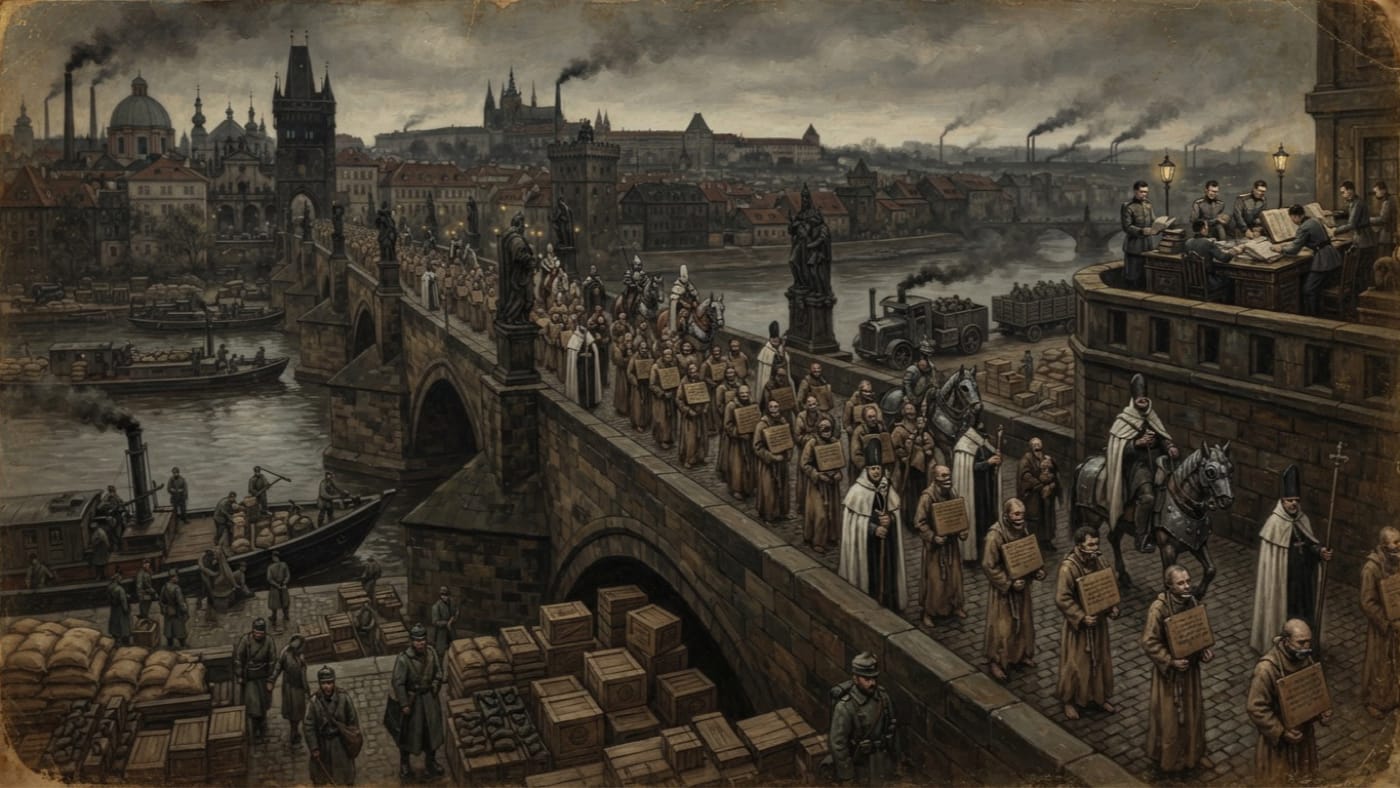
In A.S. 94 the Order of Saint Ephrath petitioned the Bureau of Purity for leave to hold processiones poenitentiales linguae in the cities of Bohemia. The petition ran to forty-one pages, and the Bureau approved it in an afternoon. Note the plural, cities, and then note what came of it: Prague alone holds the right to perform the full rite. The petition asked for a province, and the Bureau gave the Order one bridge. I can find no ledger I trust showing any other Bohemian town walking a lesser version, and I will not fill the province with processions to tidy a sentence.
Two hundred condemned walked in the inaugural march. Each had his tongue nailed to an oak tablet carved with the Articles of the Creed, and each carried that tablet through the streets. The Ephrath intake ledgers list captured Republican Guard officers, Rationalist academics and three former prefectural clerks among them.
Earlier editions of the Procession entry gave the inaugural count as "approximately one hundred and fifty." The Bureau of Records, Seventh Revision, corrects this to two hundred, on the strength of recovered Ephrath intake ledgers from the Chapterhouse archive.
The route was fixed by charter in A.S. 96. It starts at the Ephrath Chapterhouse on the hill above the Vltava, crosses the Charles Bridge beneath its stone saints, and runs through the university quarter, past the faculties where Rationalists once lectured. The planners intended the irony, and Purity has the minutes to prove it.
Six offices have a hand in each march. Purity authorises the rite and prosecutes the condemned. Ephrath performs the ceremony. The Bureau of Oaths counter-seals each sentence. The Bureau of Bells times the peals so that footfalls land on the toll. The vents of the Bureau of Orison and Song breathe fog across the street. The Bureau of Records keeps the count and revises it when Records sees fit. None of the six commands the others, and each considers itself the indispensable one. The condemned walk regardless.
In A.S. 130 the Bureau widened the categories of the condemned, since living Rationalists had grown scarce. In A.S. 187 it revised Standing Order 14-F. Neither change shortened the route.
Prague's correction does not end on the bridge. Below the city, the Order of Worms-Below questions prisoners buried alive in the catacombs. Survivors come up pale and shaking and say they were questioned by voices not entirely human. That is survivor testimony, and I file it as testimony. The Order has not asked me to file it any other way, and I have not offered.
#On the Present Condition
It is A.S. 201. Bohemia still stages for the Line. Wagons go east full and come back carrying fewer men than they took. Purity keeps its white cloaks in the province as watchfully as War keeps its quartermasters.
In Prague the arrangements are simpler. Choir schools hold silence drills in case a Procession turns the corner. Children watch from windowsills and hold their breath when a marcher stumbles. Mothers grip their beads. In an earlier year that no ledger troubles to name, Purity burned a Prague vintner for selling wine it judged insufficiently sacramental. The wine is not on record. The vintner is.
In A.S. 199, a Judge was sighted at the foot of the Charles Bridge during the march. The Ephrath Prior in charge wrote a single word in his daily report: vidit, he saw. Purity wrote back in the margin: What did he see? The Prior did not answer, and the Bureau did not ask again. I have nothing to add to either of them.