
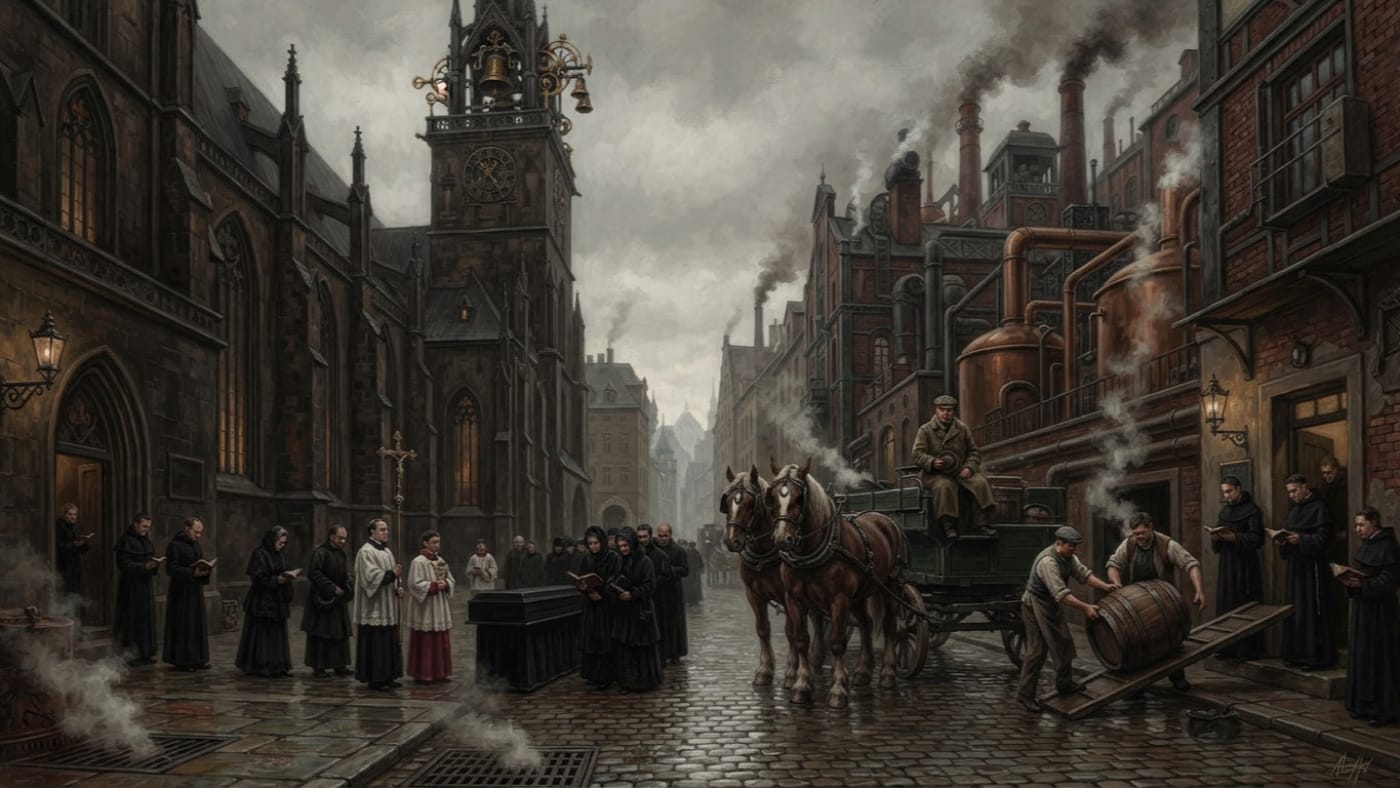
#On the Precinct and Its Neighbour
The old cathedral precinct of Munich is a working religious neighbourhood that happens to share a street with a brewery quarter. Neither party was consulted about this arrangement, and both have spent their lives complaining about it to the Creator, who has so far declined to move either of them. The precinct's doors admit the baptised, the betrothed, the penitent, the dying and the dead. On the other side of the street the copper kettles of the Bräuviertel fill the same air with malt.
The Codex records the boundary as an adjacency and nothing more exact. The published account of the Quarter puts the precinct at one edge of the brewers' thirty-seven blocks in one passage and at another edge a few paragraphs later. The survey has no independent instrument to settle which, and it will not settle the matter by inventing a compass point. The precinct adjoins the Quarter, and carts cross from one into the other. For the purposes of sin, that is enough geography.
No record the survey can cite gives a founding year, a dedication, a period of construction, or the names of the men who now hold its stalls. A cathedral chapter sits there. It keeps the offices, it preaches, it keeps its accounts, and it receives brewers at its doors with the face of a confessor who has heard this sin before.
#On Bells and Passage
Whatever the Bureau of Bells keeps on file about these bells, the street follows its own order of service. When the morning office begins, the draymen slow down. Iron-shod wheels on wet cobbles make a noise no cantor can sing over. The men on the boxes have known this since they were apprentices, so the horses drop to a walk and the casks behind them stop knocking, and the office goes on at its proper volume. Nobody issued an order for this, and nobody has ever been fined for neglecting it. A drayman who forgets is told so by the next drayman in line, in language unsuitable for the occasion.
The clergy return the courtesy. When barrels are being loaded, the minor clergy step aside: acolytes, sacristans and clerks in lesser orders wait in doorways with their breviaries shut while a cask rolls down its ramp and into the wagon bed. A hundredweight of beer has right of way over a man carrying a candle. On this one point theology and physics agree.
Funeral processions use the same streets as malt deliveries. When a bier meets a laden wagon at a corner, someone yields, and custom decides who, not any statute. Feast days strain the custom. On a feast day both sides claim passage at once, the processional cross and the brewery cart arrive at the same cobble, and incense and brewery steam fill the street together until the faithful can't tell which smell is the prayer. They go through it anyway. The Church has processed through worse.
#On the Chapter and the Brewing Houses
The chapter objects to the brewers' theology. Brewers talk loosely. They speak of the Creator as if He were a senior guild member owed a seat at the annual dinner, they bless vats in words no rubric approved, and they call their yeast martyred with the confidence of men who have never sat an examination. The chapter corrects them, preaches at them, and sends them home with improving texts they don't read.
The chapter also accepts their donations, and accepts them without visible strain.
The brewers resent the episcopal lectures. A master brewer who has kept a kettle at temperature through a hard winter dislikes being told from a pulpit that his speech lacks precision. He nods through the sermon, says the responses, and leaves irritated. He also intends to be buried by the men who preached at him, and he values that right above most things he owns. Burial rights matter to the brewing houses because the precinct is where their dead have always been taken, and a brewing family will put up with a great many lectures to keep it so.
Jurisdiction stays where it belongs. The guild court of the Bräuviertel rules inside the Quarter: it can discipline an apprentice, fine a cooper or refuse a man his beer. It has no power to summon a canon. The chapter, for its part, can't set a fermentation temperature. The survey found no treaty between the two bodies and no schedule of gifts. It found only a long run of years in which the brewers gave, the chapter took, both complained, and nobody broke the arrangement off.
#On Funeral Beer and Questioned Sanctity
Beer is offered after funerals in the precinct. Mourners come back from the rites and someone pours. There is grief in it and there is thirst in it, and only the most careless observer would confuse the two or try to tax them separately. A widow holding a mug is not committing an irregularity. The Bureau of Doctrine has stated its position with its usual tidiness: fermentation is natural, beer is civil, and drunkenness is a disciplinary matter. Funeral beer falls under the second heading. It is hospitality, and hospitality has never needed a sacramental licence.
The trouble lies in the yeast. The Bräuviertel brews with Saccharum Benedictum. The brewers say Benedictine monks preserved the culture through the Atheist Wars. That is the brewers' account of its provenance, and the Codex enters it as theirs. The Bureau of Relics received its first petition for authentication in A.S. 98. It declined that petition, and it has declined again in every one of the hundred and three years since. No condemnation has been issued either. The culture sits in its vats, unauthenticated and uncondemned, and the precinct's mourners drink what it makes.
A prior diocesan notice described Saccharum Benedictum as "a relic of unverified sanctity."
Corrected by Relics memorandum, A.S. 132. Operative description: a fermenting substance under observation. Authentication petitions continue to be declined. No condemnation has been issued.
In A.S. 171 the Bureau of Purity filed an advisory warning that the cathedral's nearness to the Quarter was letting "fermentary superstition" contaminate parish practice. The phrase is Purity's, and so is the allegation. The advisory was filed, reviewed and left unacted. No later page in the file withdraws it, and no later page proves it wrong. It simply has no disposition beyond the one recorded.
Two other findings sit in the same file. Parish attendance in the precinct is above the Munich average, and tithe remittance to the Bureau of Tithes is excellent. Any office reading those pages beside the advisory will understand why nobody hurried to act on it. No record says one paid for the other, and the survey enters none.
#On the Fourth Line and the Listening
The A.S. 178 Bavarian Creed Adjustment required Strasbourg cadence in Munich's public recitations, and it remains in force. Munich obeyed with full attendance and full posture, and it left three syllables of the fourth line where they had always been. The Codex does not reproduce those syllables. Anyone who has stood in a Munich church already knows them, and anyone who hasn't will not learn them from a survey.
The habit belonged to the old cathedral before it belonged to the city. Of all the places where the variant survived the order (kitchens, funerals, barracks, the brewers' guildhalls), the precinct kept it with the least effort. Clergy and congregation recited the line as their grandparents had, with perfect composure, in the building the habit came from. Doctrine's own observers began marking it "local solemnisation" so they would not have to file anything.
That phrase is a reporting convenience. It grants no dispensation, and nobody with authority to grant one has signed it. The mandate still applies to every public recitation in the precinct, and the precinct still lengthens the line. The observers keep writing their two careful words in the margin of the compliance table, and the table keeps reporting progress.
Next door, Purity listens in the taverns. The Marienplatz Post was established in A.S. 134 and assigns its listeners to the drinking rooms of the Bräuviertel. They have been listening for sixty-seven years. In that time they have produced nothing the Bureau of Doctrine considers actionable. That result states exactly what it says. It does not establish that the Quarter is innocent, and it does not establish any hidden finding. The post's assignment is the taverns. The precinct lies next to them and is kept by its own chapter, and the songs from the drinking rooms carry across to it on still evenings, as songs do.
#On Present Condition
As of A.S. 201 the precinct keeps its offices, buries its dead and gives the city its baptisms. The draymen still slow for morning prayer. The minor clergy still wait in doorways while the barrels go out. The chapter still corrects the brewers' theology and still accepts their gifts. The brewers still sit through the lectures and still mean to be buried by the men who give them. The fourth line is still long. The yeast is still under observation, and the funeral beer is still poured.
None of this fits neatly into a single Bureau's categories. The survey has entered it in five of them.