
#On the Station
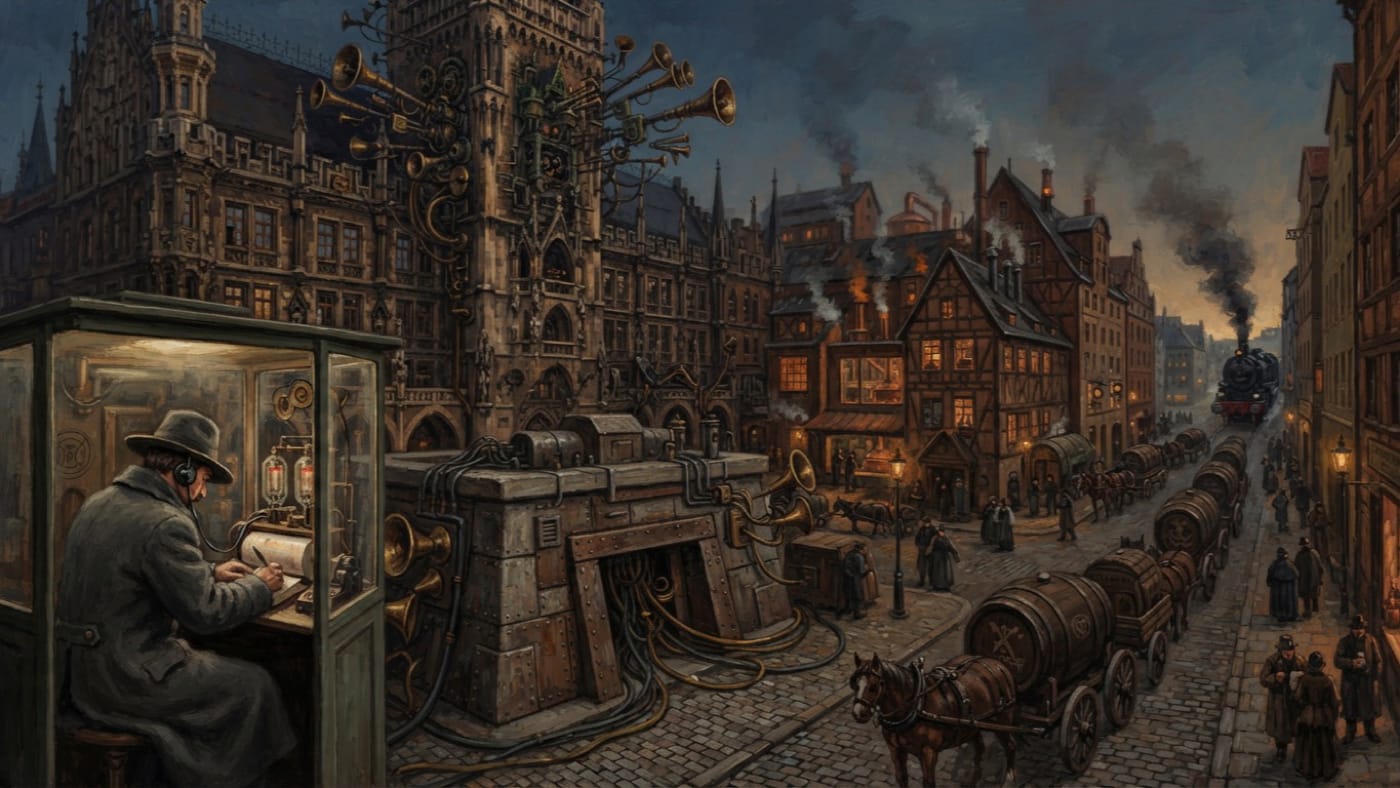
The Marienplatz Post is the Bureau of Purity's standing station in the Marienplatz of Munich. It was established in A.S. 134 to hear what Munich says once it believes itself merely thirsty. Its listeners are assigned to the Bräuviertel, the Brewery Quarter, which lies where it has always lain: thirty-seven blocks between the northern wall of the Provisorium and the old cathedral precinct. The post keeps the square. The listeners walk to the beer. Munich has never offered to walk the other way.
Everything the Codex can certify about the station fits on a single stamp, so I have had it put on one.
No abstract placed before this office records its commander, its complement, its rooms, its rotas or the wording of its original mandate. I will not supply them. Invention is a privilege of novelists and a vice of junior clerks, and I have spent a long career beating it out of the clerks.
The post belongs to the settled Synod. When it opened, the Concordat was forty-four years old and both founders had been dead since before Strasbourg. Neither blessed, inspected, nor wrote to a desk they never lived to imagine. The Quarter it watches is older than all of it. Records still lists the Bräuviertel's founding as "pre-doctrinal, administrative determination pending," so the watcher has a birth certificate and the watched does not. Purity finds this insulting. Purity is correct.
#On the Listening
Purity listens because words travel. A phrase repeated becomes a habit. Set the habit to a tune and it becomes a verse, and a verse sung in a low room by men with their hats off becomes something the Synod reserves for itself. The Bureau keeps the Index and polices public morals. It has always understood that heresy seldom starts with a pamphlet. It starts with a chorus.
According to the published account of the Quarter, the listeners attend to the taverns, and above all to songs that have grown old enough to sound doctrinal. This is a sensible use of effort. Men speak more freely after the second mug, less wisely after the fourth, and most truthfully in the interval between. A listener who has learned to count mugs has learned half his trade.
Munich will not teach him the other half. The Quarter is governed by brewers' houses whose names sat on the municipal rolls before Strasbourg finished being inevitable. Those houses keep kettle ledgers, cellar keys and apprentice oaths, and they keep a guild court that cannot imprison a man but can refuse him beer. They raise their sons to an exact verbal discipline. In Munich's songs the excise officer falls into the vat. Nobody pushes him. He drowns musically, comes up thinner, and is toasted. The verse scans and the noun stays deniable. A listener can write down every syllable correctly and carry home a perfect transcript that supports no charge at all.
#On the Quarter Under Observation
The Bräuviertel is productive, it is obedient, and its obedience is deliberate. About two million hectolitres a year leave its kettles. The Bureau of Tithes takes sixty percent. The Bureau of War requisitions twenty percent as morale supply for the forward territories, and Munich drinks what remains. Munich is the quartermaster city of the Central Heartlands, the last comfortable stop before the forward zones, and its beer rides east on the same lines as its shells. Every office would rather watch a district that fills casks for the Line than disturb it.
The brewers know this and behave accordingly. Excise barrels arrive on time. Weight declarations are filed. Receipt books are signed with a neatness so pointed that the receiving clerks feel mocked and still cannot find the infraction. This is the community Purity was sent to overhear: thirty-seven blocks of men who have turned compliance into commentary.
Then there is the yeast. The brewers ferment with a culture they call Saccharum Benedictum, the Blessed Sugar. They claim Benedictine monks hid it in a reliquary cask and carried it through the Atheist Wars. That claim remains a claim. The Bureau of Relics received its first petition for authentication in A.S. 98 and has declined it every year since. Doctrine's public position is that fermentation is natural, beer is civil, drunkenness is a matter for discipline, and talk of sacramental yeast is local exuberance.
Consider what that leaves a listener. A tavern song about the martyred yeast may be a drinking song, or it may be an unlicensed hymn. The answer depends on a classification no office has made, and the post has no authority to make it.
#On Reports Without Proceedings
The listeners have filed reports since A.S. 134. The Quarter's published account says those reports have produced nothing actionable. The city's own article is more exact: nothing the Bureau of Doctrine considers actionable. The Codex enters that as the administrative result, and it enters nothing more because nothing more has been put in front of it.
The two things must be kept apart. A report shows that a listener went somewhere and heard something. A proceeding requires that the something can be carried before an office with power to act on it. Whatever lies between the two is in the post's files, and I have not seen them. Doctrine's regional assessment for A.S. 200 rated Munich exemplary and noted, in one line, that Purity had filed a separate assessment. That separate assessment is classified. I have read the line, and the line is all I have read.
Seventy years of reports have produced nothing actionable.
Arithmetic corrected. From A.S. 134 to A.S. 201 is sixty-seven years. The year of establishment stands and the present year stands. The round number has been returned to whichever tavern lent it.
The record should be read just as strictly for what it leaves unsaid. It does not certify a Quarter free of dissent, and the songs alone would embarrass anyone who tried. It reveals no conspiracy hidden from Purity, shows no listener taking a bribe, and makes no claim that the listeners heard nothing. Sixty-seven years of reporting has found Munich careful. The file does not say whether Munich is innocent, frightened, shielded by its usefulness, or simply better at grammar than the Bureau. I will not say it on the file's behalf.
#On Jurisdiction
The post listens. That is its office and also its limit. Purity enforces clean speech. Doctrine holds the definitions, and a phrase becomes heretical when Doctrine rules on what it means, not when a listener takes offence. Relics owns the yeast question and declines it every year. Tithes counts barrels. War counts the casks going east. The Bureau of Records keeps the Quarter's missing birthday on a form marked pending.
Each of those offices has an interest in the Bräuviertel. None of them has handed that interest to a station in the Marienplatz.
The result is a Quarter watched by six Bureaus and fully governed by none of them. The post may hear a song about sacred yeast, but it may not rule on the yeast. It may hear a joke about the excise, but it may not rule on the excise. It hears the whole of the Bräuviertel and owns a sliver of it. Any listener who forgets this will learn it from Tithes, which is less forgiving than Purity and much better at arithmetic.
#On the Continuing Watch
As of A.S. 201 the post is still in the Marienplatz and its listeners are still in the taverns. The kettles boil. The tithe barrels leave on time. War's share goes east by rail. The songs keep getting older, which by Purity's own measure makes them more interesting, and the inspectors in them keep drowning and coming up thinner year after year with nobody named for it.
I approve of the watch. A Synod that stops listening to its taverns deserves whatever its taverns compose next. I also enter in the Ledger that sixty-seven years of listening has produced the most thoroughly attended silence in Zone 2, at a cost no abstract records. Munich pays its tithes, fills its casks, and sings. The post writes it down. Doctrine reads what the post writes and finds nothing to act on. The brewers drink to that and go back to work, and Purity, with exemplary patience and no result, keeps listening.