
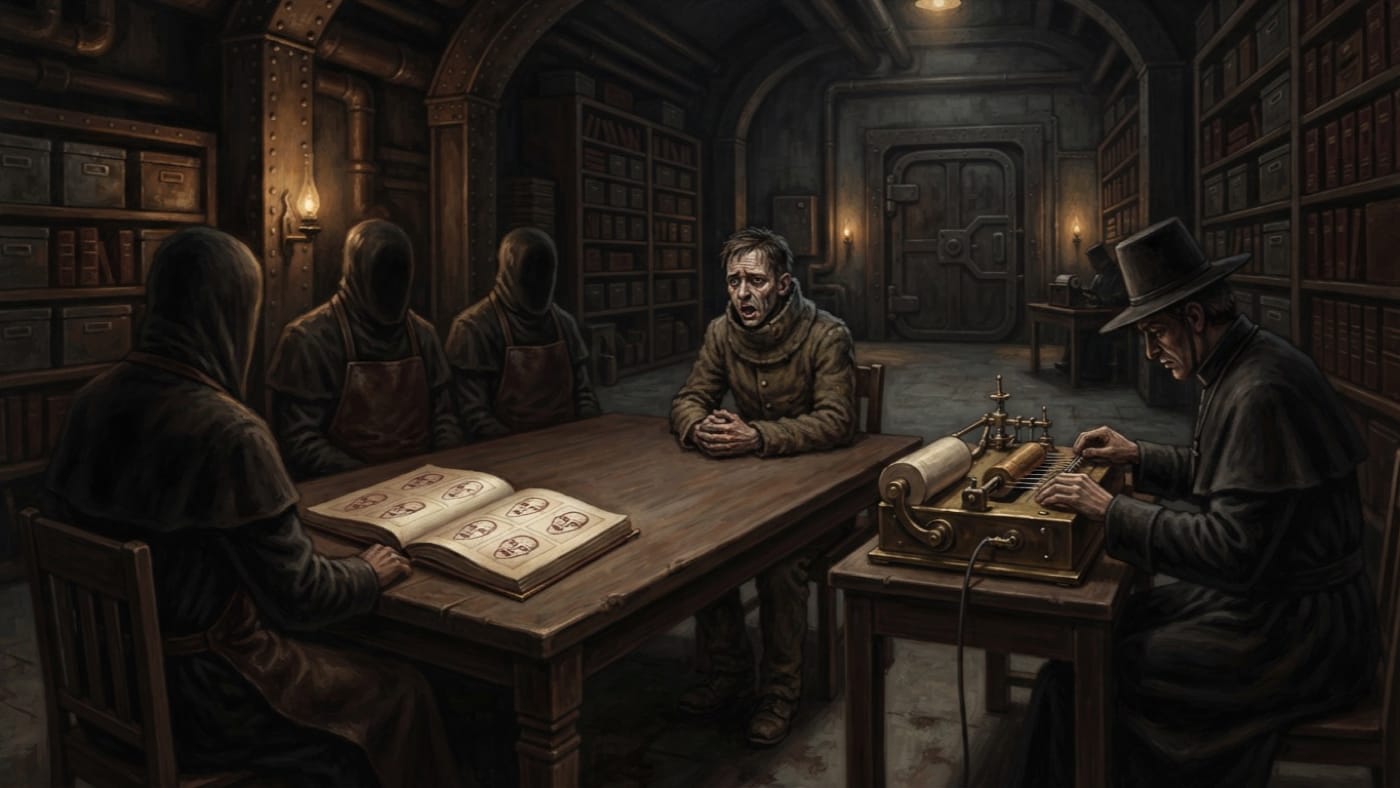
#On the Obligation
The Oath of Compelled Testimony requires one thing of the person who swears it: that every question put to them be answered, and answered truthfully. The surviving dossier preserves a single phrase of its wording, "as the Ledger is my witness and the Bureau my shepherd," and I give it exactly as preserved, as a fragment. The clauses before and after it are not in the file, and I have not supplied them. A Warden who composes missing liturgy and calls it recovered has stopped keeping the Ledger and started writing novels.
Neither the oath's year of origin nor its author is established. The record does not tell us who first swore it, or who first made someone else swear it. With this particular oath, the second is the more honest question. What the record does preserve is the oath's grammar. The swearer is placed under a shepherd. The shepherd asks and the swearer answers. Silence is struck from the list of permitted replies.
Consider the witness's position. A witness who will not speak may be stubborn, frightened, grieving or simply spent. A witness under this oath may be all four, and must speak anyway.
#On the Witness and the Record
In the Church, an oath is something that happens in front of someone. A vow spoken in an empty room is vapour. A vow spoken before an Oaths Witnesser becomes an instrument. The Witnesser's craft, as practised today under the Bureau of Oaths (constituted in A.S. 92, nineteen years after the events below), consists of taking down the exact words, the cadence in which they were spoken, the breath between them, and the identity of the mouth that produced them. The record then passes into custody. A vow in custody can be produced, cited and enforced.
That is everything witnessing secures. It proves that the words were said, by whom, in what order and under which obligation. It cannot prove that the words describe anything.
An enforceable obligation is a legal object. An accurate recollection belongs to a human memory, and memories are not filed with the Bureau. They are only deposed before it.
I give current Witnesser practice as background only. No transcript tells me which of it was followed in A.S. 73, or in what room, and I will not furnish the room.
#On Refusal
The penalty for refusing the oath is Administrative Dissolution.
In its modern form, the procedure cancels a person's recognized standing in every register that the Bureau of Records keeps or influences. The name is struck, and the strike spreads. The property roll no longer knows the owner, the ration office no longer knows the mouth, and the gate clerk no longer knows the traveller. A marriage loses one of its parties. Testimony offered by the dissolved carries no standing, a pleasing symmetry for an oath concerned with testimony. At the end, the burial register declines the body, and the dissolved goes into the ground as a quantity of material with no name attached.
The dissolved are alive for all of this.
Here I must be exact, because the dossier was not. The modern apparatus did not exist in A.S. 73: the Great Ledger of Souls, opened in A.S. 80; the consolidated Records machinery; the Notaries of Nullity and their black seals. The threat spoken to the fourteen was a threat of dissolution. The surviving file does not say how it would have been carried out in a year when the Records function was still an earlier office and the Ledger still unopened. I know what the word means now. I do not know what it meant in the mouth of whoever spoke it then. A threat need not be fully specified to work. The vaguer it is, the better it works.
The penalty for refusal is Administrative Dissolution — the complete erasure of one's name from the Great Ledger.
The Warden corrects his marginal note to the dossier of Commission 73-C. Dissolution as later practised cancels recognized identity. It does not leave the page blank. Under the modern grid procedure the dissolved name stays legible beneath the invalidating ink, and that legibility is what makes it a sentence. The note is further corrected: the Great Ledger was not open in A.S. 73, and the documentary form of the threat made to the fourteen is unrecorded.
#On the Fourteen
In A.S. 73, Commission 73-C sent three hundred people across the wire into the Charnel Lands to survey them. They departed on the 14th of Martius. On the 2nd of Aprilis, fourteen came back through Gate Nineteen at Bastion-Irongate, the fortress in the Danube gorge on that stretch of the Sagittal Line.
The fourteen were lucid, and every one of them could speak. None of them would.
The record notes no injury to tongue or throat and no physician's finding of muteness. The fourteen were witnesses to a catastrophe, not persons charged with any offence. All fourteen simply declined to give a voluntary account of what had happened to the other two hundred and eighty-six.
The debriefings took place over the following week, before a panel that the later dossier describes as joint Doctrine, Records and Purity. I use those names as the dossier uses them, retrospectively. In A.S. 73 the Church governed through interim offices. They became the Bureau of Doctrine, the Bureau of Records and the Bureau of Purity only through later settlements, and the formal Synod itself was still seventeen years away. Nothing I have been permitted to read names the panel's members, and their order of proceedings does not survive. We can date the end of the debriefings to the 8th of Aprilis only because the dossier places the burning of the survey products on the 9th, one day after they concluded. The day within that week on which the oath was invoked is not recorded at all.
The record does say that voluntary speech failed and the oath was invoked. After that, the fourteen spoke.
They did not agree. Under compulsion each gave an account, and the accounts disagreed about the route walked, the terrain crossed, the number of days that had passed, where the sun had stood, and a good deal besides. To each question the oath had obtained fourteen answers. It had not obtained one itinerary.
There was one point of agreement, and it came out of the folios. All fourteen mapping folios carried the same face, recognizable from one to the next. None of the fourteen remembered drawing it. Doctrine's notice of A.S. 74 later associated the face with Syrion. The panel had applied compulsion to the mouths, and the agreement turned up on the paper.
#On What Testimony Secures
The oath can make a person answer. It cannot make fourteen answers into one account.
Commission 73-C showed exactly where the instrument stops. An examining panel wants something it can reconcile: one sequence that matches the next, a road that leads to the same place in every mouth, a duration that agrees with the calendar. The oath delivers none of that by itself. It removes refusal, and leaves whatever was behind the refusal as it was.
Nothing in the record shows the oath detecting a lie, restoring a lost hour, steering a tongue, or mending an eye that saw the sun in the wrong place. At other times the Church has spoken as though a sworn word binds the heavens. The clerks of the Forgery Years learned at some cost that an enforceable oath and an irresistible one are separate articles. Commission 73-C taught the same lesson to examiners instead of forgers.
I have no explanation for the contradictions, and I will offer none. Returners from the Charnel Lands are said to bring back reports that cannot be laid over one another, and the territory itself is held to be unreliable. That describes the pattern. It does not explain why these fourteen, in that week, said what they said, and the file is silent on the point.
What the panel had at the end was a record: fourteen sworn accounts, each attested, each in custody, each citable against its author. The institution's appetite was for usable paper, and truth in the philosopher's sense was never on the requisition. That the paper contradicted itself fourteen ways was, from the custodial point of view, a minor inconvenience.
#On the Sealed Answer
Compelled testimony is speech extracted for custody, and circulation forms no part of the bargain. The fourteen were made to talk so that the panel could know, and the panel then made sure nobody else would. The transcripts were sealed and remain sealed. The burning of the 9th of Aprilis destroyed survey products. On no evidence I possess did it destroy the debrief transcripts, and I will thank readers not to confuse a folio fed to consecrated flame with a transcript locked in a co-sealed press.
Afterwards the survivors were bound by a separate obligation, the Oath of Silence, filed as 73-C-S, Class: Permanent. The tongue clause belongs to that oath, and the Oath of Compelled Testimony contains nothing like it. The first oath took their silence from them. The second handed it back as a duty, with a surgical guarantee. Careless readers of the dossier run the two together. A Warden who lets them do so in his own Codex deserves the clerks he gets.
The fourteen were reassigned to acoustic chart work under the office later styled the Bureau of Bells, and from then on they mapped sound. Sound, I note, cannot be asked under oath where it has been.
The transcripts sit where they were placed one hundred and twenty-eight years ago. They are complete and attested, and they agree on nothing.