
#On the Ground and the Claim
Strasbourg holds the map of Norway. The fjords hold Norway.
Norway is the western wall of the Fractured North. The Synod files it under Zone 8 and administers it chiefly by correspondence. The country is a coast that will not run straight. Its fjords cut inland between cliffs too steep for a cart and too high for a shout. The mountains behind them close their passes when the weather decides and open them again when the weather relents. Between one settlement and the next, the sea is a road in summer and an indictment in winter. A village can sit a day's skiff from its neighbour and a season's walk from anyone holding a seal.
I put the geography first because the jurisdiction follows from it. The Synod claims Norway under the Concordat, and the claim is entered, stamped and current. It reaches a fjord the way a writ reaches a man who cannot read. It arrives, it is kept dry, and it is consulted when convenient. On the water, authority belongs to whoever controls the lamp-oil, the boats and the narrows. None of those three is posted from Strasbourg.
The northern account of the Sundering of A.S. 45 speaks of earthquakes, tidal surges and a winter that would not end. I record it as the North's own history and will not improve on it. The faith these communities kept through that winter is older than any Bureau. The formal Synod that now classifies that faith was not constituted until A.S. 90. The Bureau of Rites prefers to remember the order of events the other way round, and the Bureau of Rites is wrong.
#On Compact, Chapter and Watch
Across the North, settlements govern themselves through clan moots, elder councils, harbour compacts and Watch captains elected by the households they protect. Norway follows the pattern without uniformity. Each fjord keeps its own compact and its own grudges. Each has its own view of which southern instruction deserves an answer. There is no Norwegian crown for the Bureau to petition and no capital where it can lodge a protest. Having nowhere to send its displeasure, the Bureau sends Priors.
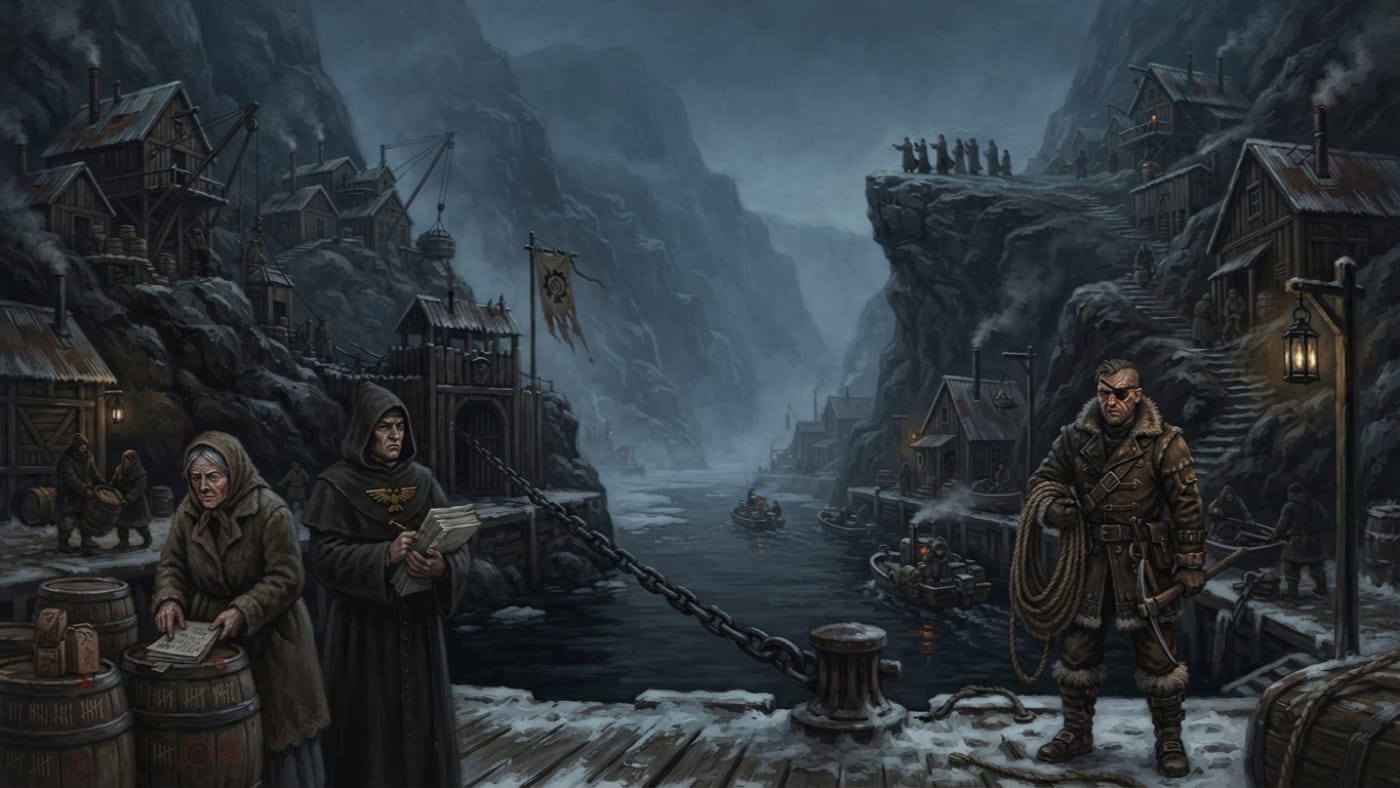
The arrangement is easiest to read at the Seal-Oil Shrinefjord of Hrafnvik. Hrafnvik is a string of hamlets along a black fjord, about seven thousand four hundred souls. It swells each winter with refugees and deserters, who arrive with nothing and are counted against everyone else's oil. Three authorities divide it, and none of them would accept being called the government.
The Clan Moot, under Elder Sigrun Half-Wick, sets the rendering schedules and allocates what the yards produce. Whoever decides when the vats boil decides who is warm in the dark months. Sigrun counts barrels the way a sacristan counts relics: often, in silence, and expecting theft.
The Shrine Chapter belongs to Prior Malthus, appointed by the Synod. Its instruments are papers and exemptions: who may travel, who is excused a fast, whose name stands correctly in the ledger. The Prior keeps up worship and correspondence with the South at the moot's sufferance. Like every Prior in the North, Malthus knows exactly when the next supply ship sails.
Watch Captain Rauk One-Eye holds the escorts and the rescues. When the ice closes and a household must be reached, the Captain picks the route, the hour and the house that is reached first.
These three hold one another in check the way three men on one rope do: badly, constantly, and knowing that if one lets go, all three drown. None of them governs Norway. None of them governs the next fjord.
#On Oil, Passage and Paper
Seal-oil is light, heat and lubricant. It keeps a gun-lock working in cold that turns ordinary grease to paste. The northern garrisons burn it. Bastion-Königsberg, the northern anchor of the Sagittal Line, keeps its lamps and its mechanisms going on northern oil. The parent assessment puts Norway's rendering-yards at roughly sixty thousand barrels a season. By the same estimate, about forty thousand go south through Hamburg. The other twenty thousand stay behind, to be rationed, traded, hoarded and fought over. I reproduce the estimate as an estimate. I have counted no barrels and will not pretend otherwise.
The Bureau of Tithes taxes the southern flow at rates the Norwegians ignore. The Bergen harbour compact helps guarantee advances against future shipments through Hamburg's banking houses. The Church's northern war is therefore partly underwritten by people whose tithe returns the Bureau marks incomplete. I find this funny. The Bureau does not.
Everything passes the narrows. At Hrafnvik a chain across the ice-choked fjord mouth can shut the whole cluster off in one pull. It answers to the clans, and it appears on no Bureau of Engineering schedule I have been shown. Grain comes in through it, along with iron tools and medicines, and also warm papers: the permits, exemptions and identity proofs of the South. The fjord treats those papers as an apothecary treats laudanum. They are measured, recorded, given in small doses, and worth killing for.
Each household owes oil, watch-hours and fast days. Lamp-time is taxed, and it can be withdrawn. Debt that cannot be paid in barrels is converted into watch duty. A household that fails beyond that becomes a dark-house and loses communal lamp aid. A dark-house in a Norwegian January is a household with a deadline.
These are Hrafnvik's practices, and I do not certify them as the law of every fjord. I do certify that in Hrafnvik a stamped paper is worth more than a coat. The South prints those papers by the ream.
#On Observance and Deprivation
The Creed is chanted before dawn, upon the cliff, in the wind. No one is excused for weather.
The Norwegians are faithful, and the Bureau should write that down before it writes anything else. Villages rise in the dark to chant the Creed on the cliffs. Wardens are few, so families enforce discipline themselves, with a thoroughness that would embarrass a tribunal. Children learn the axe and the psalter together and carry both before their twelfth year. I spent nine days among these observances at Hrafnvik in A.S. 197. I found no doubt in them anywhere.
Faith that dense costs something, and the households pay for it. The calendar sets the fasts and kin enforce them. In a lean season a fast becomes a famine, and no one announces the change. At Hrafnvik the official line is Fasting purifies the North. The other line, said more quietly in the same longhouses, is that fasting makes the weak disappear. Both are true in the arithmetic. Autonomy has never made northern elders merciful. It has made their severity local, which the household recognises sooner and escapes less often.
In A.S. 199 the Bureau of Rites reclassified the region as Concordat-Variant, Category B — Locally Adapted, Non-Heretical. That ruling settles the doctrine. It settles nothing about the bells. The Bureau of Bells opened Investigation 447-N into irregular peal practice across fourteen northern settlements, then suspended it without a ruling. I will not estimate how many of the fourteen are Norwegian. The fjords ring as they ring, and the form letters are still in transit.
Erratum — Filed by the Author, A.S. 201: The World Geography & Atlas, section six, gives the Fractured North's spiritual character as "Heretical, pagan, dangerous." The first two words are withdrawn as applied to Norway. They contradict the Bureau of Rites' Category B ruling of A.S. 199 and the conduct of the Hrafnvik congregations I saw at prayer. The third word stands. Corrected.
#On the Defence of Coast and Pass
The Winter Watch guards the coast, the passes and the routes between them. Its captains are elected and answer to the moot. They are charged with the one decision no Bureau has ever wanted to sign: which house the relief reaches first. At Hrafnvik that decision belongs to Rauk One-Eye. In a hard winter it is the only verdict anyone remembers.
Norway has no army, and the Bureau of War has wisely not invented one for it. The Bureau tried four times to fold the North's Watch into the continental levy. It got four treaties, each kept in the warm months and forgotten in the cold. The Watch remains a Non-Integrated irregular auxiliary, which is the Bureau's phrase for men it cannot command.
The Watch defends against weather, raiders, and things the Bureau has not named. Northerners say det grå vattnet when they mean the sea and den stilla hungern when they mean the land. I record both names. I do not merge them, and I do not assign either one an owner. The Ledger has enough fictions without my adding to them.
At Hrafnvik the fog answers back. Prayers spoken into it return altered, and it speaks names that no one said. During my inspection in A.S. 197 I classified the phenomenon as Category Two Localised Acoustic Distortion. The designation accurately describes what was heard and says nothing at all about why. The Watch meets the fog with triple-wick lanterns, salt circles and rules of silence on certain paths. It offers no explanation. Neither do I.
#On the Present Condition
The A.S. 201 assessment of the Fractured North records its compliance as Conditional, and Norway falls inside that condition. The revised Zone 8 population of about one million nine hundred thousand, issued in A.S. 200 without a new field survey, belongs to the whole Zone. Any clerk who prints it as Norway's figure will meet me in the margin.
Strasbourg needs the oil. The fjords need grain, tools, medicine and paper. Each side has worked out, without help from the other, what the other's collapse would cost, and each pays the price of avoiding it with poor grace. The Priors stay posted, and the barrels keep moving. The chain at the narrows stays where the clans leave it, and the clans have not said where that will be.