
#On Their Public Employment
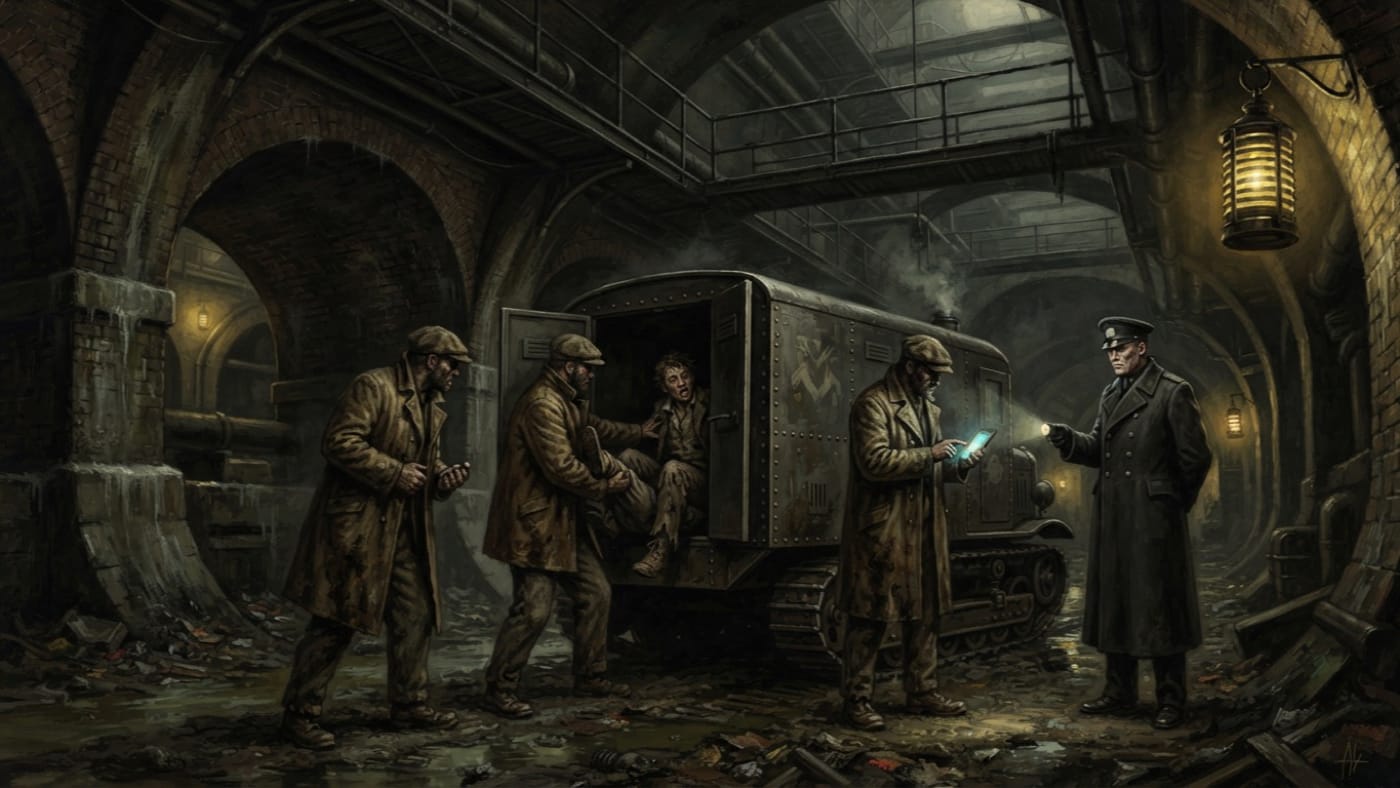
Latchford keeps its drains the way it keeps its conscience: wet, overfull, and tended at night by people the ledger declines to name. The Latchford Permit-Yards enter these people as sanitation crews. They carry hooks and brooms. They go down into the culverts after curfew, once the queue above has been counted, and they come back up having removed something. The yard calls them the Night Sweepers, and the yard is precise about what they sweep.
People.
Their acknowledged trade is clearing runoff, sodden forms and filth from beneath the catwalks. Their unacknowledged trade is abduction and quiet transport. Latchford's own reckoning places them among the Erased-but-Used, the lowest of the yard's four strata. Above them sit the Stamped and Sated. Below those sits Licensed Labor, and below that the Unwindowed, who rot in the Long Queue waiting for a bell that will not ring their number. The Erased-but-Used have no window and no standing. They have employment. Culvert crews, night cleaners and the yard's black labor all belong to this stratum, and most of them sweep nothing worse than ink-mold. The Sweepers are drawn from the erased. The erased are a much larger congregation.
The administrative marvel is this. An organization whose members do not officially exist performs work that no office officially orders, and it does that work every night with a regularity the Master Gate Clock might envy.
#On the Night-Writ
Latchford runs on paper the way a censer runs on coal. The Bureau of Records checks papers, the Bureau of War checks cargo, and the Wardens check faces. Between those three inspections a body may be weighed, stamped, confessed, deferred, conscripted or refused. Nothing moves without a document. That includes people moved without their consent.
The yard's word for the Sweepers' document is night-writ, glossed locally as a forged sweep authorization. That gloss is the whole of what the record supplies. No surviving exemplar has reached my desk. Its wording, its form, its seal, the officer whose name it borrows and the means by which a patrol might test it are all unentered. I decline to invent them. Invention is the Sweepers' prerogative.
What the writ does is easier to state than what it says. A guard on a tightened patrol route meets a sanitation crew leading a stranger toward a culvert mouth. The crew produces a paper. The guard has been taught since the first posting that if it isn't stamped, it didn't happen. Now the guard holds a stamp, so the thing has happened properly. The writ never needs to persuade a magistrate. It only needs to spare a tired Warden the labor of disbelief.
At Latchford a forgery works ex opere operato. The paper becomes valid in the act of being shown. A forged writ for a useful crime gets the same weary glance as a genuine writ for a useless errand, and the stranger goes down the ladder either way.
The queue tells a simpler story, kinder to everyone except the taken: the Night Sweepers take only criminals. The Queue Shepherds repeat it. It is believed most firmly by those who have not yet been taken.
The Night Sweepers take only criminals.
Corrected. The street keeps a second saying and labels it half true: they take anyone whose papers could fix a discrepancy. Half a truth makes a poor targeting rule, and neither saying establishes who is actually chosen. Only has been struck from the first for want of any warrant. In a yard where failed papers and crimes go before the same tribunal, the two sayings sit closer together than Latchford would like.
#On Their Ground
Latchford is built in three storeys of guilt. At the top the Clerklofts and catwalk offices hang over the yard like a choir-loft of ink-stained linen. At ground level the Long Queue waits in the mud. Underneath, the culverts and crawl-tunnels of a drowned river village carry runoff toward the drains and the Paper Sump. The Sweepers hold that lowest storey, together with the Silent Zones, where the yard's noise is forbidden and its records go to die.
The day prepares their work. At curfew the lights narrow and papers are collected. The "missing" are discovered. That is the official order of the yard's day, and I have copied it faithfully. Then the lanterns go counting-bright and the patrol routes tighten. The bells shorten their intervals until an outsider cannot say which hour they are standing in. The Minute Market moves beneath the boards. The night is given to sweeps and abductions, in that order of acknowledgement.
Their recorded method has three parts: silence, vans and forged writs. Silence, because the Silent Zones demand it and the sleeping queue rewards it. Vans, because a body that walks can be seen and a body that rides is cargo. Writs, because cargo must be authorized. The source says vans and says nothing about what draws them. I shall not hitch a horse or stoke a boiler on its behalf.
One place carries their trade in the yard's own inventory. The Silent Zone Stackhouse is an archive overflow, a building of dry dust and surplus ledger, and it is listed as a night-sweep hub. Names vanish from ledgers there. The Stackhouse and the Night Archive are separate sites. The Silent Zones that ring the Archive belong to the Sweepers' ground, and I will thank the next inspector who confuses the two buildings to remember that both keep records near the one question Latchford forbids: where the night-swept go.
#On the Market's Invitation
The Codex account of Old Sable records a local custom in a single sentence: the Night Sweepers do not raid the Market unless invited. I can add nothing to that sentence except unease.
Consider what the custom requires. A market of forgers trades beneath the catwalks, in the very understructure the Sweepers patrol, and goes unraided. So someone is able to issue an invitation. The account does not say who, on what terms, through what channel, or whether an invitation has ever been sent. A reasonable reader concludes that Sable commands the Sweepers. A reasonable reader has never been to Latchford. The restraint may be purchased, ordered, negotiated, feared or merely habitual, and the record lets me affirm none of these.
What the Market sells is better attested: forged minutes, stolen windows and route intelligence. Among the favors bought beneath the boards is the deferral of a sweep. A family can therefore buy its continued place in the queue, minute by minute, from the same economy the Sweepers decline to disturb. The poor pay to be skipped. The skipped are replaced by someone who could not pay. The ledger balances. It always balances, which is what a ledger is for.
Whatever the arrangement is, it rewards the solvent in every direction. Those who buy time keep their place. Those who sell it keep their trade. The Sweepers keep their schedule. The only party with no seat at the bargain is the row that gets taken.
#On the Missing Blanks
Late in A.S. 199, a batch of blank master-permits disappeared from the Hall of Seals. The yard's own history records, in its next clause, that the night sweeps intensified. The two facts sit side by side in the record like two prisoners on one bench: adjacent, related by the room, and unproved as accomplices.
The interests are easy to list. The street, in a rare fit of arithmetic, says Records gains control, War gains priority, Sable gains profit, and the Bureau of Shadows gains silence. Prefect Mavren Tull holds the blank permit stock. Quarter-Commander Hesta Brune holds convoy priority. Neither is recorded as master of the Sweepers. The yard calls the Sweepers Shadows-adjacent, and adjacency is a matter of geography, not a commission. Nobody has produced an order linking any of these offices to a single night's work.
So the blanks went missing, the sweeps grew heavier, and nobody has filed the page connecting the two. I note that a forged sweep authorization becomes far more convincing when the forger has genuine stock to forge it on. I note this. I do not certify it.
#On What Remains Unentered
The register of the Night Sweepers is short. The register of what it lacks is long. Their founding is unrecorded. The ford checkpoint is reckoned from about A.S. 72 (c. 1782 CE), years before a Synod existed to number it, and the Clock from about A.S. 110 (c. 1820 CE). Neither date belongs to the Sweepers. Their number is unknown, and so is their leadership. Their destinations are forbidden as a question and missing as an answer.
The yard murmurs that the disappearances and the minutes lost near the ford belong to a single account. The Minute Market repeats the murmur. I have no page to set it on.
One condition is entered in their file, and it is entered as a trigger: a witness survives. The record gives no witness and no instance. It records only that survival is what compels the Sweepers to act. Latchford knows the alternatives, and it has never asked what that action would be.
The bell shortens its interval. Somewhere beneath the boards a van is loaded, and in the morning the queue moves up one row.