
#On the Tower in the Yard-Spine
"Never trust a bell you didn't see struck." — Latchford proverb
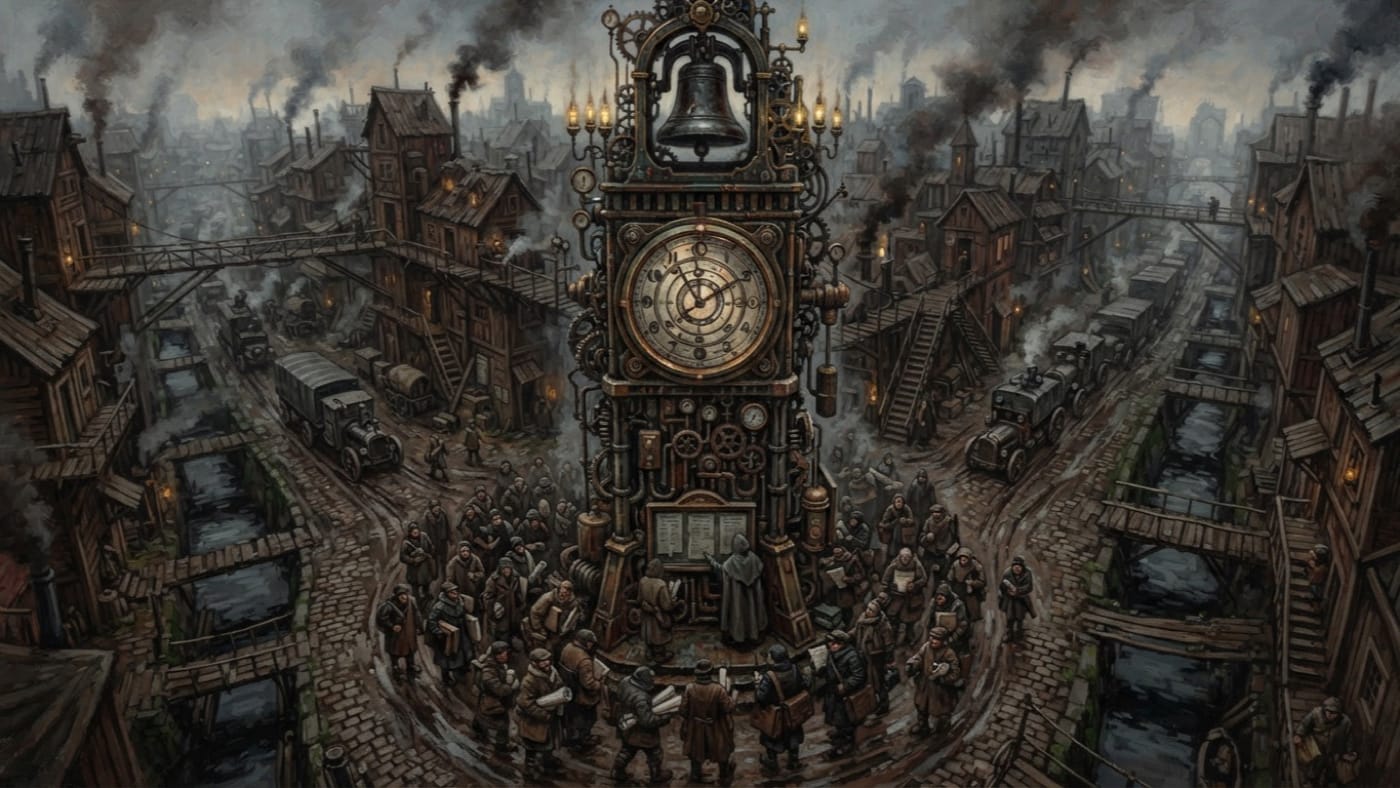
The Master Gate Clock stands at the centre of the yard-spine of Latchford Permit-Yards, on the low causeway beside the Latch River ford, in the Danubian rear-approach of the Sagittal Line. The settlement around it is timber and mud. Offices are stacked on offices, catwalks are lashed to older catwalks, drainage canals carry spent ink toward the Paper Sump, and the Processional Road, the only paved surface in the place, carries the convoys south toward Bastion-Constantinople. The clock is brass and iron. It is the one object at Latchford the mud has failed to claim, and the mud has tried.
At dawn the windows are posted on it. The crowd presses toward the notices, which are damp before they are legible, to learn whether it has the right to move that day. After that the bell decides. When it strikes the close of a window, the window is closed. It makes no difference what the clerk's hand was doing, what the applicant was saying or what the papers in that applicant's two hands declared.
Latchford worked as a checkpoint for decades before it had a clock. It grew up around a ford, a ledger-post and a timber gate in about A.S. 72 (c. 1782 CE). The offices that ran it then were early organs of a Church that would not become the formal Synod until A.S. 90, and we call them Bureaus now only because we file backwards. Local memory records a First Stamp Riot, of no settled date, in which windows were cut without notice and the queue trampled its own. Records installed machinery afterwards. The chronology the Codex now carries places the clock's installation at about A.S. 110 (c. 1820 CE). Nobody has produced a commissioning document, and I have not asked for one.
#On the Window and the Bell
"What's your next window?" — Latchford greeting; outsiders say "tomorrow" and are marked as outsiders
A window is a period during which the Hall of Seals will process one category of paper and nothing else. The Bureau of Records and the Bureau of War set the windows together through Bell Orders, which are the product of memoranda exchanged between people who would rather not share a room. Prefect Mavren Tull holds the blank permit stock for Records. Quarter-Commander Hesta Brune holds convoy priority for War. Tull wants the count to be correct and Brune wants the convoys moving, and the clock turns whatever they settle into a deadline that can be heard across the yard.
The Hall answers to the bell. Its thirty-two bays each process eleven applicants per bell-hour, so the Hall's whole capacity is three hundred and fifty-two souls per bell-hour, provided every bay is staffed and every clerk is awake. The applicant shows the papers with both hands, because one-handed presentation marks a stranger. The applicant declares a destination aloud, because the Yards regard travel as a confession and want it spoken. The applicant then receives a Transit Window Pass, a document divided into minutes like a penitent's chart, where every square is something the holder may still lose.
An example will show how this works, and I offer it as an illustration only. A carter arrives with a cargo permit that is valid, sealed and countersigned. He reaches the bay as the bell strikes the close of his category. His permit is still good. His window is gone. From that strike until the next posting he is Unwindowed: he holds papers but has no time slot in which they can be honoured. He is not yet a blankface. Blankfaces have no recognised standing at all, while the Unwindowed have standing and nowhere lawful to use it. The Yard Tribunal knows the difference exactly and charges for it.
This is the clock's real authority. Records issues the paper, War empties the road, and the Hall applies the stamp. Only the bell can turn a correct document into a late one.
#On the Drift
"If you argue with time, time wins." — Latchford proverb
The clock drifts. The published record says it loses minutes in clusters and regains them at intervals that match no maintenance schedule. It also produces strikes that the bell-ringers do not remember making. At Latchford, ringing an unsanctioned bell is one of the offences punished by instant annihilation. I note, for the Ledger's amusement, that nobody has decided whom to charge when the sanctioned bell does it by itself.
The locals call the wider disturbance Minute-Eddies: small time-shears that gather around the ford and the clock. Nearby clocks wander. Bells strike twice. People swear they have lost two to five minutes, and then they find a stamp on their papers that they do not remember receiving. The Yards use three kinds of time, and I keep them in three separate drawers. Bell-time is permission. A Minute Market minute is a purchased favour (an extended window, a faster stamp or a deferred sweep) and has nothing to do with sixty seconds. An eddy is something taken from a person without that person's consent. No conversion table links the three, whatever the cant of the minute-mathematicians under the catwalks may say.
The Bureau of Engineering has inspected the mechanism nine times. Each inspection produced a report, every report was filed, and none led to any action. The Office of Bells has certified the clock's precision as "doctrinally adequate." I am setting down these facts in their proper order. The clock is observed to be irregular. The clock remains legally valid. A strike nobody initiated still closes a window, and a window closed by that strike is as closed as any other. Latchford would find it easier to give up the ford than to admit that its bell can be wrong. Admitting it would reopen every window the bell has ever shut.
#On the Seventh of Corvus
"If it isn't stamped, it didn't happen." — Yard Litany
On the seventh of Corvus, A.S. 200, the Master Gate Clock drifted by five minutes. Half the settlement's papers became invalid all at once. Nothing had been forged, altered or revoked. Every window had simply moved out from under its holder. The Yard Tribunal processed forty-seven cases in a single bell-hour. Prefect Tull smiled throughout. Quarter-Commander Brune requisitioned more holding cages. Old Sable raised his prices.
Those three responses are the whole incident. Records recovered its composure, War recovered its capacity and the market recovered its margin. The papers recovered when the drift ended. Some of the people holding them had spent the interval in a cage, and the cage did not recover them.
The theft came first. In late A.S. 199, a batch of blank master-permits disappeared from the Hall of Seals. The official inquiry blamed inventory fatigue. Gossip in the queue blames Sable, and so does every inadmissible document in the Yards. The Tribunal has accepted no admissible evidence that he did it. I am recording the theft as fact and his responsibility as suspicion.
The slips that circulated afterwards are another matter. Records admits three confirmed occasions on which Sable's minute-slips were processed as genuine. The later slips do something worse: they carry windows that the clock has not yet announced. A forger who copies an official window is only a criminal. A forger who prints the window before the bell strikes it has either an informant in the room where Bell Orders are drafted or some knowledge of the schedule that the schedule-makers do not share. Neither possibility proves that Sable winds the clock, commands whoever tends it, or answers to anyone. They prove only that the clock's authority can be anticipated, and Latchford now knows it.
The Bureau of Shadows knows of Sable and has not moved against him. I have been asked to interpret that patience. I decline, because the people who ask me to interpret Shadows tend to be reassigned soon afterwards.
#On the Present Condition and What Lies Beneath
"The queue remembers." — Latchford proverb
This entry reports the clock's condition as of A.S. 201 and relies on the published record. I have made no new visit and do not intend to. The clock is operational. Bell Orders are issued and the windows are posted at dawn. Throughput is classified as sufficient, the word Latchford uses when the cages are full but not overflowing.
The allegation still stands. I recorded it in the Latchford account and I hold to it: the clock is fed. The minutes lost in the eddies, the people taken by the Night Sweepers and the stamps that come before their events all point toward the brass. My charge is that something beneath the ford needs stabilising and that minutes drawn through the clock are what stabilise it. I cannot say what that thing is, and I cannot say how a minute leaves a person or where it goes. Those are my limits as a witness, and I will not dress them up as findings. The Bureau of Rites inspected the bone pattern under the ford planks in A.S. 195 and refused to classify it. Rites has offered no explanation of the clock either. At Latchford a refusal from Rites is the nearest thing to a confession anyone is going to get.
The Queue Road reports its own Minute Drift in its Barricade Maze, linked in its own records to an apparatus beneath Gate Nine. The symptoms are similar, and the permit economy is a close relation. The geography is different, and so is the evidence. I will not join two wounds into one just because they bleed in the same way.
Earlier administrative reports from Latchford asserted that no disappearances attributable to institutional action had occurred within the settlement boundary.
This correction has already been entered in the Latchford account and is repeated here because the clock stands at the centre of it. The boundary Records drew in A.S. 194 leaves out the culverts, the Silent Zones, the Paper Sump and the ford. The eddies are reported in the region around the ford and the clock, and the ford lies outside the boundary. Within the boundary the original statement remains accurate.
The clock is still the instrument of lawful passage for Records and War, it is still certified as adequate, and the anomalies remain under inquiry. No inquiry has been opened.