
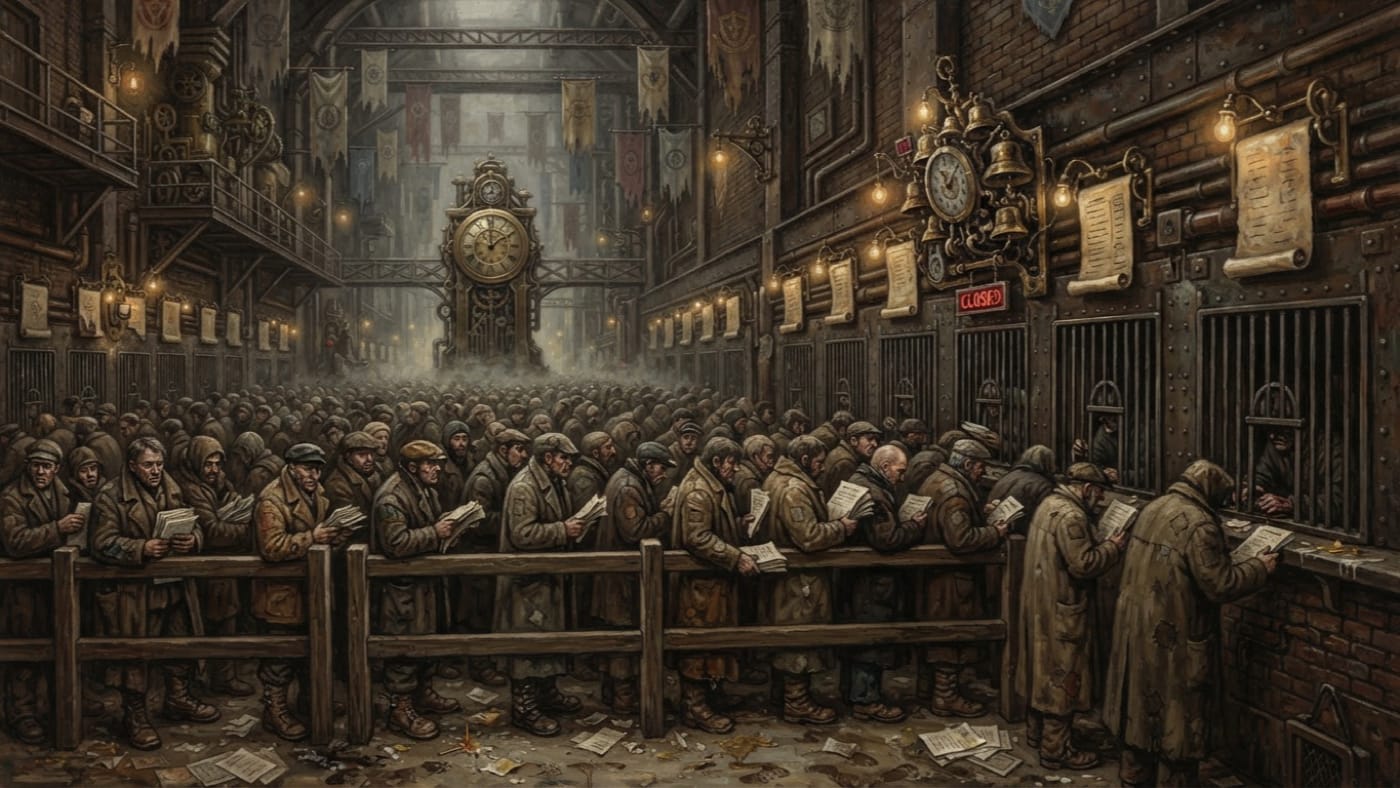
#On the Hall and the Counter
"If it isn't stamped, it didn't happen." — Yard Litany, attributed to no one, repeated by everyone
Anyone who has been to Strasbourg will assume they know the Hall of Seals, and they will be thinking of the wrong building. Strasbourg's Hall keeps dies, rations colour and passes judgment on crests. It answers to Heraldry and to Masks and Seals, and it would sooner be demolished than stamp a carter. The Hall of Seals at Latchford stamps carters by the thousand. The two buildings share a name and, so far as I am prepared to certify, nothing else.
The Latchford Hall is one of the Yards' eight named districts. It stands on the low causeway above the Latch ford, where the Danubian rear-approach of the Sagittal Line narrows to one crossing and one paved road, the Processional, along which the convoys grind toward Bastion-Constantinople. The catwalk offices climb around it and the drainage canals run below it. Inside, the air is hot wax, iron, sweat and sanctified oil, in proportions that change with the bell.
The Hall has thirty-two stamping bays. Each is worked by a permit clerk whose hands are stained with sanctified wax beyond any scrubbing, and each bay processes an average of eleven applicants per bell-hour. The Bureau of Records holds this figure to be optimal. The Bureau of War holds it to be an insult to operational tempo. Both have committed their views to memoranda, and the memoranda now outweigh the clerks.
The wax smells faintly of burnt hair. The Bureau of Doctrine attributes the smell to the sanctifying additives. I repeat the attribution exactly as it was given to me.
What the Hall manufactures is personhood. A stamped person may cross the ford, board a convoy, draw rations and appeal to the Yard Tribunal. An unstamped person is a blankface, with no legal standing, no ration entitlement and no protection from the Tribunal. In Doctrine's formula, a blankface is also unrecognised by the Creator, insofar as the Bureau enumerates His attention. I record Doctrine's formula here. I do not audit the Creator's ledger against the Bureau's. That would be presumption, and presumption is processed in a different window.
#On the Window and the Bell
"What's your next window?" — Latchford greeting; outsiders say "tomorrow"
The stranger arrives believing a window to be an opening in a wall. The Hall has such openings: thirty-two grilles, spattered with wax, each with a clerk seated behind it. These are counters. A window is an allotment of bell-minutes during which the Hall will process one category of paper and refuse every other. The categories include ration renewals, Cargo Sanctification Slips and draft-deferment requests.
The day's windows are posted at dawn on the Master Gate Clock, the brass-and-iron mechanism at the centre of the yard-spine, installed about A.S. 110 (c. 1820 CE). The schedule comes out of a negotiation between Records and War, conducted entirely in memoranda and settled each day by the bell. When the bell strikes the close of a window, the window is closed. The counter stays open and the clerk stays seated. The petitioner stays standing at the grille, papers raised in both hands. None of it matters any more.
Here is how the arithmetic runs. A petitioner reaches the grille holding a Transit Window Pass with its minute-grid properly inked. They declare their destination aloud, as procedure requires. They present the papers with both hands, as courtesy requires, because a one-handed presentation marks an outsider and outsiders are processed with particular care. Then the bell falls in the space between the declaration and the clerk's reach. The petitioner's category has closed, and another has opened in its place. They are in the right building, at the right counter, with the right papers, and they are administratively nowhere. Latchford calls such people the Unwindowed. The clerk does not apologise, because no form exists for apology.
Records defends its eleven per bell-hour as accuracy. War calls it obstruction wearing a cassock. The dispute is fought one bell-minute at a time in the dawn postings, and the queue pays for every concession either side wins.
#On the Hands and the Blank Stock
"A clean seal beats a clean soul." — Latchford proverb
The permit clerk stamps, and that is the whole of the office. Seal-waxers heat the wax and pour it. Discrepancy clerks find the irregularities they are employed to find and write them up as Discrepancy Citations for the Tribunal. Runners carry files between the bays and the Clerklofts. Counterfeit spotters hold suspect slips up to the bare bulbs and squint. The Queue Shepherds deliver the crowd to the doors and take their tolls along the way. Every drop of wax and every mould in the building comes from the Waxwrights, a guild whose monopoly is kept by the oldest method in commerce, which is choking the supply. When the wax sheds tighten, the stamps fall more slowly.
Over all of this sits the Hall of Seals Office. Its public motto is "orderly transit." Its working aim is throughput optics and quota compliance. The Office governs by audit, and the audit's favourite instrument is the Confession Attachment Receipt, which carries Doctrine's seal. A soul that has confessed in writing can be audited against itself, and this leverage is dearly prized.
Two officers of the joint yard command hold the Hall's hours, though neither built it. Prefect Mavren Tull controls the blank permit stock, so every unwritten form passes through Records custody under his hand. Quarter-Commander Hesta Brune controls the convoy priority lanes, and a quarterman in a red sash may find that his paper's window opens remarkably early. The Stamped and Sated, meaning the clerks and the officers, stand at the front of every line they choose to join.
Beneath the catwalks, Old Sable keeps the Minute Market. A market minute is not sixty seconds. It is a quantity of bribery that can extend a window, hurry a stamp or defer a sweep. The bell's minute and Sable's minute are separate currencies. The Hall honours the first, and on three confirmed occasions it has accidentally honoured the second. The yard has a word for a stamp obtained this way: a wet-stamp, freshly bribed, with the wax still soft.
#On the Missing Master-Permits
"Never trust a bell you didn't see struck." — Latchford proverb
In late A.S. 199 (1909 CE), a batch of blank master-permits disappeared from the Hall of Seals.
The public record says nothing more. The size of the batch, the method, the hands responsible and the destination of the forms are all unpublished. No recovery has been announced, and none of the many suspects murmured in the queue has been proven. I note one point of principle: a master-permit with no name on it is the most dangerous object in Latchford. It is a person waiting only for a name and for wax. Blank vellum and master-seal moulds are already contraband in the Yards. An authoritative blank is worse than either, because it is genuine stock taken from genuine custody, and no counterfeit spotter's bulb can show it to be false.
The night sweeps intensified afterward. The lanterns went counting-bright earlier and stayed so longer.
On the seventh of Corvus, A.S. 200, the Master Gate Clock drifted by five minutes. Half the papers in the settlement became temporarily invalid. Their minute-grids, ruled against the clock, now described windows that had never opened or had already closed. The Yard Tribunal processed forty-seven cases in a single bell-hour. Prefect Tull smiled throughout. Quarter-Commander Brune requisitioned additional holding cages. Old Sable raised his prices.
The queue tells these two events as one story. I record them as two, because nothing in the public record proves that the missing blanks moved the clock or that the clock swallowed the blanks. The queue also says the clock is fed, though it does not say on what. I record that saying as the queue's, at the queue's own risk. The Bureau of Engineering has inspected the mechanism nine times and filed nine reports, and none of the nine has been acted upon.
No petitioner who enters the Hall of Seals leaves it unaccounted for.
Correction: the Hall's accounting extends to the settlement boundary, which the Bureau of Records defined in A.S. 194 so as to exclude the culverts, the Silent Zones, the Paper Sump and the ford. Records Sub-Prefect Harlan (since transferred) reported that no disappearances attributable to institutional action had occurred within that boundary. On its own terms, the statement stands.
#On the Present Condition
"If you argue with time, time wins." — Latchford proverb
In A.S. 201 the Hall works. The windows are posted at dawn. The stamps fall in thirty-two bays, and the clerks' hands go on darkening. Ration renewals open and close. Cargo slips receive their double seal, and confessions are attached, receipted and kept for audit. The settlement has gathered around the ford since about A.S. 72 (c. 1782 CE), when the Line had stood defensible for some years and its practices were still hardening into standard. Nobody in the record remembers when the Hall itself was raised, and I do not supply a date for it.
The Minute-Eddies persist around the ford and the clock. The clock drifts, and the bell sometimes strikes twice. Petitioners swear they have lost two minutes, or five. Some find stamps in their papers that they do not remember receiving. The locals lay salt lines across thresholds, seal their boots with wax and keep to the painted queue boards. The Bureau has not endorsed any of these remedies as a cure, nor has it forbidden them.
The Bureau of Shadows knows about Old Sable and has not moved against him. Its reasons have not been entered in any ledger I am permitted to read, and I am permitted to read a great many.
The missing blanks remain missing. Somewhere between the ford and the front, a person may at this moment be walking with genuine paper and a name that no clerk at Latchford ever wrote. The Hall does not know who they are. On present procedure, the Hall will stamp them through without ever finding out.