
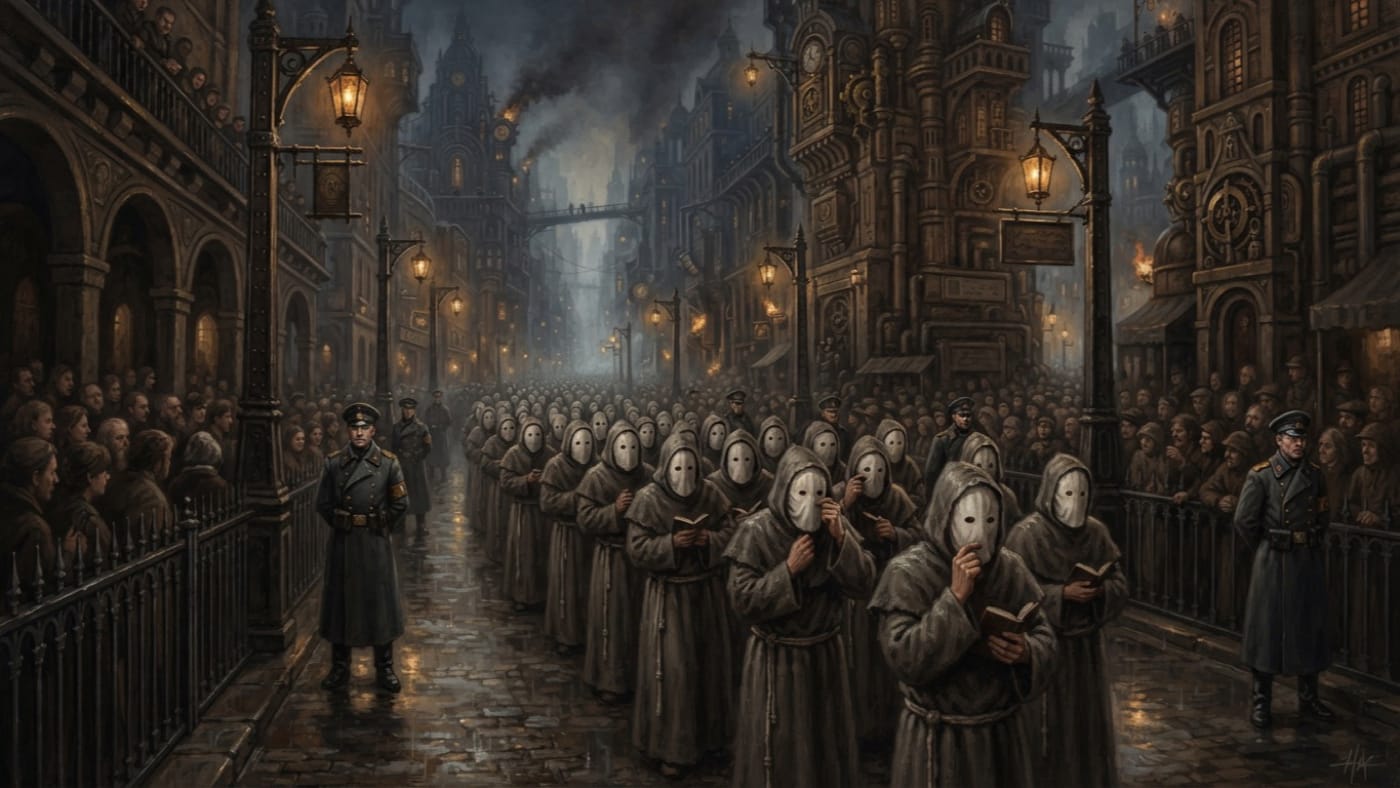
#On the Mandated Mask
The Bureau of Festivals orders that on the Night of Penitents the procession goes masked. The order takes up one line in the Festivals register. What follows from it fills a drawer of the Mask Registry.
The penitent is in an odd position, and since nobody else will pity them, a clerk may as well. They come into the street to be seen repenting, and the Synod forbids them to show the face that repents. They cover the one document Doctrine trusts, and in its place they carry another: a licence, numbered and stamped, with its entry in a ledger at Strasbourg Cathedral. Their neighbours can no longer see who they are, but the Registry can still find them. The column is hidden from the street and counted in the vault, one pair of eye-holes at a time.
The mandate applies to the procession. A parishioner at the kerb who keeps their face bare does so lawfully, and nobody is required to join the column. The penitents wear the cloth. Everyone else watches them wear it.
#On the Face as Confession
The Bureau of Doctrine keeps the rule in Article Fourteen of its Standing Catechism. The face declares the self. Concealing the face conceals the self, concealing the self conceals the soul, and concealing the soul is spiritual fraud. The article is never suspended for the Night. It hangs over the whole procession like a canon over a font, and the procession walks underneath it with a licence in every hand.
What follows is my own reading, and it carries no seal but mine. Shame wants somewhere to hide, and the Synod owns every hiding place, so for one night it rents one out. A penitent who weeps behind cloth weeps privately before the Creator and on record before the Bureau. In a well-run Church that is the proper order of witnesses. The face goes into the dark and the sin stays on file. Anyone who has hidden themselves under licence has confessed twice: once to the Creator in the street, and once to the Registry on the application form.
So for the length of the procession the penitent becomes no one. Their neighbour does not know them, the magistrate cannot name them, and they answer to the Creator alone.
ERRATUM: Night of Penitents, Survey of A.S. 201
The final sentence of the preceding section is withdrawn. Under the mask the penitent is unknown to their neighbour. They remain known to the Bureau of Masks and Seals, which holds their licence number, the design they were permitted and the measured width of their gaze. Any office entitled to consult the Registry may name them. A licensed concealed face is a numbered face, and anonymity has never been one of the things the licence grants. The Creator is no longer the penitent's only auditor. The Registry is a second, and it keeps better files.
#On the Licence of the Penitent
Every mask worn under Synodal jurisdiction is registered, stamped and given a number. The Mask License then sets four conditions, and the penitent's mask meets all four or fails.
The first condition is the occasion. A mask licensed for the Night of Penitents is licensed for the Night of Penitents. It confers nothing for any other day on the calendar, however much the wearer's conscience aches the following week. Contrition does not carry over from one occasion to the next.
The second is the duration. The licence runs for the period it states. When that period ends, the same cloth on the same face turns back into the fraud Article Fourteen describes, and the wearer has gone from penitent to offender without moving a step.
The third is the design. The Bureau of Heraldry decides what a covered face may mean: which colours, which emblems, which few things a penitent may say with a brow they have agreed to hide. A penitent wishing to look abject must look abject in an approved way.
The fourth is the eye-holes, and their dimensions are exact. Archon Casselius of Mainz insisted on this condition himself. If an opening is cut wider than its licence allows, the Bureau classes the mask as "an instrument of surveillance rather than devotion," confiscates it and fines the wearer. The penitent has come out to be looked at, and the Synod has set by measurement how much of the street they may look at in return. The fourteen archivists of the Registry see to it that no two licensed masks in a parish share the same eye-hole dimensions. Each penitent's narrowed view of the world is therefore theirs alone, and it is filed under their number.
The work is divided by function. Festivals keeps the occasion. Heraldry governs what a design means. Masks and Seals registers the object, assigns the number and presses the stamp that makes the other two enforceable. Casselius holds Heraldry and Masks and Seals in personal union, while the charter keeps them as separate jurisdictions, and he keeps both seals within reach of the same inkwell. The penitent's paperwork passes through all three offices, and in theory the Archon can see two of them from one chair.
#On the Procession
What follows is what a masked column is like for any penitent in any parish where the Festivals calendar sends one out.
Breath comes first. Within a few streets the cloth at the mouth is warm and damp, and each inhalation pulls it a little against the lips, so the penitent tastes their own contrition, along with whatever starch the seamstress used. Then sight. The street shrinks to two ovals of licensed width. The penitent sees the shoulders of the one ahead, a slanting stretch of cobbles, and lantern light coming off wet stone. The crowd at the edges turns into a blur of coats and bare faces, all of which can see them clearly. They walk on display and see almost nothing of the people watching. The arrangement is deliberate, and the measuring guarantees it.
Clothing does the rest. A hem catches on the step of a kerb the wearer cannot see. Sleeves get pushed up to clear the way for hands that keep straying to the mask, to settle it, to wipe under it, to make sure it is still there. Every one of those touches is a small anxiety about the licence. The stride shortens because the ground is half-guessed. A column of penitents moves like men walking a rampart in fog, close together and careful, each trusting the back in front of them more than their own feet.
Festivals runs the occasion with its usual machinery: the procession is kept in order and the crowd is kept behind it. Inside the mask, all of that machinery comes down to two holes and the breath behind them.
#On the Other Masked Observances
The calendar has more than one covered face, and clerks confuse them at their peril.
The Carnival of the Triune Knot also requires a masked procession, under a licence of its own. A mask approved for the Carnival is worthless on the Night of Penitents, and the reverse holds just as strictly.
The Feast of the Departed Flames is a third occasion on which Festivals orders a masked procession. Its torches and its reading of the dead belong to that feast and stay there.
The Night of Masks falls on the eve of the Feast of the Sealed Door. It has its own carnival faces, its own inspectors and its own rules for children. It shares half a title with the Night of Penitents and none of its paperwork.
The Feast of Buried Names asks the most. Every citizen is expected to walk the parish in plain white cloth and in silence, applications are submitted by the parish in bulk, and the Bureau of Purity has filed its objections. That white cloth, and that whole-parish obligation, belong to that Feast's licence.
The figure of roughly eleven thousand annual applications covers the Bureau's entire mask remit. It is not a count of the Night's penitents. Any clerk who quotes it as one will be corrected in the margin.
#On the Present Permission
As of this survey in A.S. 201, the mandate is in force. Festivals still orders the procession masked, and Article Fourteen still forbids what the procession does. The Synod keeps both commands on the same shelf and has never felt any need to choose between them. Each penitent's licence still runs to four conditions. Each mask still carries a number and a stamp, and it may be worn on one occasion only, for the stated time, in an approved design, through openings no wider than Casselius would allow.
The penitent is free to hide their face from the Creator's lesser creatures for as long as the licence runs. When it lapses the face comes back on, the number goes back in the drawer, and the sin goes back into the ledger, where none of it was ever hidden.