
#On the Licensed Night
"Show the wax, and pass."
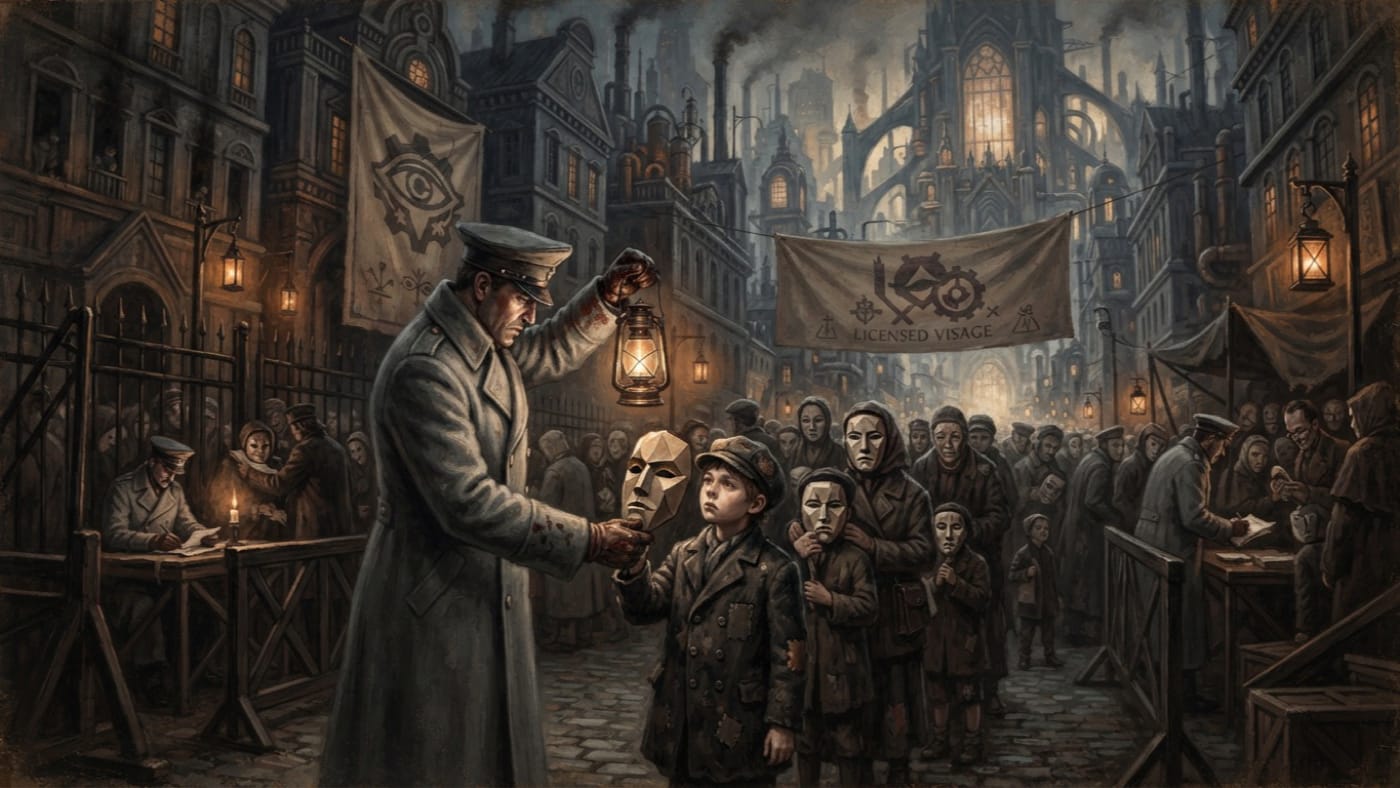
The examiner turns the mask over in a gloved hand and tilts its rim toward the lantern. He is looking for wax. Somewhere inside the curve, where the mask meets the cheek, there should be a small impression of the Bureau's approval, pressed there by a clerk at some earlier hour and carried since in a coat pocket, a sleeve, or a child's damp fist. If the wax is present, the mask goes back on the face and the face goes back into the crowd. If it is absent, the mask comes off and stays off.
This is the Night of Masks, the carnival of the Synod. It is held every year on the eve of the Feast of the Sealed Door, and it has been drained of every Rationalist frivolity the old world once poured into its carnivals. The streets fill. Citizens laugh behind painted faces, buy sweets and point at their neighbours' disguises. They enjoy themselves, and they mean it. Every face they show that night has been registered, licensed and approved by the Bureau of Heraldry.
I cannot tell you when the first Night was held. No register I am prepared to sign records its founding, and I will not invent one to give the reader a tidy origin. The eve is documented. The beginning is not.
#On the Offices Behind the Masks
"Festivals keeps the hour. Heraldry keeps the face."
Three offices take part in a single paper face, and the celebrant tying its ribbons rarely knows which office is which.
The Bureau of Festivals organises the Night. It decides when the celebration occurs and where, and that is the whole of its authority. What a reveller may look like while celebrating belongs to the Bureau of Heraldry, which governs the meaning of every visible thing in the Synod: every colour, every line, every creature permitted to appear on a surface. A mask is a surface, worn at the height of a face.
Behind Heraldry stands the Bureau of Masks and Seals, which registers the object, assigns its licence number and supplies the authentication that makes Heraldry's judgement enforceable in the street. Heraldry decides what a mask may say. Masks and Seals certifies that this particular mask has said it lawfully.
The charter of A.S. 92 keeps these two Bureaus distinct. Practice has not. Archon Casselius of Mainz holds both offices in personal union, so the hand that approves a design and the hand that keeps the die are attached to the same man. The Bureau of Records maintains separate filing for each, and Casselius keeps both seals on his desk.
For the citizen, the arrangement reduces to one fact. Their festival face answers to three authorities, any of which may declare it void.
#On the Permitted Face
"No beast, no wrong colour, no forbidden geometry, no condemned likeness."
A Heraldic Examiner reviews each design before it may be worn. The review is narrow, and nothing within its scope escapes it.
The examiner looks first for beasts. Since the Beast Proscription of A.S. 108 the Synod's permitted animals have been few and geometric, and a snout that is a little too natural fails at once. Next come the proscribed colours, which are matched against the swatches, and then the forbidden geometries, which are measured. Last and most delicate is resemblance. No mask may bear any likeness to a face listed in the Index Damnatus, and the rule covers incidental resemblance as well as intentional. A maskmaker who has never seen a condemned heretic's portrait may still carve the heretic's cheekbones by accident. The accident is no defence. The examiner compares the mask with the Index, and the Index never needs to prove what the maker intended.
A design that passes receives its wax. The approval is pressed inside the rim, where only the wearer and the inspector will ever see it. Once the wax is set, the mask belongs to its wearer for any street and any evening they choose.
ERRATUM: Night of Masks, On the Permitted Face
The final sentence above is withdrawn. A mask licence states the occasion on which the mask may be worn and the duration for which it may be worn. A licensed mask worn outside those terms is not a licensed mask. The wearer owns the pasteboard and nothing more. The Bureau regrets the generosity of the original sentence and has corrected it.
The licence names two further conditions: the permitted design, and the exact dimensions of the eye-holes. An aperture cut wider than its specification exposes the wearer to confiscation and a fine. The Synod tolerates a covered face on its carnival night, but it does not tolerate a covered face that sees too much.
Children may wear simpler masks. That is a concession of design and nothing else. The child's mask still passes the examiner and still carries wax, and its little eye-holes are still measured.
#On the Checkpoints
"Eyes on you."
For the occasion the Bureau erects temporary checkpoints, and at any of them a wearer may be required to produce the stamp.
The officers who staff them are recognisable at forty paces. They are Sigil Inspectors in grey coats, with the brass eye-badge on the breast and gloves stained with years of ink. Each carries a seal-book of permitted designs, a fan of colour swatches and a measuring cord. Each carries an inspection lantern, because dusk lies about colour and the Inspectorate does not take dusk's word for anything. Mostly the checkpoints are quiet. A mask is lifted, the rim is shown and the wax catches the light. The inspector nods and the reveller is gone, still laughing at whatever they were laughing at before.
When the rim is bare, the mask is torn from the face in the street, with the wearer's friends looking on. The Bureau of Heraldry then charges the bare-faced citizen with identity theft. Heraldry coined the term, and the Bureau of Doctrine ratified it. I sit in Doctrine, and I can report that the ratification went through without lengthy inquiry into what Heraldry meant. The logic, once you see it, is clean. An unlicensed face belongs to nobody the Synod has approved, so the wearer has stolen an identity, even if the only one available to steal was their own.
The sentence that follows the charge is not posted at the checkpoint, and I will not post it here. The tribunal that receives the case keeps that page, and the citizen will learn its contents at the proper desk.
#On Children and the Archon's Face
"The game is the lesson."
The children love the Night. I will not pretend otherwise, and I would think less of the Bureau's craftsmanship if they did not. They chase one another between the checkpoints, compare masks, and lift their rims for the inspector with the solemn pride of a chorister showing clean hands. Some of them, I am told, practise the gesture at home in the days before.
In my reading, though the Bureau has published no such programme, the children are being taught a catechism without knowing it. To hide one's own face is sin. To display the licensed face is loyalty. The difference between the two is a disc of wax no larger than a thumbnail, and the right to wear any face at all is granted in Strasbourg. A child who has lifted a mask rim to an Inspector every year since infancy will lift a ration card, a travel writ or a confession receipt in adulthood without anyone needing to explain why. The Bureau has never stated this purpose and has never needed to.
The pleasure is real, and that is what makes the lesson hold. A frightened child forgets what it was frightened of, but a delighted child remembers how the delight was arranged.
I attended the Night in Strasbourg in A.S. 198. My mask bore the face of a minor Archon whom I dislike. The design went before the examiner and the Bureau approved it. The Archon objected. I shall not name him here, for reasons the reader may supply. I record the episode for what it shows. A licence may approve a satirical face, and the Warden of the Sacred Ledger may obtain one. Nothing in that approval extends to the reader.
#On the Permission Still in Force
"The licence is in force where it is in force."
The Night does not reach every corner of the Synod. After the Tumults of Lyon of A.S. 170, Carnival masks were prohibited in three provinces, and those provinces have not regained Carnival permission. The records I have consulted do not list all three, and they do not say how the prohibition bears on the Night of Masks itself. I therefore describe the observance where it is licensed and claim no more. Lyon's own Carnival of Saint Bérard's Misrule is a different festival. Its goats and foxes have no place in this article, and they would never get past Heraldry's examiner.
One more boundary needs marking. There are whispers of a Festival of the Sealed Door at which whole parishes are locked inside their churches and made to chant until they collapse. Records calls such Secret Festivals myths. The Night of Masks establishes only that the feast has an eve and that the eve is licensed. It proves nothing about what happens on the morning after, and it does not make the officers of the eve the keepers of the feast.
As of this survey in A.S. 201, the arrangements stand as I have set them down. Festivals keeps the hour. Heraldry approves the face, and Masks and Seals numbers it. The wax sits inside the rim and the Inspectors wait with their lanterns. The children lift their masks and are allowed through.