
#On the White Face
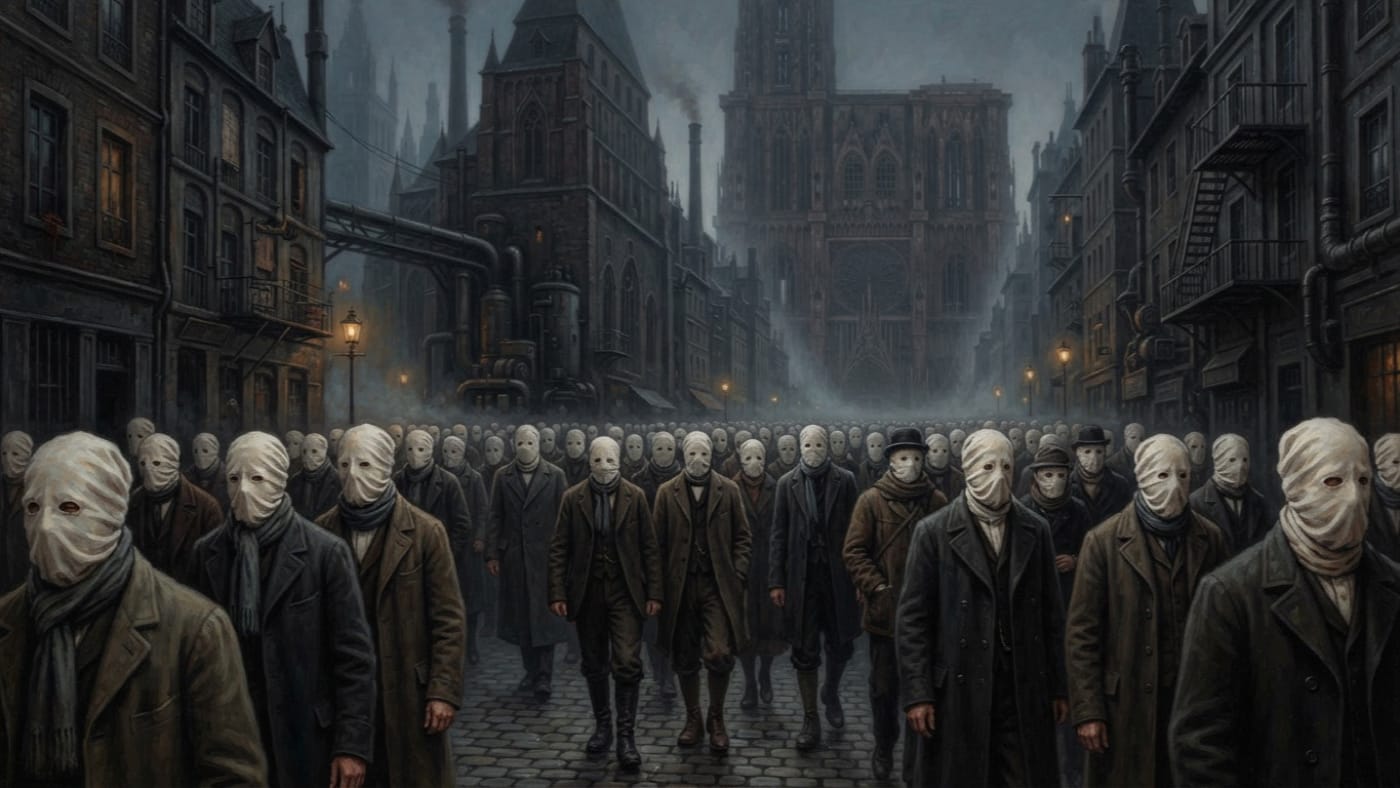
On the Feast of Buried Names, every citizen of the Synod is expected to cover the face with a plain white cloth mask and walk through the parish in silence. The Codex can certify nothing more of the rite than that: a square of white cloth with two openings for the eyes, and the parish street underfoot with no word spoken along it.
The Bureau of Doctrine calls the observance an act of "collective anonymity before the Creator" and has declared it "theologically necessary." The Bureau of Purity has declared the same observance "a security liability of the first order." Both declarations stand. Neither Bureau has withdrawn a syllable, and nobody has drafted a decree to reconcile them. The Synod is content to keep two sealed opinions in a single binding as long as both carry valid wax.
I prefer Purity's sentence for its candour and Doctrine's for its signature.
#On Anonymity Before the Creator
In ordinary hours the face is a confession. Article Fourteen of Doctrine's Standing Catechism holds that to conceal the face is to conceal the self, and to conceal the self is to conceal the soul. That is spiritual fraud, and in the Synod it is committed with the hands. A man who ties a cloth across his mouth in the market square without authority has done more than hide his chin. He has lied to the Creator in public.
On the Feast, the parish covers its faces together, and Doctrine calls the act devotion. Its reasoning lies in the phrase it chose. Before the Creator, rank, trade, family and debt are equally covered. The tanner and the canon wear the same white. The Creator, Doctrine assures us, needs no face to know a soul. Purity observes that the parish watchman needs one to know anything.
A concealed face is fraud, and a licensed concealed face is liturgy. The difference between them is a number on a form.
I hold that the buried name is the one a man answers to in the street. It is laid under a square of cloth for the length of a procession, then exhumed intact and correctly spelled by the Registry the moment anyone with standing asks for it.
ERRATUM — Office of the Warden of the Sacred Ledger
The preceding paragraph's account of the Feast's name is the Warden's reading and is withdrawn as a statement of origin. No Bureau has certified an etymology for the Feast of Buried Names. The observance, as recorded, includes no burial of any name, document or person. The Warden may keep the reading for private devotion.
#On the Parish Application
The Synod records whatever concealment it prescribes. The Bureau of Masks and Seals registers and stamps every mask worn within Synodal jurisdiction and assigns each one a licence number. The Feast's white cloth gets the same treatment as the gilded visor of a Hierarch. For the Feast, each parish submits bulk applications on behalf of its congregants. The parish does the applying and the parishioner does the wearing. Doctrine has not had to choose which of the two is the more devout.
Each licence specifies the occasion, the duration, the permitted design and the precise dimensions of the eye-holes. The eye-hole provision was Casselius of Mainz's personal insistence. An opening wider than its licensed specification makes the mask, in the Bureau's language, "an instrument of surveillance rather than devotion." The wearer forfeits the mask and pays a fine. The penitent who widens the holes to see the cobbles more clearly has stopped praying and started watching. The Bureau has written that conversion down as a measurement.
I am asked what happens to a parishioner who speaks during the procession, or stays at home. The Registry does not say. The Registry measures holes.
Casselius also holds the Bureau of Heraldry, and the separation of the two offices explains why a plain face still needs paperwork. Heraldry decides which appearances the Synod may show. Masks and Seals licenses the physical object that shows one. Plain white may be the most permitted appearance in the Synod, yet the cloth itself remains unlicensed until the second office has numbered it.
The applications go to the Mask Registry, which occupies three floors of the eastern transept of Strasbourg Cathedral. Visitors confuse it with the Sigillary, the die-cutters' workshops beneath the eastern cloister, at their peril and to my irritation. The Sigillary cuts the instruments of authority. The Registry keeps the faces. Fourteen archivists work there full-time, and their stated task is to ensure that no two licensed masks within the same parish share identical eye-hole dimensions.
So on the one day Doctrine buries a whole parish's names under identical white, the Registry still keeps every one of them on file, sorted by the width of the wearer's view.
The Bureau puts its mask applications at roughly eleven thousand a year across its entire remit. The figure rises markedly in the Feast season, when the parishes file. These are applications. They are not a count of masks or a tally of attendance. A bulk application is still one application, and the published figure does not say how many faces it covers.
#On the Silent Procession
The procession belongs to the parish. Its streets are the parish's own streets, and its walkers are the parish's own people, bound for nowhere the record bothers to name.
From inside, the cloth lies against the face and warms with the breath. Sight narrows to two measured openings, so the walker ahead becomes a back, a pair of shoulders and a gait. Without voices, the street hears only shoes: clogs, boots and slippers worn thin, all on the same stones, with nothing said over them. Neighbours who have argued over a fence-line for a decade may walk elbow to elbow and never know it. That is what Doctrine asked for.
The Synod has always liked an orderly crowd. Elsewhere the Bureau of Festivals mandates masked processions on the Feast of the Departed Flames, the Night of Penitents and the Carnival of the Triune Knot, and the Carnival's masks are worn by its processions. Only the Feast of Buried Names expects the mask of the whole citizenry. Its silence also differs from the dawn-to-dusk silence of the Fast of Silence, which keeps its own hours and its own sticks. The record gives the Feast silence in procession, and I add nothing to it. Which officers walk beside the parishes, and with what instruments, the record does not say. I will not hire drums for a procession that never ordered any.
#On the Masks That Could Not Be Distinguished
In A.S. 199 (1909 CE), a routine audit of the Mask Registry found 2,311 active licences for masks described as "blank, featureless, white, no distinguishing marks."
The Bureau could not determine whether these licences belonged to the devotional masks of the Feast of Buried Names or to the operational equipment of the Bureau of Shadows, an office which does not exist and issues face-coverings to operatives who also do not exist. The Bureau sent a request for clarification to both offices. The Bureau of Festivals replied that the masks were liturgical. The Bureau of Shadows did not reply.
The Bureau filed the discrepancy under "Resolved by Silence."
Consider the Registry's position. Fourteen archivists exist to tell one mask from another, and they had found 2,311 they could not assign to a purpose. Eye-holes separate one licensed face from its neighbour in the same parish. They say nothing about which office cut the cloth, or why. A description written to be devotionally plain turns out to be just as useful to a man who wishes to be no one in particular, and the paperwork cannot tell the two of them apart.
None of this proves that the masks were operational, or that they were liturgical. Festivals' answer is an answer. Shadows' silence is also an answer, of the kind the Synod respects most and reads least. The file is closed and its status is correct. The 2,311 licences remain active.
#On the Present Observance
As of A.S. 201, the expectation stands. The parishes file, and the Registry fills its three floors of the eastern transept. Its fourteen archivists measure the eye-holes, and somewhere in their columns sit 2,311 white faces the Bureau has declined to look into further. Doctrine still calls the Feast necessary and Purity still calls it a liability. Casselius still signs for both the meaning and the material.
So the citizen walks the parish white-faced and silent, anonymous before the Creator. The Registry has the citizen's eye-holes on file.