
#On the Market in the Seville List
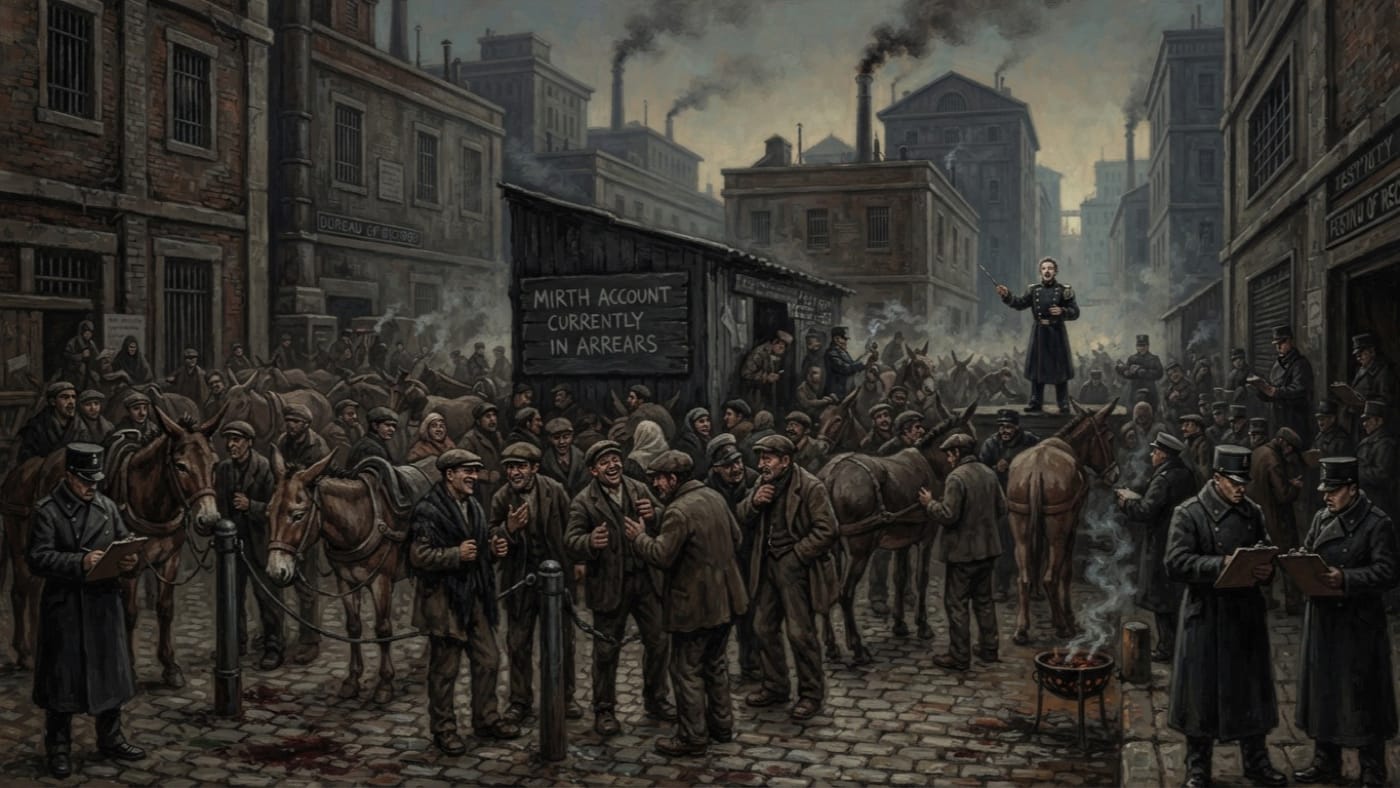
The Mule Market survives in the archive because one clerk ran out of page. In the Seville ward copy of the List of Laughters, kept during the Laugh Riots of A.S. 153 / 1863 CE, he turned the book sideways and wrote in the margin: Mule Market: laughter accompanied by hoof percussion, animal complicity unresolved. That sentence is the market's entire file, which is more than most saints get.
The place is in Seville, in Iberia, and its name says what walked there. The entry gives nothing else: no trade, owner, boundary, gate or paving. I will not lay cobbles that the Censorium never inspected. Three other places share the sideways margin. Guallin House is timed at seven minutes. Bellfounders' Hall laughed with a hostile undertone. At Fishmongers' Court the clerk suspected melody. A shared margin proves that four places filled one clerk's evening. It proves nothing about a shared street, proprietor or fate.
The other three entries each record a human sound. The Mule Market entry records two sounds and then declines to say whose the second one was.
#On Hoof Percussion
Read the sentence the way Records reads a confession: slowly, and for what it leaves out. Laughter is the offence the List exists to count. Accompanied by is the language of Festival Form 19-M. Its sixth clause governs instrumental accompaniment, and its eighth rules that stamping feet is percussion and that percussion needs a separate entry. Hoof percussion means the clerk heard a rhythm under the laughter and traced it down, past the laughing men's knees, to the animals. Then he reached the word complicity and his nerve failed.
He had reason. The List separates the chuckle from the guffaw and files a table-slap under Bodily Percussion, Non-Musical. It pricks the page with a pin whenever a sound has rhythm. Every one of those categories assumes a throat or a palm belonging to a baptised person who can be fined. A mule has hooves, an owner and opinions about loads. The Censorium of Taverns has never licensed any of them.
So the questions remain where the clerk left them. Did the beasts stamp because the men laughed, or did the men laugh because the beasts stamped? Was the rhythm taught, borrowed or accidental? Was it only the noise animals make after standing too long in a yard full of shouting? Did a muleteer keep time with his heel and let the clerk blame the mule? The entry answers none of this. It records that the two sounds came together and that an officer of the Church could not decide which party to charge.
#On Seville's Measured Insolence
A market got into a tavern register that week because Seville had turned the whole city into a tavern, as far as the Bureau was concerned. The A.S. 153 quota reduction followed laughter at the Feast of the Cracked Bell. It imposed half-volume mirth for ninety days, required songs to be cleared in advance, kept tavern doors open, and posted a Festival Chorus-Master on every licensed square. After sunset, Form 19-M was needed for nearly anything worth doing. Its first clause lists the bodies that may apply for mirth above licensed volume, and market company is among them, between the guildhall and the licensed mourning procession. The Bureau had already conceded that a market could laugh. It had not considered what else in a market might keep the beat.
Seville answered with a timetable. Taverns and guildhalls overran their allocations one after another, so Purity runners arrived late and Festival auditors arrived sweating ink. The form left the desk and went into the street. According to the riot account, by the fourth day illiterate mule-drivers could recite Clause 7, which prohibits "unscheduled hilarity during penitential transit." The form's own account has muleteers shouting the clause over the oranges. The dye-yard women conducted mock silences with strips of linen dyed Festival-baton blue. By the fifth day Clause 7 was a drinking song.
The same account says that mule markets put up chalk notices reading MIRTH ACCOUNT CURRENTLY IN ARREARS. Note the plural. No surviving document puts a particular slate on a particular wall of this market, and I will not nail one there for decoration.
Clause 12 reserves to the Bureau every sonic continuation the form did not foresee. That clause is the only licence the mules ever received.
#On the Correction of the City
Festivals first classified the disturbance as spontaneous morale surplus and proposed cutting the next month's allocation by two percent. Seville laughed at that as well. On the fourth day the file went under black-edged cover to the Bureau of Purity, which sent the Lictors of Purity with braziers, tongs and knives. Lictors are editors of speech. They read Form 19-M aloud before each correction, so every tongue left its owner with a Festival clause attached.
By sunset the Fast of Silence covered five wards. By the second day of correction, three hundred and nine citizens had been processed. After that the number was classified, and it still is.
In 412 A.S., the Laugh Riots broke out in Seville when taverns were fined for exceeding their mirth quotas. … Inquisitors arrived on the fourth, cutting tongues en masse to restore silence.
Corrected twice. The riots belong to A.S. 153 / 1863 CE. The knives belonged to the Lictors of Purity, who would rather be blamed for their own work than credited with somebody else's. The Lore Book's copyist has been told about both errors and has asked to be told about fewer.
The Mule Market entry carries no sentence. It names no muleteer and counts no tongue against the market, and it records no seized licence or confiscated animal. Whether anyone who laughed in that yard later met the brazier is not recorded in any document I am allowed to cite. I will not stock the market with victims to make it look more important in the archive.
The Subjugation of Seville came two years later, in A.S. 155 / 1865 CE. The granaries were stripped, feast days revoked and auditors stationed permanently. That is a separate file. The riots were a correction of sound. The Subjugation was the conquest of a city whose silence had started to frighten Strasbourg.
#On the Question Left Open
In A.S. 201 Seville is still under audit. Its auditors still count applause, lullabies, funeral keening and market cries. Its people still tap their cups twice before drinking: short, short, long. Those facts describe the city. For the Mule Market itself the archive has no later page. It records no closure, burning or renaming, and no survey of whatever trade, if any, goes on there now. Since A.S. 199 the public copies have said devotional levity allocation instead of mirth quota. The Seville register of 153 keeps the old words. The Bureau of Records has left the market's classification exactly as the clerk wrote it.
The page still lies sideways in the ward copy. To read it you turn the book, as the clerk turned it to write. The mules are exactly as guilty as he left them.