
#On the Hall in the Seville File
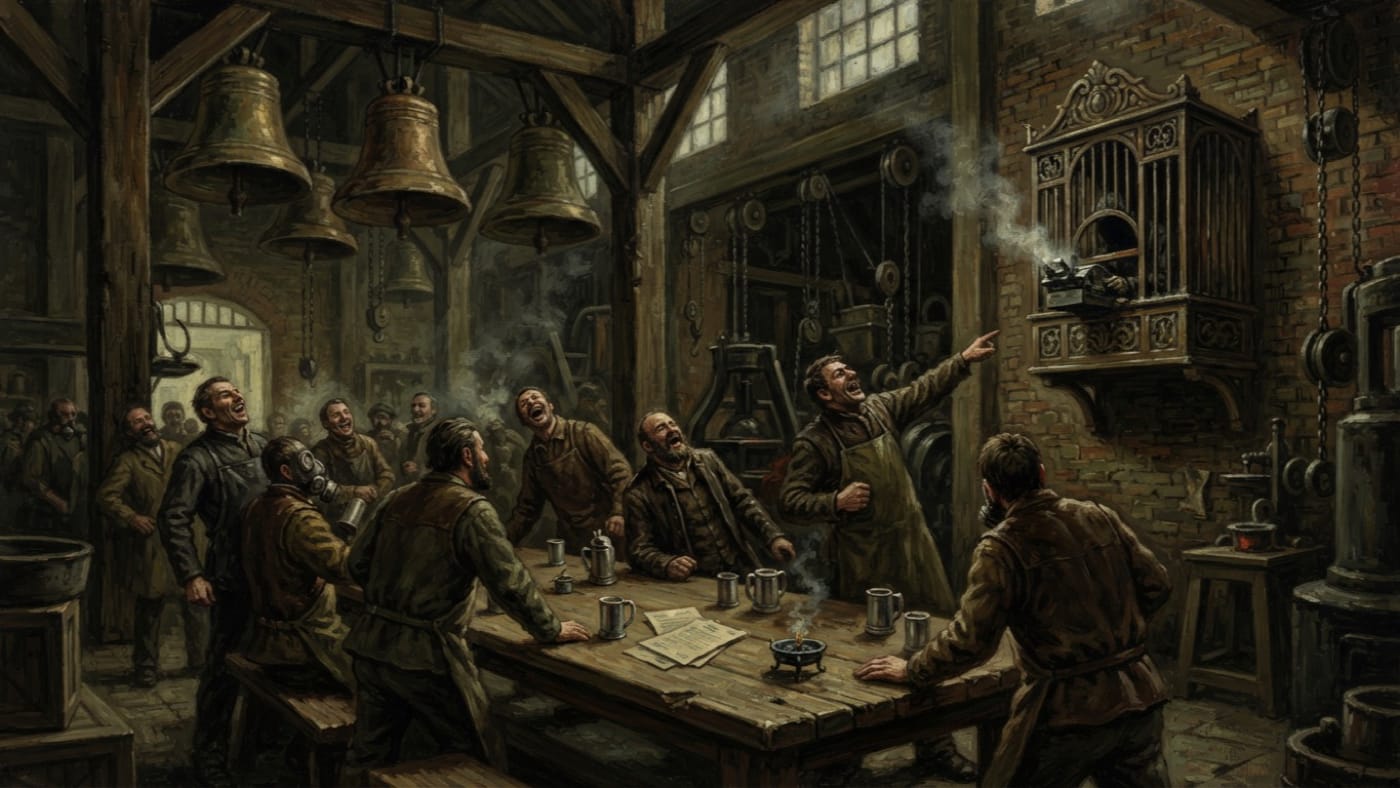
Bellfounders' Hall is the gathering house of the bellfounders of Seville. It is in the Codex because in A.S. 153 its members asked permission to grieve, were given permission to laugh, and used both.
Two documents preserve the Hall, and none of the others is worth a cleric's eyesight. Festival Form 19-M holds the application. The List of Laughters holds the result. The Form's account places the opening of the Laugh Riots of Seville between those two entries. The Fishmongers' Court says otherwise, and has said so every year since, before dawn, by tapping cups.
A guild gathering has no obvious business in a tavern register. The Censorium of Taverns keeps the List for houses that pour drink and so need their throats supervised. Form 19-M, however, reaches guildhalls as well as taverns, and in that season Seville's ward Lists filled so quickly that clerks turned the pages sideways and entered whatever building had made the noise. The Hall's name therefore sits among taverns, a fish court and a mule market. A respectable trade body ended up on the same page as livestock.
I do not know when the Hall was founded. Its owner is unrecorded. The documents do not say whether a working foundry stood behind it or only the people who knew how to run one, and I will not supply a furnace that the Bureau never inspected.
#On Bells and Licensed Grief
The Feast of the Cracked Bell teaches obedience through the damaged bell's uneven tone: the Creator permits a flaw so that the flawed may learn their place. Bellfounders live closer to that doctrine than anyone else in a parish. They hear the crack before the congregation does.
In A.S. 153 the Hall's members performed a maintenance rite for a cracked bell. The record does not name the bell, and it does not say what part, if any, the rite had in the Feast's ceremonies. A grief toast followed, and nobody recorded whom or what the toast grieved. No one is named as dead. I have seen clerks weep over a smudged seal, so a bellfounder's grief for a cracked bell would have been grief enough.
The season was already unkind. Three taverns in Triana had gone over their permitted laughter during the Feast. A junior officer filed the breach, and Seville was put on half-volume mirth for ninety days. After that, nearly everything worth doing after sunset required Form 19-M. The bellfounders filed theirs as obedient applicants do, in the correct box, for the correct occasion, and at the lowest rank Festival governance recognises.
Permitted sound is divided among offices that guard their shares jealously. The Bureau of Festivals controls celebration and civic timing. The Censorium keeps the List. A Festival Chorus-Master regulates rhythm and measured release. Bellwardens supervise the bells themselves whenever Clause 6 brings bronze into a petition. The bellfounders held none of these offices. Bell work everywhere smells of oil and metal dust and rings with chain. Whether the Hall smelled that way on the evening in question, no clerk thought it worth writing down.
#On the Seven Minutes
An attending clerk received the application and granted one brief laugh, provided it was directed toward humility.
Read the permission as the bellfounders read it. It contains three conditions. One sets a number. Brief sets a duration and leaves it undefined, which is the Festival manner, since a sealed limit teaches obedience better than a published one. Directed toward humility names a target. The clerk evidently wanted the mourners to laugh at their own pride, in a small and penitent way, the sort of sound a flawed bell might make to its maker. What the clerk actually wrote turned humility into an addressee, a party to the transaction, something close to a person with preferences.
Seville has never let a careless noun go unpunished.
Someone in the Hall read the permission aloud. That was lawful. A permission is meant to be known by the people it permits, and reading it aloud is the most obedient thing an applicant can do with it. The record names neither the reader nor the questioner, and I respect that silence more than I respect most testimony.
Someone else then asked whether humility preferred the laugh before or after payment of the supplementary stamp fee.
The clerk's answer, if there was one, has not survived.
Seven minutes followed.
The List entry reads prolonged laughter with hostile undertone. The permission and the offence must be kept separate, because the Bureau did keep them separate, and because the gap between them is the whole case. The clerk licensed a brief laugh, and the Hall produced a prolonged one. The clerk licensed laughter toward humility, and the List found it hostile. Every word of the offence answers a word of the permission, which shows that the List had read the Form before the laughter stopped.
Had the Hall been allowed a defender, the defence would have been simple and ruinous: the laugh was directed toward humility exactly as licensed, only it was the clerk's humility.
Duration needs a note of its own. The List gives seven minutes to Guallin House. The Form article gives seven minutes to the Hall. Readers should not merge the two venues because the figures match. Two houses laughed for the same length of time. Seville kept excellent time, and that was the whole trouble with it.
Remember that the Bureau provided every element of this offence. It wrote the form, attached the fee, sent the clerk and chose the noun. The bellfounders provided a voice to read it and a second voice to ask a question. Ridicule cost them nothing beyond breath, which the quota had already priced.
#On the Sound Beyond the Hall
According to the Form's account, the Hall's seven minutes came first. By evening, Clause 7 of Form 19-M, which prohibits unscheduled hilarity during penitential transit, was going round the taverns as a refrain. By morning it was in the streets, and guildhall boys were copying it onto broom handles painted Festival blue. No source says that the Hall ran this circulation, sheltered its organisers or produced its copies. The city did not need a headquarters. It needed a text, and the Bureau had already printed one.
The riot that followed used coordinated excess. Taverns and guildhalls went over their allocations in sequence. One square laughed and fell silent, and then another began. The Bureau's first classification, spontaneous morale surplus, took for an overflow what was really a timetable.
Seville's Laugh Riots broke out in 412 A.S., when taverns were fined for exceeding their mirth quotas.
Corrected. The Laugh Riots belong to A.S. 153 (1863 CE). The Lore Book's later year is obsolete and appears in no ward List, no Festival memorandum and no Purity transfer. The Bureau of Records is asked to stop dating Seville's laughter by the length of the shame it caused.
On the fourth day the file passed from Festival to Purity. The Lictors of Purity came with braziers and knives, and tongues were cut under Festival vocabulary. The Fast of Silence came down on five wards. Every one of these consequences is recorded for the city and its offices. None of them is recorded for the Hall. No source names any member of the Hall who was arrested, maimed, transported or fined, and none records the Hall being seized, closed or burned. I will not fill that absence with bodies to improve the drama. Seville already provided bodies, and they were counted elsewhere.
The Subjugation of Seville is a separate matter. It came two years later, in A.S. 155, and the official record calls it a procession of cleansing. Copyists who merge the riot and the Subjugation into one bad season are guilty of compression, which is a fault the Bureau punishes in clerks and forgives in sermons.
#On the Anniversary and the Record
Every year, before dawn on the anniversary, the Fishmongers' Court taps its cups to claim that it breached first. The Court's own entry in the List speaks of chanted quota clauses and suspected melody. The Hall's entry speaks of prolonged laughter and hostile undertone. The Form says the first breach belongs to the Hall. The Court disagrees, with crockery.
I will not settle the dispute. No witness, timestamp or Bureau ruling survives to settle it, and I refuse to make one up for the satisfaction of either fish or bronze. Records has never ruled on the question, and I will not rule on Records' behalf without being paid for it.
The Hall survives in the Codex in two places. Form 19-M preserves the occasion: the rite, the toast, the clerk, the permission and the question. The List of Laughters preserves the verdict on the sound. The first anticipates noise and the second prosecutes the memory of it, and together they make the Hall's whole file. Nothing more is held, and I have looked.
Whether the Hall still stands in A.S. 201, whether bellfounders still meet there, and whether any of them knows that their grief toast is the most cited guildhall gathering in Festival training, I cannot say. The file does not say, and I have not asked. Since A.S. 199 the official term has been devotional levity allocation. The old term, mirth quota, is kept for history and for those of us who prefer an honest noun.