
#On the Court in the Seville File
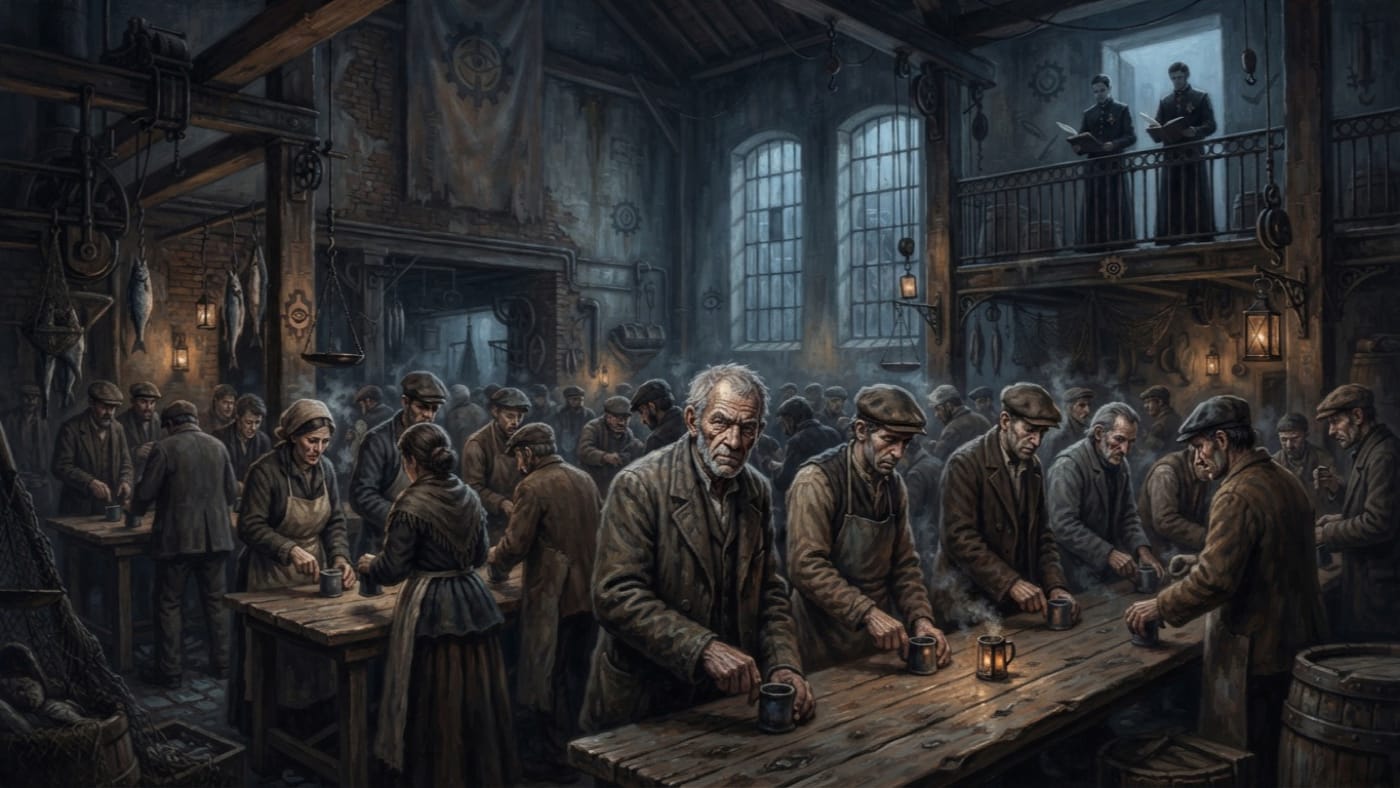
The Fishmongers' Court is the fish trade of Seville as the ward clerks heard it in A.S. 153 (1863 CE). It was a gathering of people who gutted, salted, weighed and cried fish, and during the Laugh Riots of Seville they found a use for their voices that the Bureau liked even less than selling. Seville uses the name for both the community and the place where it gathered. I do the same, and I leave it to the clerk's ghost to say which one he meant.
Two instruments preserve the Court. The List of Laughters holds its offence. Festival Form 19-M holds its grievance. Neither holds a charter, a roll of officers, a founding year, a seal, an address or a headcount, and I have looked for all six. Festivals took an interest in Seville's fish trade only when the trade made a noise, and it lost interest once the noise stopped. That is roughly how Festivals regards the fish.
Read the entry as the clerk wrote it. Chanted records what the clerk heard. Melody suspected is fear borrowing the grammar of observation. The clerk did not record a tune. He recorded that a tune might exist, and that was enough to put a pin through the column.
#On the Clauses Given a Voice
The quota was sealed. A ward learns its permitted laughter by being punished for going over it. In A.S. 153 Seville got extra lessons. Three taverns in Triana had overrun their allocation during the Feast of the Cracked Bell. The provincial office answered with half-volume mirth for ninety days, pre-clearance for public songs, tavern doors held open after dark, and one Festival Chorus-Master posted to every licensed square. After that, nearly every evening pleasure in the city had to pass through Form 19-M, the Application for Civic Mirth Above Licensed Volume.
By the List's account, the Court did not laugh at the form. It recited it.
The Censorium of Taverns had no column ready for this. Laughter is counted in beads: one for a chuckle, three for a guffaw. A chant hands the Bureau's own sentences back to the Bureau in unison, and every word of them is authorised. A clerk cannot fine a fish trader for quoting a document he has been ordered to obey. All the clerk could do was write down that the quoting sounded organised. Hence chanted. Hence the pin.
The List does not say which clauses. Clause 7, which forbids "unscheduled hilarity during penitential transit," is the obvious candidate, since it became the refrain of the whole city. Obvious candidates are also how copyists convict the wrong house. In those days fishwives all over Seville recited the form in antiphon, while women from the dye-yards conducted mock silences with strips of linen dyed Festival blue and tied to broom handles. That was a citywide practice. The record does not say whether those fishwives stood in the Court, belonged to it or only shared its smell, and I will not enrol them in it because of their trade.
The Court's entry proves something narrower and worse. A body of tradesmen took the official wording, repeated it together, and made a Festival clerk afraid of rhythm. In their training slang, Chorus-Masters call this an open chant: a crowd sound that began without a cue and will not stop for one. Their manuals warn against letting a crowd sing unaccompanied after the final beat. The manuals do not mention fish. They had no need to.
#On the First Breach
The Form's account gives the first breach to Bellfounders' Hall. Its members filed for a licensed grief toast and were allowed one brief laugh, directed toward humility. They read the permission aloud and asked whether humility preferred the laugh before or after payment of the supplementary stamp fee. Then they laughed for seven minutes. The riot account puts those seven minutes on the third night of the restriction and says the Fishmongers' Court had joined by dawn. That is one account's order of events, and no surviving timestamp confirms it.
The Court disagrees. It has disagreed every year since, before dawn on the anniversary, by tapping cups.
Compare what each side holds. The Hall has paper: the Form, the clerk's permission and a recorded duration. The Court has a custom. The List gives the Court no duration of any kind. Guallin House has its seven minutes, the Hall its hostile undertone, the Mule Market its hoofbeats, and the Court its clauses. No spokesman for the Court ever filed a counter-claim. No witness has said the chanting began at a certain hour on a certain night. The Court does not argue for its precedence. It performs it.
Records has never ruled on the question, and I will not either. Two trade bodies in one city have spent forty-eight years quarrelling over which of them made the first indictable noise. Settled, the precedence would be a fact. Unsettled, it is a liturgy.
#On the Correction of Seville
The Bureau of Festivals first classified the disturbance as spontaneous morale surplus and proposed cutting the next month's allocation by two percent. A city was chanting the Bureau's clauses back at it in sequence, and the Bureau answered with arithmetic.
On the fourth day the file went to the Bureau of Purity. The Lictors of Purity came with braziers and knives. Tongues were taken in Festival vocabulary, with each offence read aloud in the Form's own phrasing before the tongs closed. By sunset the Fast of Silence covered five wards. On the second day of correction the Lictors processed three hundred and nine citizens. After that the number was classified.
This is where the Court's file stops. It names no one who was punished. The ceremonial corrections included a fishwife, and copyists have been eager to hand her to the Court. A trade is not a membership, and I will not attach a nameless woman's tongue to a trade body's file to tidy up the story. The three hundred and nine belong to the city's correction. They are not a Court roll and not a Court death toll.
In 412 A.S., the Laugh Riots broke out in Seville when taverns were fined for exceeding their mirth quotas.
Corrected. The riots belong to A.S. 153 (1863 CE). That date is borne out by every ward List, Festival memorandum and Purity transfer. The Lore Book's year lies two centuries beyond the present, which would make the Fishmongers' Court the only fish trade in the Church indicted before it existed. That account also names no Court, no clauses and no cups. This article corrects the omission. The year is corrected everywhere.
The Subjugation of Seville is a separate matter. It came two years later, in A.S. 155, and brought a shorter calendar: thirty feast days were struck, and auditors were stationed in the city for good. The Court's part in it is unrecorded. Copyists who fold 153 into 155 and file both as one bad season are guilty of compression, the vice that turns two catastrophes into one handy anecdote.
#On the Cups Before Dawn
Seville remembers without using its voice. People tap their cups twice before drinking. They raise two fingers to the mouth when a Festival baton passes. Children knock out the rhythm of Clause 7 on table wood: short, short, long. These habits belong to the whole city. The Court's own observance is plainer. Before dawn on the anniversary, its cups strike wood, and the strike means we were first.
I cannot give you the pattern. I have found no account of the beat, the number of strikes, the calendar day the anniversary falls on, or who calls the room to order. A lesser archivist would supply a secret code here, all knocks and pauses, with a sinister grandmother who alone knows the full sequence. The file offers crockery and conviction. That will do.
Consider what the cup has achieved. Purity took tongues and left knuckles alone. A precedence claim that once travelled as chanted clauses now travels in earthenware, too quiet for a List clerk to lift a bead. A fishmonger's knuckle on a cup sounds like breakfast, and the Bureau has never thought to regulate breakfast.
The file does not say whether the original court still stands, whether the same families still meet there, or whether any of them still sells fish. An annual memory proves that people remember every year. It proves nothing about a deed, a membership or a building.
Since A.S. 199 the public term has been devotional levity allocation. In A.S. 153 it was the mirth quota, and the mirth quota was what the Court chanted. I keep the older noun because the offence was committed against it. On the anniversary, the Festival clerk on duty in Seville records compliance and the List stays blank. Somewhere before dawn a cup strikes a table, and the clerk, who has been trained, does not lift a bead.