
#On the Opening Invocation
"Say the first words. The guard does not want the rest."
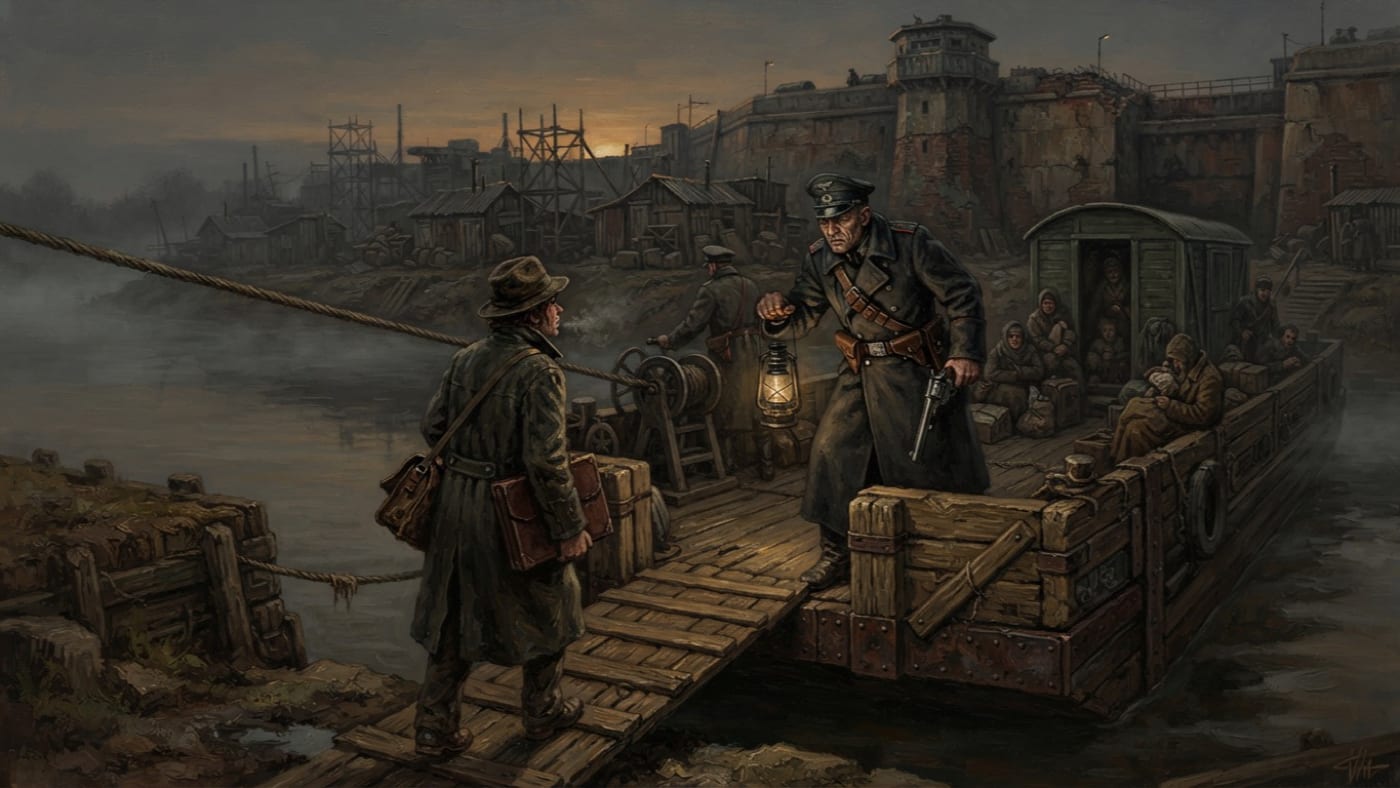
The Codex can certify one structural fact about the Minor Lauds, and I intend to give it the respect owed to any fact that has survived a ferry queue. The Minor Lauds has an opening invocation. That invocation belongs to the repertoire of saint-phrases the Church employs as crossing passwords along the Zones 2–3 river network, where the Rhine tributaries are crossed by flat barge and hemp cable because there are no bridges left to cross by.
The published account of the Ferry Chokepoint Broker names it alongside two others: the third verse of the Canticle of Edras, the opening invocation of the Minor Lauds, and a particular declension of the Penitential Creed. These are three texts on one list. A list records a filing decision. It makes its items neighbours, and neighbours need not be kin. No clerk who compiled that rotation has been asked to certify that the three share an author, a theology or a parchment, and I will not certify it on his behalf.
Readers will want more: the composer, the year, the melody, the number of lines after the opening, and the reason anyone called a liturgy Minor. The Codex holds none of these in a form it would seal. Speculation about them is a private vice, and I have enough public ones.
That leaves the useful part. Whatever the Minor Lauds is in a choir-stall, at the water it is a set of opening words that a guard may demand from a stranger before the cable is hauled. This article concerns that second life. The first belongs to whoever keeps the book.
#On the Phrase at Sundown
Crossing passwords rotate at sundown. The Bureau of Doctrine administers the rotation, and Strasbourg sends the current assignments under seal, by courier, to the nodes of the Rope-Ferry Chain and the tributary ferries around it. On a given evening the opening of the Minor Lauds may be the phrase in force at a given rail, or one of the many phrases that are not. Nothing entitles the reader to assume that every crossing uses it, that every traveller knows it, or that tonight's guard wants it. It is in the drawer. That is all.
A careful reading of the mechanism yields a distinction the Bureau has never troubled to print. The words do not change at sundown, but their validity does. So far as any record shows, the invocation spoken at a vigil this week will be the same invocation next week. What expires with the light is the ruling that those words, at this rail and to this guard, open this barge. Liturgy supplies the text. The password is a licence stamped on the text and revoked at dusk, a transit writ made of breath.
The licence travels more slowly than the sun. Couriers from Strasbourg arrive late, or with the superseded sheet. Sometimes they do not arrive at all, having been held at an earlier ferry whose guard refused the courier's own password because it expired while he was on the road. The crossing then holds two truths, one in the guard's ear and one in the courier's pouch. The traveller standing between them holds neither.
Speech is one gate among several. A guard who hears the Minor Lauds correctly opened will still ask for the name, the seal and the writ, and the clerk behind him will still consult the ledger. A perfect invocation from a man without papers makes him a pious man without papers. He may pray on the bank for as long as he likes. The Church has never objected to prayer on the bank.
This is the opening the brokers exploit. Where the invocation is concerned, a Broker sells knowledge of the right phrase, the right guard and the right hour. He carries tomorrow's phrase because an upstream lockhouse clerk has been bribed, and last week's because some guards have not been told it has changed. The stale phrase is my favourite. It is an expired licence honoured by a guard nobody informed, so the Minor Lauds can go on opening a barge for a day after Doctrine has closed it, all because a courier's feet were sore.
#On the Mouth That Must Say It
A password exists in two places, the dispatch sheet and the guard's ear. The traveller's mouth has to carry it from one to the other undamaged, and the mouth is the least reliable vessel the Church administers. Cold makes it stiff and fear makes it hurry. A missing tooth whistles. A valley accent swallows a syllable that the next valley pronounces in full. An invocation formed in one parish's speech can reach a guard raised in another and arrive as noise.
At Nominalist's Gate, three hundred travellers with valid papers, seals and transit writs were refused after a guard heard Adras where the assignment required Edras. That phrase came from the Canticle. The Minor Lauds has no part in the record of that morning. I cite the case only because it fixes the rule for every saint-phrase in the drawer. The guard's ear decides, and the writ in the traveller's hand is reviewed afterward, if at all.
ERRATUM — against the Broker article That account attributes the Nominalist's Gate refusals to "a consonant." Edras and Adras differ in their opening letter, and both letters are vowels. The three hundred were refused for a vowel. The correction alters nothing for the three hundred.
The brokers answered with the phonetic card. It is inked in oil so the river cannot lift it, it gives the current phrases as they must sound to particular guards, and it carries notes on whichever accent is likely to be on duty. At certain crossings, then, the opening of the Minor Lauds circulates in an unauthorised second edition, spelled for one man's hearing and kept dry in an oilskin folio.
The cards are contraband. The Bureau of Purity confiscates them, and its inspectors rely on the same trade when they need to cross. I record this without suggesting that the trade taints the invocation. The words on the card are the Church's words. Purity prosecutes the private sale of the Church's own pronunciation: access priced on a plank rail by people with no seal to sell it.
Refusal has a schedule of costs. There is the night on the bank, the waiting-time charge, the pen for travellers whose papers outrank their vowels, and the next sundown, when the phrase they finally learned is withdrawn.
#On Responses and Silence
The challenge is not a hymn. At a crossing, an assigned invocation is spoken on demand to whoever asked for it and answered according to the protocol in force. That exchange is required. Brokers also tell their clients not to sing: no devotional singing, and no hymn to quiet a child. The two instructions do not quarrel. The first is a controlled exchange the guard expects. The second is unscheduled sound over open water, and it draws attention from the bank and, at certain crossings, from below it. Speak the words when asked. At all other times keep your mouth shut.
The Bellwater Breach taught the limit of the spoken word. A water-demon sat beneath a hull and reproduced the ferrymen's calls with the correct words at the correct times. The barge-hands obeyed. Seventeen died, and a season's grain went into the river. The record does not identify the calls copied that night as the Minor Lauds, and I will not enrol them. The lesson still binds every phrase: a correct word proves only that something knows the word. The later protocols added sanctified challenges and harmonic responses, certified by the Bureau of Bells and not yet observed to be replicated by any demon. Yet is the Bureau's own word. The Bureau chose it.
The brokers' Split Prayer is a separate device. The client learns one half of a phrase and the Broker keeps the other, so a client taken and questioned can confess only half. Applied to the Minor Lauds, this means the opening invocation may be cut in two on a riverbank by a man with no orders. Nothing in the record shows the Minor Lauds composed in halves. The cut is a smuggler's precaution, and it is applied to the text from outside.
#On the Present Application
As of A.S. 201, the opening invocation of the Minor Lauds remains in the crossing repertoire. On some evenings, at some rails, it opens a barge. On others it is offered to a guard who wanted something else, and the speaker goes back into the mud with his seal intact and his evening lost. Its value at the rail is exactly the value of the assignment. That assignment is set by Doctrine, carried from Strasbourg, delayed by water, and resold by Clean Slips who pay the expected bribes at the expected rates. The Black Oars ignore it, since a crossing that asks no permission needs no password.
Knowing the invocation buys a traveller the right to keep waiting: for the clerk, the seal, the courier, the hour and the guard's ear. The Bureau of Records measures throughput and calls it adequate. The queue measures it in nights.
At shift's end the brokers burn their password scraps. The invocation survives the fire because it was never theirs. Only the licence burns.