
#On the Received Canticle
"Every child on the river can sing the Canticle. The ferry wants to know which part, and when."
The Canticle of Edras is a devotional text carrying the name of Saint Edras. The road-pilgrim has heard that name since before he could walk. He has seen it cut into ration-stones beside the pilgrim roads (One meal to Saint Edras) and kissed the stones bloody. He has heard it at funerals and fasts, and before his own processions. A saint's name that familiar carries authority. The Church has given it a second job. At the river crossings of Zones 2 and 3, the third verse of this Canticle is one of the saint-phrases a guard may demand before he lets a man onto the barge.
That is the whole of the documented record. The Canticle has a numbered third verse. It was taken into the crossing repertoire. How many verses it has, which melody it is sung to, who composed it, and the year it was first sung, I have not found in any docket I hold. Nor have I found that the Saint wrote it himself, whatever the pilgrims say. The Third Psalm of Edras and the Hymn of Saint Edras are separate texts, and each has its own history, much of it disputed. The faithful mix the three up all the time. A ferry guard cannot afford to.
#On the Third Verse at the Crossing
The bridges came down in the war years between A.S. 48 and A.S. 65, under Church authorities whose offices received their Bureau names only later. What replaced them was the flat barge on its hemp cable, the drowned pilings, and the queue. Where the Church does not permit movement without speech, the speech must be correct. The Bureau of Doctrine rotates the crossing phrase at sundown at every transit node from the Rope-Ferry Chain downstream. One evening the phrase is the third verse of the Canticle. Another evening it is the opening invocation of the Minor Lauds, or that week's declension of the Penitential Creed.
The text itself does not rotate. The Canticle in a widow's hymnal reads the same on Monday as it did on Sunday. What expires is the assignment: the ruling that this verse, spoken to this guard at this crossing, is valid until the next sundown bell. Any pilgrim knows the prayer. What a traveller needs is the schedule. If you had sung the third verse every night of your life, you would still be turned back on the one evening the guard wanted the Lauds.
The schedule leaves Strasbourg by sealed courier, and couriers fail in the ordinary ways. Some arrive late, and some carry last week's sheet. Others never arrive, because they had to cross a river on the way, met a guard holding a newer phrase than theirs, and were left standing in the mud with the new schedule in their satchel.
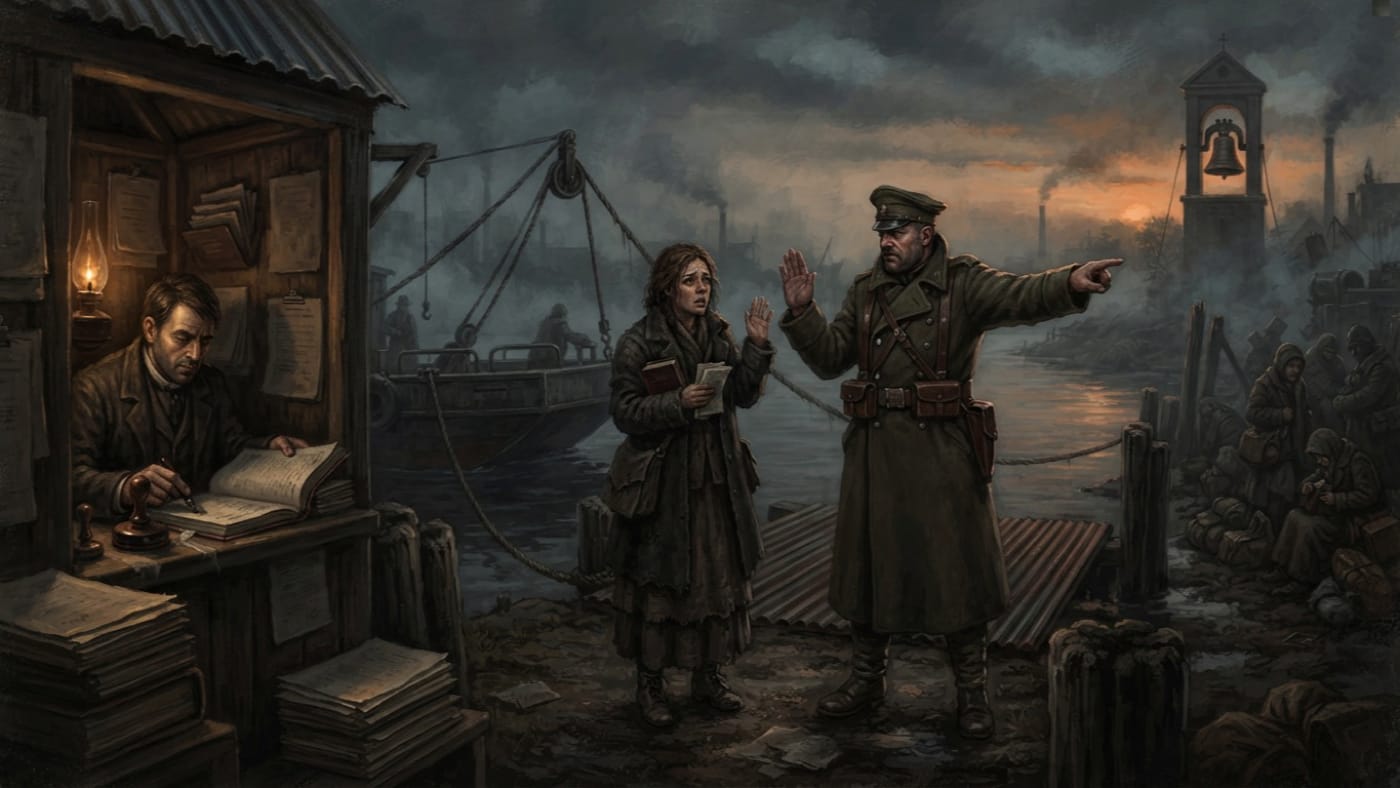
Clearance at a typical crossing runs in a fixed order. The traveller gives his name. The clerk looks for it in a ledger gone soft with damp. The seal is held to the lamp and the transit writ unfolded on the cold rail. Only then does the guard give the challenge, and the traveller answers with the phrase of the day. The Canticle is the last of four tests and the one failed most often. Speaking it correctly opens nothing by itself. A perfect verse from a man without a writ gets him detained with excellent diction.
The Ferry Chokepoint Broker makes his living in the gap that last sentence leaves. He knows tonight's phrase. He usually knows tomorrow's too, bought from a lockhouse clerk upstream who likes warm wine. He also keeps last week's, because a guard whose courier never came will still accept it if it is said confidently enough.
#On Pronunciation and Refusal
The name is said with the stress on its second syllable. Every Broker's account agrees on this, and every Broker's account goes on to complain about guards who were taught otherwise.
At Nominalist's Gate the guard at the lead barge heard Adras where the schedule required Edras, and he refused the crossing. The guard behind him heard the dispute and refused the next twelve supplicants as a matter of principle. By afternoon three hundred souls stood on the trench-bank with valid papers, valid seals and valid transit writs. The barge rode empty on its cable until dark, smelling of wet hemp and tar. The saint's name, said wrongly once, had stopped the whole crossing.
ERRATUM — Office of the Warden The entry for The Ferry Chokepoint Broker states that the three hundred at Nominalist's Gate shared "one shared deficiency: a consonant." Edras and Adras differ in their opening vowel. The Warden withdraws the word "consonant." The three hundred remain refused.
Since then, Brokers have carried phonetic prayer cards. These are slips of card inked in oil so that the river cannot lift the letters, showing how the current phrase should be said. Each is annotated for the regional accent of the guard most likely to be on duty. One card can carry the Canticle's third verse marked for an upriver sergeant and the same verse marked differently for the man who relieves him at the second bell. The cards are contraband. The Bureau of Purity confiscates them, and its inspectors are known to have used them. A card shows how one guard expects to hear the verse. It has no authority over the verse itself.
What the Broker sells, then, is narrower than a prayer and dearer. He sells the right portion of the text for tonight, and he sells the way this guard needs to hear it said.
#On Responses and Silence
The Canticle was written to be sung. At the crossing it is whispered.
Every Broker gives his clients the same instruction: do not sing. That applies to hymns of comfort and to quieting a frightened child. It applies to the very Canticle whose third verse the client has just spoken to the guard. Singing carries over water and draws attention. At certain crossings it draws something worse than attention, and the Broker who lets a hymn be sung on his barge has stopped working as a professional and started gambling with his clients.
The Broker record links this rule to the Bellwater Breach. At a minor crossing south of the seventh node of the Chain, a water-demon learned the ferrymen's call-and-response. It sat beneath the hull and gave the correct phrases in the pilot's own voice. The barge-hands heard the right words at the right moment and hauled the vessel straight into an ambush. Seventeen were killed and a season's grain was lost. The record does not say the copied phrases came from the Canticle, and I will not say it either. What the Breach establishes is that the right words can come from the wrong mouth.
Correct wording had been the whole test. After Bellwater it was no longer enough. Challenges were blessed under the authority of the Bureau of Bells, and the responses were set to harmonic signatures that no demon has yet been observed to reproduce. Doctrine does not dwell on the word yet. Brokers do. They counterfeit those signatures as well, because a client who cannot give the sanctified response does not cross.
The Split Prayer is the Broker's own protection. He divides the phrase, the client learns one half and the Broker keeps the other, so that a client who is taken and questioned can confess only half a password. No liturgy authorizes cutting a saint's verse in two, and nothing in the record says the Canticle was composed in halves. Brokers cut it anyway.
#On the Present Application
In A.S. 201 the Canticle of Edras exists in two forms. The first is the licensed text in licensed hymnals, unchanged, sung in churches and processions. The second is the working copy, carried in oilskin folios, on waterproof cards, and on password rings threaded on gut-cord, with wax and counterfeit seals beside them. Every working copy I have handled has been a crib made by some Broker for that week's guards. If an original manuscript of the Canticle survives, it has never been shown to me.
The Bureau of Records files the matter as scheduling. The two factions of the trade deal with it differently. The Clean Slips work through the lockhouse with stamped papers. Their clients whisper the verse with the stress properly placed and are logged as having crossed. The Black Oars cross at night in unnamed hulls, past posts where no guard is standing to ask for anything. Their clients need no verse. They are instructed to keep perfectly silent.
The clearest case is an ordinary one. A woman stands on the bank as the light fails. She has known the Canticle since childhood and could sing all of it. She has her writ, and her seal is good. The clerk reads her name from the soft ledger. The guard gives his challenge, and she begins the third verse correctly, with the stress where it belongs.
The sundown bell rings across the water before she finishes, and tonight's phrase is the Minor Lauds.